Showing posts with label May Day. Show all posts

Thursday, April 30, 2026

Deptford May Day Festival and Jack in the Green 2026

Deptford is bringing in the May this year with Full Bloom, a weekend music and beer festival: 'Led by Villages Brewery and a network of local venues, Deptford in Full Bloom brings together live music, folk sessions, DJs, zine fairs, art exhibitions, and pop-ups across the neighbourhood. Expect everything from open mic nights and jazz sessions to street celebrations and the iconic May Day parade. You can see the full programme here. 

The main event as usual will be the Fowlers Troop Deptford Jack in the Green festival, a revival of a 19th century tradition that has itself been going since 1984. On May Day the procession will begin and end at the Dog and Bell, making its way through the day between various local pubs (route below).


The 19th century Jack in the Green procession was very much associated with chimney sweeps in particular, with May Day known as 'the sweeps' holiday'. As an 1862 court case from Woolwich shows, it wasn't always a respectable affair. In this instance, participants in the local Jack in the Green were accused of fighting and smashing up the Wellesley Arms pub after being refused beer (the now demolished pub stood in Hillreach SE18)

Kentish Independent, 3 May 1862


I have previously written a history of May Day in South London, you can buy a copy of the pamphlet  from Past Tense (please don't order from Amazon, I don't use that account and am locked out of it!). You can also read it at archive.org


Friday, May 02, 2025

May Day 2025: Deptford and Camberwell

'A Salute to May Day' at St Giles Church in Camberwell on Tuesday April 30th was a lovely night promoted by Broadside Hacks and Dash the Henge. It started off with the Belles of London City morris dancing in front of the church, followed by Daisy Rickman, Goblin Band and Tealeaf playing inside. Loved Goblin Band in particular with their set of May themed songs including Birds in the Spring, the First of May, May Morning Dew and a rousing version of the Padstow May Song which had people dancing in the aisles and pews with the Belles and a horse!


Goblin Band in St Giles

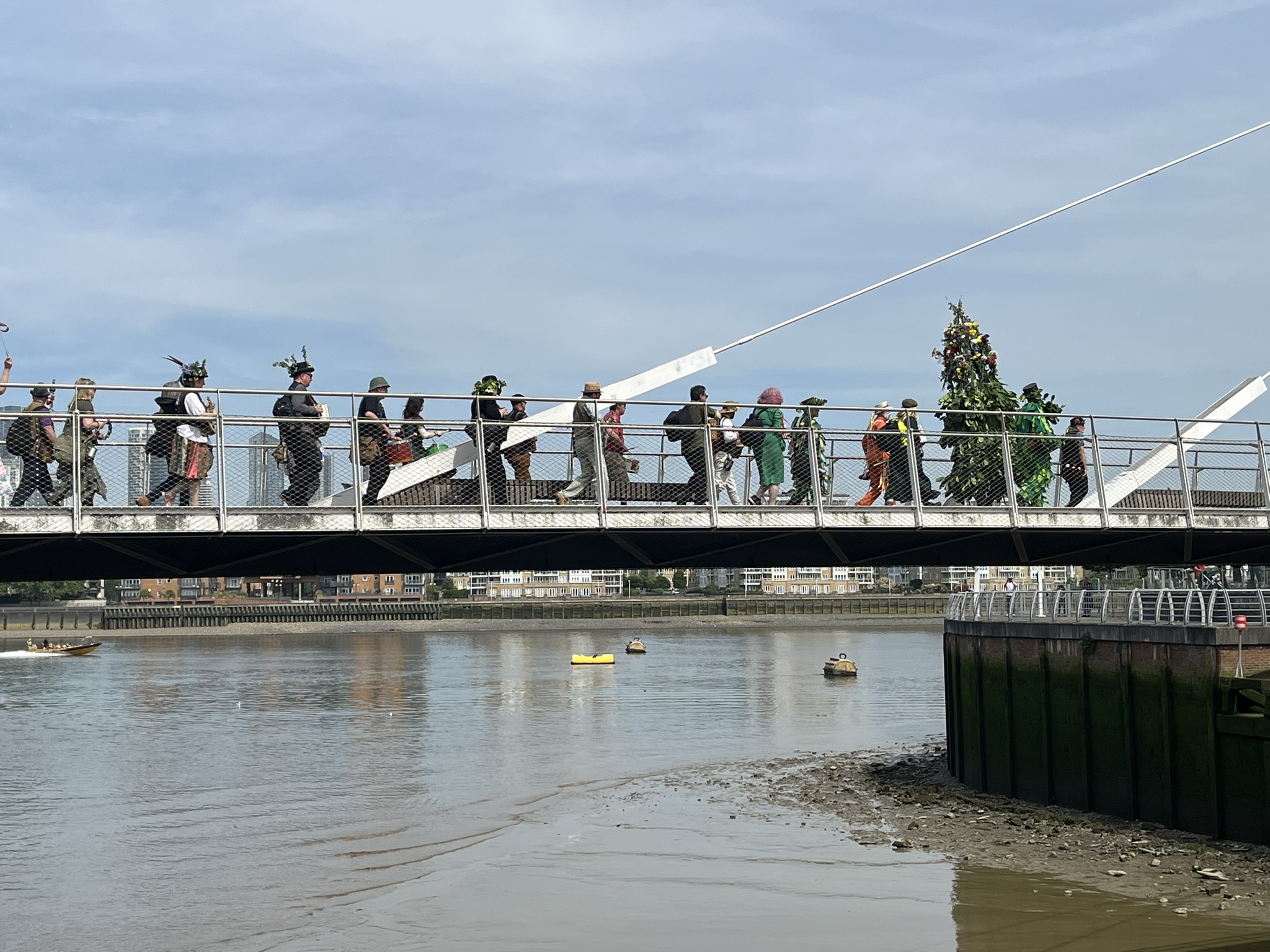
On May Day itself there was a big turn out for the annual Fowlers Troop Deptford Jack in the Green procession. It started out at the Dog and Bell in Deptford, heading along to the Salt Quay on the Greenwich river front then around various local drinking places.


A personal highlight for me was seeing my first swifts of the year swooping over SE14. 'You never heard so sweet as the birds in the spring'.


Pleased to see too that Past Tense Publications has reprinted my pamphlet on the history of 'May Day in South London' which you can purchase here.


See previous posts on May Day in South London

Sunday, February 09, 2025

Goblin Band and some South London folk nights/open mics

Goblin Band were great at the Goose is Out last week (Friday 31st January 2025) at the Ivy House, bringing a new energy to traditional folk song including not one but two versions of Widecombe Fair, a song which as they note they have resurrected after it being out of fashion for years. Excellent support too from Scottish singer/harpist Holly Murphy and unaccompanied singer Victoria Lynn (Goblin Band also played a few days later at the New Cross Inn, a benefit for Transgender Action).


Holly Murphy

Folk music is pretty accessible for those who want to take part, you don't even need to learn an instrument! For people who want to try singing and performing themselves there are plenty of entry points locally. The Goose is Out has a monthly singaround at the Ivy House (next one is  Sunday 9th Feb) where people take turns with standing and singing a song.


Deptford Folk is on the last Thursday of every month downstairs at the Endeavour, 39 Deptford Broadway, and has floor spots. Folk of the Round Table is a weekly Sunday open session  at SET Social (55a Nigel Road SE15 4NP). There is a Thursday night open mic at the Shirkers Rest in New Cross. As a spin off from that a New Cross Songwriter's Circle is doing a night there too.


Update May 2025:

Goblin Band were amazing at the Broadside Hacks May Day event at St Giles Church in Camberwell (30 April 2025), ending with a hobby horse and the Belles of London City dancing in the church in a night that also featured singer Daisy Rickhman.


Wednesday, April 27, 2022

Reweirding: Lost Landscape and Found Lore

A packed Amersham Arms in New Cross last month for the first of a series of 'Reweirding' events there. The theme for March was for 'Reweirding London: Authors on the Secret City', with interesting talks from Caitlin Davies on female crime,  Lara Maiklem on mudlarking on the Thames shore and Tom Chivers on  'London Clay: Journeys in the Deep City' (pictured below left holding his underground London map with host Scott Wood).


The next event,  'Reweirding: Lost Landscape and Found Lore', takes place on Thursday 28 April 2022, 7 pm:

'Discover what remains of south London’s Great North Wood and revel in the revival of the Deptford Jack in the Green mayday celebration. Complementary verdant short films from Video Strolls.

C.J. Schüler, author of The Wood That Built London, charts the fortunes of the North Wood from its earliest times: its ecology, ownership, management, and the gradual encroachment of the metropolis.

The Fowlers Troop Jack in the Green was revived by members of Blackheath Morris Men and friends in the early 1980s. It is a revival of a Jack in the Green from the late 19th/early 20th century which was taken out around Deptford, South East London on May Day by the original Fowlers Troop.

Sarah Crofts tells the tale of the Deptford Jack-in-the-Green and presents David Aylward’s film of the 2006 procession. Artist Sarah Sparkes demonstrates, with some help, with shadow puppets'.

(further details and tickets here).


David Aylward with the Deptford Jack in the Green

Friday, May 01, 2020

Deptford Jack in the Green 1889 & 2020 (and a frightful death at Camberwell)

There will be no May Day demonstration or procession of the Deptford Jack in the Green this socially distancing May Day. The Jack though has been spotted in garden somewhere in South London...


I wrote a whole pamphlet about the history of May Day in South London a while ago, which you can download here. I'm still finding new nuggets though, especially now that you can search newspapers online - that pamphlet was the result of many hours in libraries and archives.


Here's a report I hadn't come across before of the Jack in the Green in Deptford in 1889 (from Woolwich Gazette - Friday 03 May 1889):


'A wild scene of revelry was witnessed in the streets of Deptford on Tuesday night. A motley band of present day Bacchanals kept up the festivities which have, from time immemorable. been observed at the advent of 'That very merry month of May, For music made, so poets say'.  The revellers were, indeed, as merry as could be and their music was— well, loud. Round a conical wicker work frame, prettily dressed with flowers and leaves, and which was carried on the sturdy shoulders of an outwardly invisible being, the dancers careered. "Jack in the Green" was fain to join in the fun and skoppadiddle-like he would at times spin round with amazing rapidity upon his well shod feet. The fantastic dresses and curious masks of the merry men and rustic maids were well worth seeing, and brought to mind recollection of the Nini Moulins of Parisian routs in the carnivals of gay July. Merrily sounded the drum, and shrill shrieked the fife as the Broadway was crossed. Round about "Jack" the dancers skipped, and when the throng came within the far reaching rays of a chemist's crimson globe, it was possible to imagine the weird effect of the scene so graphically described by Poe in "The Dance of the Red Death."


The Deptford Jack is also mentioned in a rather sad 1886 report of a child abuse case: 'Joseph 0'Hara, 32, of 48, Charles- street, Deptford, was charged with violently assaulting his daughter Rose, aged ten years, by beating her. The child said that that morning, about eight O'clock. she was sent for a haddock. She went to look at a "Jack-in-the- Green" and did not get home for two hours. Her father then put her on the bed, and caned her... She had a very severe beating [and] The neighbours were "up in arms " against him... Mr. Marsham remanded the prisoner in custody, and sent the child to the workhouse (Lloyd's Weekly Newspaper - Sunday 02 May 1886).


A Jack in the Green in Camberwell had even more serious consequences in 1879, leading to a child apparently being frightened to death in Camberwell: 'DEATH THROUGH FRIGHT. On Saturdav Mr. W. Carter held an inquiry at the Lord Raglan, Camden-grove, Peckham, respecting the death of William Thomas Coker, aged nine years, of 78, East Surrey-grove, Camberwell. From the evidence of the mother it appeared that on Saturday a "Jack-in-the-green" was dancing in the road, which frightened her children very much. A few minutes afterwards a man dressed in a burlesque costume, with his face painted red, came into the passage, where deceased was, and directly the child saw the man he gave a scream and fell backwards, When picked up it was found that he was vomiting blood. A doctor was sent for, but the child died soon after his arrival. Medical evidence having been given showing that death had resulted from the rupture of a blood vessel caused by fright, the jury returned a verdict of 'Death from natural causes' (Lloyd's Weekly Newspaper - Sunday 18 May 1879).

Monday, May 01, 2017

Music Monday: Lisa Knapp - Til April is Dead: A Garland of May

What could be better for May Day than a whole album of May Day themed songs? Beautiful singing combined with found sounds, birdsong and spoken word samples - including what sounds to me like folklorist Steve Roud on the opening track. The Guardian review likened her vocals to a 'south London Björk', though I don't think that fully does her justice. Guests include Graham Coxon and David Tibet.


(for more on May Day folklore, history and politics see May Days in South London - Neil Transpontine - free pdf pamphlet)


Sunday, April 30, 2017

May Day 1894: Peckham anarchists in Hyde Park

'The May Day demonstrations - The London anarchists - Violent scenes'

'A demonstration arranged by the Social Democratic Federation was held today in Hyde Park. The processionists, who did not exceed 3000 in number,  were for the most part orderly, and included contingents from Camberwell, Hammersmith, Bow, Bromley, Deptford, Greenwich, etc. Among the speakers were Dr Aveling, Messrs Keir Hardie, W Morris, J H Watts, P Curran. Congratulatory telegrams were sent to workers assembled throughout the world urging them to neglect no means towards their emancipation from wage slavery, and to work unceasingly for the establishment of the international co-operative Commonwealth, in which all the instruments of industry will be owned and controlled by the organised communities. The International Anarchist Communist group from Peckham brought a black banner inscribed "away with authority and monopoly, with free access to the means of life".

The Commonweal Anarchists held a meeting close to the Federation meeting place. At one platform a speaker was hurled from his place and the red flag was torn to pieces, but, protected by the police, the speaker managed to escape before receiving further injuries. Several disturbances occurred, but none of a serious character. There was a large body of police in attendance. After the excitement had subsided the anarchists restarted the meeting, when speeches were delivered by Samuels, Mowbray, and Louise Michel, who was followed by a man named Tochatti. He was frequently interrupted with cries of "shut up" and finally thrown to the ground by a crowd, by whom he was roughly handled. The police, after much exertion, rescued Tochatti and started him in the direction of the marble arch, where he was again set upon, and received several ugly blows on the head and face. The police again intervened, and to Tochatti was eventually placed in a cab in a very exhausted condition and driven away.

(Daily Express, 2 May 1894; James Tochatti (1852-1928) was a Scottish-born anarchist living in Hammersmith. For more on the Peckham anarchists of this period see Pressure Drop in Peckham by Nick Heath at libcom; the Paris Communard exile Louise Michel's time in South London is covered in this earlier Transpontine post; see also William Morris and South London)

My historical overview of 'May Days in South London' (50 page pdf pamphlet) is available as a free download here

Tuesday, May 03, 2016

May Day 2016: Jack in the Green in Deptford and Greenwich

 
Another May Day, another procession through the streets of Deptford and Greenwich with the Fowlers Troop, featuring the Deptford Jack in the Green.
 
As in previous years it all started at the Dog and  Bell pub  in Deptford, before heading eastward down to the Cutty Sark, Greenwich Park and various pubs.
 
Of course the area is changing, as it always has, some old pubs and bars have been and gone, others have sprung up in new riverside developments. In a way this procession represents something of a beating of the bounds, the enveloping of new spaces within a story of an older South East London (the current Jack in the Green dates back to the early 1980s, reviving a tradition recorded at the start of the 20th century). So on Sunday for instance, the procession visited the new Sail Loft pub overlooking the Thames between Deptford and Greenwich town centre.


Thursday, May 01, 2014

May Day Greetings - Wat Tyler's Deptford May Day 1381 (as imagined By Robert Southey in 1794)

All the best you May Day revellers... or like me dreaming of revelling on a stressful day at work.

On Monday night, I gave a talk on the history of May Day in South London at a Haunt London event at the Miller pub by Guys Hospital SE1. Sarah Crofts also spoke on the 30th anniversary of the Deptford Jack in the Green, while David Aylward introduced a film of the Jack's 2006 procession through Deptford.

I have spoken and written about all this before - and you can download my history pamphlet 'May Day in South London' for free here. I had some new material for the talk though, including something on this dandy....


The romantic poet Robert Southey (1774-1843)  wrote his dramatic poem 'Wat Tyler' in 1794, at the height of his youthful radicalism and support for the French Revolution. Later he became Poet Laureate and a staunch defender of the status quo, and he was embarrassed when his paean the 1381 peasants revolt was reprinted in 1817.

The play opens at 'A BLACKSMITH'S-SHOP, Wat Tyler at work within. A May-pole before the Door' A group of May Day revellers including Tyler's daughter sings:

'Cheerful on this holiday,
Welcome we the merry May
On ev'ry sunny hillock spread,
The pale primrose rears her head;
Rich with sweets the western gale
Sweeps along the cowslip'd dale.
Every bank with violets gay,
Smiles to welcome in the May'.

'...During the Dance, Tyler lays down his Hammer, and sits mournfully down before his Door'. His friend Hob Carter asks:

'Why so sad, neighbour?—do not these gay sports,
This revelry of youth, recall the days
When we too mingled in the revelry;
And lightly tripping in the morris dance
Welcomed the merry month?'

Tyler has other things on his mind though:

'who should pay for The luxuries and riots of the court?
Who should support the flaunting courtier's pride,
Pay for their midnight revels, their rich garments,
Did not the state enforce?—Think ye, my friend,
That I—a humble blacksmith, here at Deptford,
Would part with these six groats—earn'd by hard toil,
All that I have! To massacre the Frenchmen,
Murder as enemies men I never saw!
Did not the state compel me?

His daughter Alice admonishes him:

'Did we not dance it well to-day, my father?
You know they chose me queen, and your friend Piers
Wreath'd me this cowslip garland for my head—
Is it not simple?—you are sad, my father!
You should have rested from your work to-day,
And given a few hours up to merriment—
But you are so serious!'

Still Tyler is no mood for merriment - he's got a major insurrection to launch!

I think in this extract we have most of the elements of the London May Day story:  the songs and dances of Merry May, the May Queen, the maypole and the Morris Dance, the nostalgia for the good old days, the radical politics, and a South London location too. Southey sets Tyler's blacksmith workshop in Deptford - this leader of the Kent rebels in 1381 has been variously attribute to here and to Dartford and Maidstone, Southey has presumably been influenced by Thomas Paine's The Rights of Man (1791) which states that 'Wat Tyler, whose proper name was Walter, and a tiler by trade, lived at Deptford'.

Incidentally, Southey himself lived in 1797,at Prospect House in Newington Butts, by what is now the Elephant and Castle.

Wednesday, April 23, 2014

May Day events next week

Next Monday April 28, Haunt London presents:

May Day in South London and the Jack-in-the-Green Day in South London and the Jack-in-the-Gr
'The first day of May has long been a time of riots, revelry, ribaldry and the Jack-in-the-Green, a dancing leafy green giant once seen all over London and revived in Deptford thirty years ago this year by the Fowlers Troop.

Come hear of London customs and celebrations and protest from Sarah Crofts of the Fowlers Troop, Dave Aylward of Fowlers Troop and Blurt and Neil Transpontine, south London blogger and historian. It will be a night with talks and film that will include chimney-sweep celebrations, possible neo-paganism, anarchists and the story of David Bowie and the Bromley May Queens.

The Miller Pub, 96 Snowfields, SE1 3SS, 8 pm (£3/£2 concessions)

(facebook event details)

Deptford Jack in the Green

Meanwhile on May Day itself, the Deptford Jack in the Green/Fowlers Troop will be parading through Greenwich and Deptford, details as follows:

Thursday 1st May 2014

11.30 meet: Dog and Bell, 116 Prince St  London, London SE8 3JD, leave at 12.00,
12.15: Duke, 125 Creek Rd, London SE8 3BU, leave at 12.30,
12.45: Old Loyal Britons, 62 Thames St, London SE10 9BX [lunch stop], leave at 13.30, via Old Royal Naval College*,
14.00: Star and Garter, 60 Old Woolwich Rd, Greenwich, London SE10 9NY, leave at 14.35,
14.50: Plume of Feathers, 19 Park Vista  London, London SE10 9LZ, leave at 15.20, via Greenwich Park*,
16.00: Greenwich Union, 56, Royal Hill, Greenwich, London, SE10 8RT, leave at 16.30,
17.00: Ashburnham Arms, 25 Ashburnham Grove,  Greenwich, London SE10 8UH.

All times approximate.

Dressing the Jack will take place from 20.00 on Wednesday 30th April at the Dog and Bell, any flowers you have will be very welcome. Further details here

Deptford Jack in the Green on Creek Road in 2013

Tuesday, May 07, 2013

May Day 2013 - what happened?

The Shard shines through the May Day blossom in St Johns Churchyard SE1

So how was May Day and the holiday weekend for you? On May Day itself the Fowlers Troop made their way through Deptford and Greenwich with the Jack in the Green - pictured here outside the Rose and Crown in Greenwich.

Photo from Diana Hale's blog, which includes a detailed report and lots of great photos.

On Saturday May 4th, around 100 people took part in the Croydon Trades Union Council May Day march in the town centre, headed by a pipe band.

Front of Croydon May Day march - photo from Sangha Kommune
I gather there was also a Workers Liberty  protest on Saturday outside the Lewisham branch of Primark, one of a number by different groups around the country in solidarity with the victims of the Rana Plaza factory fire in Bangladesh. At least 500 people died in the garmant factory complex which supplies Primark, Mango and other UK high street stroes.

Monday, May 06, 2013

The origins of the May Day bank holiday

Enjoying the May Day bank holiday?  A resolution calling for two new public holidays a year, on May Day and New Year's Day, was passed by the Trades Union Congress in 1970 and in 1975 the Labour Government declared that from 1978, May Day (or the Monday after it) would be a bank holiday. So this is the 35th May Day bank holiday. But the significance of May Day for the workers movement goes back to the 1880s. Here's another extract fom my pamphlet 'May Day in South London: a history', which you can now download for free here:

'For the early workers movement internationally a key demand was for a reduction in the length of the working day. The 1884 Chicago congress of the Federation of Organized and Labor Unions (which later become the American Federation of Labor) declared that from May 1st 1886, it would impose an eight-hour working day in the United States by industrial action... the events of Saturday 1 May 1886 and the succeeding days are well documented. The eight hour day strike went ahead in parts of the USA, and by May 3 1886 perhaps 750,000 workers had struck or demonstrated. In Chicago police killed two people when they opened fire on Monday 3 May during clashes outside the McCormack Reaper Works, where workers had been on strike since February. The following day a policeman was killed by a bomb thrown at a protest meeting in Haymarket square in the city.

Eight anarchists who had been in the forefront of the 8-hour-day agitation in Chicago were convicted of murder, of whom seven were sentenced to death. There was an international outcry against the trial and the sentences. In London those who spoke out included William Morris, Annie Besant (who had lived in Colby Road, Upper Norwood), George Bernard Shaw, Peter Kropotkin (then living at 6 Crescent Road, Bromley), Oscar Wilde, Edward Carpenter, Ford Madox Brown, Walter Crane, E. Nesbit (then living in Lewisham), Eleanor Marx and Edward Aveling (who later lived in Sydenham). A meeting on the case was held at the Peckham Reform Club (Freedom, November 1897). Nevertheless, four of the accused were hanged. The deaths in Chicago had a powerful impact across the world, not least on Jim Connell who was inspired to write 'The Red Flag' anthem in 1889 on a train to New Cross - he was living at 408 New Cross Road at the time (he later lived at 22a Stondon Park SE23).

The movement for a shorter working day did not die with those who became known as the Chicago Martyrs. In December 1888 the American Federation of Labour called for a national day of demonstrations and strikes on 1 May 1890, and this call was echoed in July 1889 by the international socialist conference in Paris. So it was that from 1890 May Day became an annual international festival of working class solidarity.

The 1890s

In London, May Day 1890 was marked by a huge demonstration in Hyde Park, a venue that was to become the focus for May Day protests for many years to come. May 1st 1890 actually fell on a Thursday, and saw London anarchists holding a meeting at Clerkenwell Green. The main demonstration took place on the following Sunday - May 4th - and saw contingents heading towards Hyde Park from all over London. A description from the South London Press of the attendance of the North Camberwell Radical Club and Institute' provides an insight into how local groups organised themselves for the march:

‘A goodly contingent went from this club to take part in the monster eight-hours demonstration. The procession was headed by the club's excellent band, which discoursed some well-chosen music on the way. A large banner followed, bearing the device in front, 'The Proletariat Unite', and on the reverse side the legend, 'Eight hours' work, eight hours' pay; Eight hours' rest, eight bob a day'. Mr Oodshorn devised and executed the banner, which was very effective. Mr J. Harrison (chairman of the club) headed those who marched in front, and Mr. H.J. Begg accompanied the contingent until it took its place in the general ranks. Two breaks followed the pedestrians - one full of ladies, and one containing those of the sterner sex who were not equal to a four-hours march on a warm day. Messrs. Benstroke and J.Sage (chairman of the Political Council) acted as marshalls. The breaks, which added greatly to the effectiveness of the procession, were under the charge of Mr A. Boreham (chairman of the Entertainment Sub-Committee). The contingent arrived in the park in time to hear some good speaking from No.7 Platform, and afterwards Mrs Besant's stirring speech from the Socialists' platform. The whole affair was excellently managed, and good humour and good order prevailed throughout’ (South London Press, 10 May 1890).

The next few years saw this route being repeated. In 1891, the North Camberwell Radical Club was again said to have been busy in preparing for the 8 hours demonstration in Hyde Park (SLP 25 April1891). The Club was based in Albany Road.

In 1892 a crowd estimated between 300 and 500,000 marched from Westminster Bridge to Hyde Park, with 350 banners and 110 bands. An observer reported that 'The great staple industries of London, the dockers, the stevedores, the coal-porters, the gas-workers... railway workers, and so on, came first: and then a whole host of miscellaneous trades, led by little Jew cigar and cigarette-makers from the East End... The Workgirls… were in great force. The chocolate-makers had a smart little wagonettte all to themselves, from which they dispensed 'Union Chocolate' in penny packets' matchgirls’. Those present included Bernard Shaw, Tom Mann and Louise Michel (all of whom spoke), Eleanor Marx and the elderly Frederick Engels.
The crowd was so large that 'the South London contingent, led by John Burns, never got in at all, and it turned sadly back without a chance of attending the meeting. In a word, London has never seen such a gigantic turn-out of the forces which create her wealth' (Penny Illustrated Paper, 7 May 1892)

Crystal Palace and Walter Crane

The turn of the new century saw the main May Day event moving to South London at the Crystal Palace. The Palace had been hosting May Day celebrations for many years. In the 1850s, William Husk of the Sacred Harmonic Society had helped recreate a Tudor-style May game there. On May Day 1866 'a great concert of five thousand voices was given by children and others connected with the metropolitan schools... Ethardo [a circus performer] also reappeared, his lofty pole being converted into a gigantic maypole. On the following day Mr Charles Dickens kindly undertook to give a reading of Little Dombey' (PIP 5 May 1866). In 1898 a 'Crystal Palace May Day Festival' had included 'May-Day Sports and Maypole dance' with a programme featuring 'the Clan Johnson, Scottish Dancers and Champion Pipers and an Old English Maypole Dance' as well as a 'Grand May-Day Concert' featuring 'madrigals by the Crystal Palace Choir' (advert in the Times, 1 May 1899).

May Day 1900 was different in tone. The Times reported that 12,000 took part, including 'about 150 associations connected with the Social Democratic Federation and London Trades Council'. Six platforms were set up and the resolutions carried included one asserting 'their determination to overthrow wagedom and capitalism, and to establish by united efforts that international co-operative commonwealth in which all the instruments of industry will be owned and controlled by the organized communities and equal opportunity be given to all to lead healthy, happy human lives' (Times, 2 May 1900).

The event did though include more traditional May Day elements alongside the socialist speeches: ‘There was a procession at half past two, and meetings at 3 o'clock. There were also cycling and athletic sports, a Maypole dance and other attractions. The programme concluded with a display of fireworks by C.T. Brock & Co., including a special set Labour piece by Walter Crane' (South London Press, 5 May 1900). Other attractions of the 'International Labour Festival' included a variety show and a performance of Bernard Shaw's 'Widowers' Houses' (advert in Times, 1 May 1900).

The artist Walter Crane recalled: ‘Labour's May Day, which has become an international festival in the Socialist movement, was this year celebrated at the Crystal Palace, which certainly afforded plenty of space for the gathering, as well as entertainment and refreshment in the intervals of the functions. A vast meeting was held under the dome, and this was addressed by many of the leaders, such as Mr. H. M. Hyndman, Mr. G. N. Barnes, Secretary of the Amalgamated Engineers (and now in Parliament), Mr. Pete Curran, Mr. Ben Tillet, and many others. I made a design for a set piece for the firework display which was carried out on a gigantic scale and with remarkable success by Messrs. Brock. It was a group of four figures, typifying the workers of the world, joining hands, a winged central figure with the cap of Liberty, encircled by the globe, uniting them, and a scroll with the words ‘The Unity of Labour is the Hope of the World’. It was the first time a design of mine had been associated with pyrotechnics. I was rewarded by the hearty cheers of a vast multitude'.


'Labour's May Day' by Walter Crane


The eight hour day was achieved for many workers through strikes in that period, such as the 1889 gas workers strike. So as you enjoy your Monday off work spare a thought for the people who through their efforts brought us shorter working days, weekends and many bank holidays.

Wednesday, May 01, 2013

May Day in South London: free pamphlet

For May Day 2011, Past Tense published my pamphlet, 'May Day in South London':

'For centuries people have been celebrating the height of Spring, and the first signs of Summer, at the beginning of May. This pamphlet examines the diverse ways they have done so in London South of the Thames. It is a story of milkmaids, chimney sweeps, kings, socialists, pagans, Christians, school children and anarchists...

...includes the stories of Walworth and Bromley May Queens, May Games in Greenwich Park, the Deptford Jack in the Green, demonstrations in Bermondsey and Woolwich, Horse Parades on the Old Kent Road, Maypoles in Kennington and  St Mary Cray, festivals on Clapham Common and at Crystal Palace, and much more besides'.

Contents include:

- Ancient Festivals
- The Merry Month of May – Middle Ages to Puritans
- Milkmaids, Chimney Sweeps and the Jack-in-the-Green
- Reinventing May Day in Victorian times
- The Workers’ May Day: origins to 1930s
- The Workers’ May Day After the Second World War
- The Counter-Culture and the Folk Revival
- Anti-Capitalist May Days
- 21st Century May Day


The printed version sold out shortly after May Day 2012, so in the spirit of May Day abundance I am making a pdf version of the full 50 page illustrated version available as a free download. You can download it here.


Tuesday, April 30, 2013

Happy May Day

The Fowlers Troop/Deptford Jack in the Green will be out doing their traditional May Day procession on May 1st, details as follows:

12.00 Depart from Dog and Bell, 116 Prince St London, Deptford SE8 3JD.
(pub will open at 11.00),

12.45 Rose and Crown, 1 Crooms Hill, Greenwich, London SE10 8ER,

13.45 Star and Garter, 60 Old Woolwich Rd, Greenwich, London SE10 9NY,

14.25 Plume of Feathers, 19 Park Vista London, London SE10 9LZ,

15.25 Richard I (the Tolley), 52/54, Royal Hill, Greenwich, London, SE10 8RT,

16.10 Ashburnham Arms, 25 Ashburnham Grove, Greenwich, London SE10 8UH.


Doug Adams

Doug Adams (left, on the accordion)
Photo from Francis Sedgemore
This will be their first year since the death last September of their musical stalwart Doug Adams, remembered as follows in The Guardian:

'Doug Adams, who has died of cancer aged 60, was the lead musician at the Deptford Jack in the Green. This traditional event, last seen in Deptford around the end of the 19th century, was revived in the early 1980s. The Jack in the Green, a large leaf-covered framework decorated with flowers, is carried through the streets on May Day, accompanied by a band of attendants and musicians. Doug also played melodeon for several morris teams in south-east London as well as leading bands and playing at English traditional music sessions.

Originally from Bratton Clovelly, Devon, Doug arrived in Greenwich in the mid-1970s after taking an applied physics degree at Lanchester Polytechnic (now Coventry University). He had a love of English traditional music which, at the time he started playing, was not as well known as Irish traditional music.

Doug had learned piano and recorder as a child, then switched to piano accordion and finally the melodeon. It was as a melodeon player that he joined his first morris team, Greenwich Morris Men, in the late 1970s. While pursuing his other great interest at the time, re-enacting civil war battles with the Roundhead Association, he broke his leg very badly, but continued as a musician, first using a wheelchair and then on crutches.

Doug then joined Blackheath Morris Men and gradually became their main musician. One of their enterprises in the early 1980s involved the revival of the Deptford Jack in the Green for which Doug was musician on the first and then most of the subsequent outings on May Day each year including 2012. Doug played regularly at English music sessions at the Horseshoe Inn, near London Bridge, and the Lord Hood in Greenwich as well as at the Sidmouth and Dartmoor folk festivals'

Sunday, April 21, 2013

In the Neighbourhood

A few things going on locally that people have asked us to mention:

Hill Trader Community Shop 

'The Hill Trader Community Shop is an exciting new pop up shop in the Hill Station Café, run by local people for local people. As part of what we’re doing at the Hill Station, Kitto Rd, SE14 we have opened this shop as a pilot for 4 months, selling locally handmade things as well as bread and milk. We are working with local people who are giving us some of their products to sell, and in return will volunteer at the shop for a session a week. This means we all get lovely things to buy and they get valuable retail experience without the financial risk of renting a stall or shop.

Our vision is to provide a space for people to both buy and sell locally produced goods, share skills and inspire others who want to create things to sell. We have aimed to be as inclusive as possible and are trialling a range of different items produced by people of all ages and backgrounds. We’re excited about starting this new venture and we are keen to hear whether you agree a shop like this would be a great resource for our community. Please do also get in touch if you have something you would like to produce for the shop.

Please feel free to talk to one of the volunteers running the shop, Stephen, Jacqui at the Hill Station Cafe counter or Sarah Bickers directly at sarah@thehillstation.org'

May Day Social

The Death of Thatcher(ism?), Sunday 28th April 5pm –9pm at Harts Lane Studios, SE14 5UP (Behind T K Maxx, New Cross Gate). Entertainment starts at 7pm. Lewisham People Before Profit say: 'An opportunity to celebrate May Day and chat about how we can work together to end Thatcher’s legacy, so eagerly continuedby Major, Blair, Brown, Cameron, Clegg. Bring your works of art, films, photos and poetry for display from 5pm'. Food and drink available, with Strawberry Thieves Socialist Choir.

Something Human: Performance Artists wanted

From Mirabelle Spreckelsen from 'international curator-collective Something Human':

'Something Human, in partnership with Brockspace, is seeking live performance artists for a line-up of live performance work entitled FRESHLY PACKED / ALWAYS CHECK THE LABEL (working title). This programme will take place across the summer of 2013 and aims to bring new work and build new audiences for live performance work in Brockley, south-east London and beyond.

Submissions should respond with the following: Original performative work that explores themes surrounding notions of the biological, corporeal, flesh, food, sustenance and mortality'.  Details including applications from and proposal guidelines available at www.something-human.org

Freeforming Contact Meditation

'Freeforming cuts through distraction to bring you alive to the moment. It makes you present. Practitioners connect their attention though movement and voice. This synchronises your mind and body to open to creative possibility. Freeforming was developed by Peri Mackintosh drawing on Zen, Aikido, Gestalt and the improvisatory arts.

Beginners always welcome. Come and try! 6:30-8:00pm Tuesdays, Edmund Waller Primary School, Waller Road, London SE14 5LY, Cost £10'. More at www.freeforming.net

Friday, March 22, 2013

May Day 2001: a police spy at the Elephant & Castle?

A guest post from "La Infanta de Castilla"

The Elephant and Castle has been a bit of a hive of radical activity of late. The Self Organised London Social Space is still going a month after the initial occupation of Eileen House on Newington Causeway, a former Department of Health building scheduled for demolition. Nearby at 44-50 Lancaster Street, the empty Colorama 2 building has also been occupied as the Library Street Community Centre (though having been there since September 2012, they may soon be evicted having been in court this week). Last week there was a protest against workfare at the  London HQ of the Salvation Army also on Newington Causeway, and on March 7th activists from the Anti Raids Network disrupted UK Borders Agency checks opposite Elephant and Castle shopping centre.

Back in 2001, the Elephant was one of the gathering points for the May Day anti-capitalist protests. The theme that year was May Day Monopoly, with actions planned at sites across London.


Well as everyone knows Old Kent Road is the only South London location on the Monopoly board, so clearly the Elephant and Castle just had to be the South London focus.


The South London Mayday Collective met to plan for the event, calling on people to gather at the E&C roundabout from noon on Tuesday May 1st 2001. Several hundred people did so and there was a bit of a picnic on the roundabout with the Rinky Dink cycle powered sound system, before people headed off towards Kennington and then into town, dodging round side streets to get around police blockades.

In Central London a large part of the 5,000 crowd ended up being 'kettled' by the police for 8 hours by Oxford Circus. There were 92 arrests on the day, and plenty of bruises as police made free use of their batons.


But perhaps not everybody who was at the Elephant on May Day 2001 had straightforward motives. As part of its ongoing investigations into police infiltration, The Guardian last month identified 'Rod Richardson' as a possible undercover police agent, seemingly using the identity of a dead child ('Rod Richardson: the mystery of the protester who was not who he claimed', Guardian 6 February 2013).  Richardson is also discussed in another Guardian article by his former friend Laura Oldfield Ford:

'It was April 2001, and I was walking across the complicated system of roundabouts at Elephant and Castle in south London to meet a group of fellow activists in a bar at the Southbank. We were a group of anarchists, environmentalists and anti-capitalist protesters who were having a planning meeting for a May Day demonstration which was only days away. It was a balmy spring evening, and the sense of mounting excitement was palpable. At these big meetings you'd see a group of your friends and gravitate towards them. These were people you shared a strong affinity with – people you'd been on big European protests with, who you'd put yourself at risk with, maybe even been arrested and beaten up with. These were people you trusted implicitly, and with whom you shared a strong bond.

When I arrived, one of the first people who grabbed me in an embrace was Rod. We had only been friends for a year or so but in that time shared a lot of intense experiences, living as we did in an environment of strong camaraderie and full-time activism. We had both been around various anti-capitalist groups where we had occupied buildings, worked together on actions, travelled around the country together and enjoyed long drinking sessions after protests. He would come and visit and we would have meals together; he would sit at the table with us discussing ideas and strategies. It wasn't until after he vanished without a trace in 2003 that I became suspicious that "Rod" wasn't whom he claimed to be, and that he may have been an undercover police officer...

In 2001 we begun small meetings in my flat to discuss the logistics of blocking the Elephant and Castle roundabout to clog up a main artery into the City. Rod was a regular visitor, and even stayed the night there on occasion, most notably the night before the May Day 2001 protests. His reason for doing this was that he lived up in Hertfordshire and wanted to be in central London for the first actions of the day. Around this time, my flat was raided by the police – this seemed disproportionate when what we were actually arrested for was flyposting. We were held overnight in police cells, where even the duty sergeant expressed surprise that someone being held for "graffiti" would have their home raided.

Ten years on, "Rod" is now suspected to have been an undercover police officer. It is a disturbing thing to read about, to know that the name we called him may actually have belonged to a baby who died at two days old. Such an infiltration affects you psychologically, and impacts on your relationships with other people. It makes it more difficult to welcome new people into your friendship group. Politically, it's easy to see how damaging it is: the movement can't function if trust between activists is eroded. When a network is riven by accusations and suspicions, organisation and practical actions become an impossibility.

The weirdest thing of all is that I liked Rod a lot – he was such a nice bloke, always smiling and a good laugh in the pub. He appeared to be a committed activist, not afraid of breaking the law, challenging police lines and subjecting himself to, and in some cases instigating, difficult and dangerous situations for the sake of our collective principles. He never, to my knowledge, tried to initiate any kind of intimate relationship with anyone in the scene, but came across as genuinely decent and friendly. He left behind an odd floating feeling akin to grief, with questions left unanswered and a sense of betrayal and loss.

from Indymedia

If I saw him now, I would for an instant expect the smile and the warm embrace, because I haven't adjusted to the idea that the entire friendship may have been fake. I am still deeply confused by the whole episode. There is an element of me that wonders if he experienced confusion as well. It's hard to accept that all those feelings of kinship and affection, those familial bonds that form through full-time activism, were perhaps a sham. If Rod was indeed misguiding us all along, surely feelings of revulsion and guilt must have shivered across him when we called out to him in that stolen name'

As discussed here before, another infiltrator of radical movements - 'Jim Sutton' - lived undercover in East Dulwich around this period. Not that the practice is anything new - during the 1926 General Strike the Lewisham Council of Action was believed to have been infiltrated by a man called Johnstone.

Wednesday, May 02, 2012

Fowlers Troop 2012

Deptford Fowlers Troop did their annual May Day procession yesterday, featuring the Jack in the Green, musicians and various outlandish costumes. They started out in Southwark Street, went over London Bridge and around the City (where I took these photos) then back over the Millennium Bridge to Bankside.


Tuesday, May 01, 2012

May Day Horse Parades

May Day greetings everyone, looks a bit wet right now to go and wash your face in the morning dew but hopefully it will have cleared up a bit by the time the Deptford Jack in the Green procession gets going later - not in Deptford or Greenwich this year, but around north Southwark and the City. They will be starting off around noon at The Wheatsheaf (24 Southwark Street SE1) and end up around 4 pm at The Charles Dickens, 160 Union Street, London, SE1 (full route here). On the political end of May Day, there will be the usual march in Central London and a day of action against workfare targeting companies involved.

From my pamphlet 'May Days in South London' (2011), here 's some information about a largely forgotten May Day custom - horse parades.

Horse Parades

A final group of workers associated with May Day was those working with horses. May Day 1860, saw  'the decorations of horses belonging to the several railway companies and other large establishments' in South London. The annual procession from the South-Eastern Railway Company from the Bricklayers Arms on the Old Kent Road 'created some sensation in the locality' with the streets crowded and the horses 'preceded by a band of music'. In the evening 'a supper was provided for the drivers, presided over by the principal officials, at which about one hundred sat down'. However another custom had already faded away by this date: ‘The procession of mail-coaches which formerly drew such crowds to witness at the General Post-Office on May-day, no longer exists’ (South London Chronicle 5.5.1860).

An annual May Day parade of horses was held in this period at Wellington Wharf, Lambeth by Eastwood and Co. Ltd. The event had outgrown the Wharf by 1899 when it was moved to Battersea Park and featured nearly a hundred 'gaily bedecked' horse drawn vehicles. In the same year St Olaves Board of Works in Bermondsey agreed to give 5 shillings to each carman and dustman in its employ for the 'parade of horses on May 1' (South London Press, 6 May 1899).

Local Council workers also held a parade. In 1892 ‘the Bermondsey dustmen and other servants of the Vestry turned out with twenty-two teams’, and prizes were awarded to the most effective of them' (The Graphic, 7 May 1892).

Bermondsey Horse Parade 1892
(The Graphic, 7 May 1892)

This event was still taking place at the turn of the 20th century: 'On Tuesday the annual May Day parade of the horses belonging to the vestry of Bermondsey was held. Twenty four horses, with their carmen, paraded in Spa Road... at the conclusion of the judging, the parade was continued through the streets of Bermondsey until 1:30 pm, the carmen being given the remainder of the day as holiday'. Prizes were awarded for the best cared for animal (SLP, 5 May 1900). In 1920, May Day horse parades were put on in Lee by employees of Mr. A. Manchester, horse and steam contractors (based at Dacre-Park) and at the Whitbreads bottling store in Lewisham, the latter a revival of 'a popular feature before the war' (KM, 7.5.1920).