Showing posts with label New Cross Stadium. Show all posts

Tuesday, December 09, 2014

New Cross Speedway Programmes

 The New Cross Stadium stood next to the old Millwall FC ground in New Cross on the land now known as Bridgehouse Meadows. As covered here before, it featured greyhound racing, stock car racing  and speedway. Here's a selection of New Cross speedway programme covers

1948

1949

1950
1953

July 1963
The stadium closed in 1969 and was demolished in 1975.

Programmes from the huge collection of speedway memorabilia on sale at ebay by G.Williams Sporting Memorabilia. Click images to enlarge.

Saturday, April 26, 2014

New Cross and Deptford Free Film Festival 2014


New Cross and Deptford Free Film Festival 2014 kicked off last night with 'Bend it Like Beckham' at the Hill Station Cafe and Superman of Malegaon at the Big Red Pizzeria. Loads more free events at interesting venues over the next week - see full programme here.

I will just mention a couple of events with particular local historical resonance.

South London Hardcore is showing Once a Jolly Swagman at no.178 cafe on May 1st, a great 1948 speedway film starring Dirk Bogarde that was filmed at the now vanished New Cross Stadium.


On 29 April, The Hustler is showing at Shades Snooker Club on Deptford High Street -a building that once housed one of the area's first cinemas, the Deptford Electric Palace (1910-54)

Wednesday, February 22, 2012

History Corner: Nights Out in South East London 1939

Last week on Deptford Market I found a crumpled copy of the South London Advertiser dated April 21st 1939. War was in the air, and indeed the paper reported that 'When Ellen Hamilton Williams (72), a widow, of Lawrie Park Road, Sydenham, heard over the wireless that the Italian troops has occupied Albania she was upset. Later she took an overdose of medinal and died'.

But still, people needed to enjoy themselves and the paper's adverts give a fascinating snapshot of South East London social life in that period.

The Cinema

Going to the cinema seems to have been the popular option. One of the biggest in the area was the New Cross Kinema (now the Venue nightclub) which had a cafe restaurant and a Palais de Danse as well as showing films. Like most cinemas it has a Saturday morning 'Kiddies Club'.


The East Dulwich Odeon was next to where Goose Green Primary School now stands on Grove Vale.


The Gaumont Palace in Lewisham was on Loampit Vale had live performances as well as films - with Billy Cotton and his Band playing at this time - they were one of the biggest dance bands of the period.


Peckham cinemas included the Odeon (on the High Street near to the current Job Centre) and the Tower cinema on Rye Lane (part of the latter building is still there).


Camberwell Odeon was on Denmark Hill near the Coldharbour Lane junction. It later became Dickie Dirts jean store in the 1980s and then was squatted for a while before demolition in 1993.


Forest Hill cinemas included the Astoria on Wastdale Road and the Capitol - the latter now the Weatherspoons pub on London Road.


The paper reported that a new organist was starting at the Capitol - Rudy Lewis, apparently far famed after stints at Lewisham Gaumont, Luton, Dagenham and Grimsby (where he said he was mobbed by autograph hunting girls). He wrote his own songs: 'The number - the words are his own -which he has been playing much to the delight of the Capitol audiences this week is "Doing the Gas Mask Walk"'. Born Rubin Lipshitz, he seems to have ended up in Washington DC where he died in 1990. I suspect he was also responsible for Rudy Lewis and The Sputniks who released a single in 1960 (not to be confused with a different Rudy Lewis who was in The Drifters).


The Rink cinema in Sydenham was on Silverdale. It was originally opened as a roller skating rink, then converted to a cinema. It closed at the start of the war and never re-opened, though the building survived until the 1990s.


Going to the dogs

There was greyhound racing in New Cross three nights a week. The stadium was near to the present Millwall football ground, off Ilderton Road (see photo here). 


There was also greyhound racing at Crayford and Charlton.


Theatre

The New Cross Empire was a theatre and music hall. In April 1939 The Court Players were performing Lot's Wife, 'A saucy comedy about charming people'. The paper reported 'Now that the Players have settled down at New Cross they are growing increasingly popular with the patrons and many people go week by week mainly to see their favourite performers'. It interviewed 'Leslie Handford, who is making a great success in light comedy parts at the New Cross Empire' following stints in the army and with the circus as a clown. He went on to have minor parts in 1950s TV and cinema


Eating Out

The Amersham Hotel (now the Amersham Arms) was advertising 'four course luncheon' in its restaurant and a 'first class snack bar... for those in a hurry... something tasty always ready'


In Forest Hill, The Swiss Cottage was advertising 'The Luxury and Comfort of the West End in the Suburbs'.


Politics

Politics everywhere was dominated by the question of war and peace. A meeting was held at Lewisham Town Hall called by the 'Congress of Peace and Friendship with the USSR'. The speakers included Hewlett Johnson, the famous 'Red Dean' of Canterbury Cathedral and Arthur Skeffington, later a Labour MP for Lewisham. Johnson has been accused of apologetics for Stalinism as he loyally followed the twists and turns of Soviet foreign policy in this period, though ultimately his call for Britain to ally with Russia against Germany was to become government policy in the Second World War.

Anyone know more about R.W. Usher, the organising secretary who lived at 257 Sydenham Rd?

[source for all the above: South London Advertiser, 21 April 1939]

Thursday, January 27, 2011

New Cross Greyhounds

The New Cross Stadium has been mentioned here before - it occupied the piece of land now called Bridgehouse Meadows, and was next door to the old Millwall ground (and not far from the new one). It opened in the 1900s and closed in 1969 before being demolished in 1975. The picture below, from Millwall History, shows the two grounds in 1962 - Den on the left, New Cross Stadium on the right.

As well as speedway and stock car racing, the stadium was famous for its greyhound racing. There's a fantastic collection of New Cross greyhound badges at Greyhound Derby (have just reproduced a couple here to give a flavour).


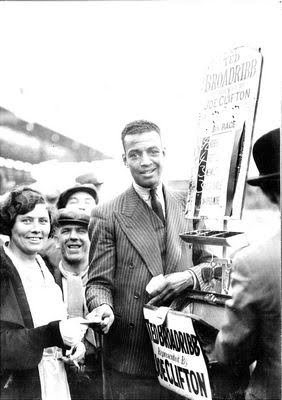
The following picture comes from the Working Class Movement Library, and shows Manchester-born boxer Len Johnson at New Cross Greyhound Stadium in 1933. Johnson's boxing career was hampered by restrictions which prevented black boxers having a crack at title fights. He later got to know Paul Robeson and became a Communist Party activist. There were boxing matches at New Cross Stadium too, which presumably explains what Johnson was doing there - he is standing next to a sign which mentions Ted Broadribb vs. Joe Clifton, two interwar boxers.


Wednesday, July 22, 2009

Pathe News: Brockley and New Cross

Thanks to Cath on Twitter I've come across another addictive historical archive, the British Pathe News archive of old newsreel footage. I am still trawling through but have found a couple of Brockley film clips already - only trouble is I think the archivist has mislabelled some of the footage.

For instance, there is a 1917 clip showing the Lord Mayor of London pinning a DCM (Distinguished Conduct Medal) on one Sergeant North - the caption says 'Brockley, Suffolk', but why would the Lord Mayor of London be in Suffolk. The buildings look like Victorian terracing of the (London) Brockley kind.


Likewise there's a 1931 clip of a folding car - the caption says 'Not sure which county Brockley is in - probably Somerset. May also be Brockley in Suffolk' - but the housing looks very much like round here, maybe even Telegraph Hill? Maybe even Drakefell Road - check out the crest of the hill and the gates next to the house - an entrance to the park?


Have a look and let us know what you think.

On safer ground with the New Cross footage - some great 1958 film of dogs at New Cross stadium, and from the same venue stock car racing at Easter 1954. There's a 1935 film of a Donkey Derby at Milllwall (donkeys on the pitch at the Den, never). The latter was part of an annual Jockeys vs. Boxers charity football match, which is also shown in a 1936 film, where the match was attended by the comedians Gert and Daisy. There's also a 1938 Millwall match against Man. City (check out size of the crowd) and of Millwall v. Birmingham in 1957 .

1935: crowd watching Donkey Derby at Millwall

From 1948 there's some cycle speedway in the bombsite ruins of a Wesleyan church in New Cross, and from 1952, London's last tram coming in to New Cross depot.

Update 23 July: walking up Drakefell Road I am now 95% convinced that the folding car footage was filmed there, specifically where the Greenstreet Hill wooden self-build now stands (I believe this replaced war damaged housing). There is still a post box opposite on the corner of Aspinall Road, which you can see in the film. Or am I deluding myself?

Tuesday, June 17, 2008

Roy Porter: a New Cross Childhood

A plaque was unveiled on 5 June at 13 Camplin Street, New Cross Gate to commemorate the historian Roy Porter (1946-2002), who lived there from 1946 to 1959 and attended Monson School. Porter was best known as a medical historian - he was the Director of the Wellcome Institute for the History of Medicine from 1999-2000 - and as the author of London: a Social History (1994). In the preface to the latter, Porter recalled his New Cross childhood:

"I grew up in south London just after the war. Three miles from London Bridge, New Cross Gate was… a stable if shabby working-class community completely undiscovered by sociologists. In many ways, that past now seems another country: bomb-sites and prefabs abounded, pig-bins stood like pillboxes on street corners, the Co-op man came round with a horse and cart delivering the milk, everybody knew everybody. Some of the houses in Camplin Street still had gas lighting, as did my infant school; clanking trams are a vivid memory, and it was fun creeping to school through pea-soupers, a torch vainly held out in front. In those years of austerity, ration-book coupons taught me my sums -locals grumbled about how run-down and old-fashioned the area was, hemmed in by the railway sidings, canal and docks that had long provided secure employment but which imparted a grimy, dingy feel.

The three-up, three-down council house that my parents shared with my grandparents and an uncle had an outside lavatory; a tin bath was hauled in once a week from the bottom of the garden, set down on the scullery floor, and filled from kettles and a wheezing Ascot gas water-heater. Domestic overcrowding was worsened but redeemed by the sanctity of the front room, used only at Christmas, though unlocked once a week so that the Rexine three-piece suite could be polished with Ronuk.

… There were plenty of things to do around home. The Gaumont, ABC and Astoria all lay within easy walking distance. There were municipal parks and swimming-baths. Millwall Football Club was' only five minutes away at the Den, Cold Blow Lane; there were also greyhounds on thurdays and Saturdays, and speedway on Wednesdays. In the summer 'there was the Oval, and that magical Surrey cricket team.

Nobody liked living in New Cross Gate. Yet there was much to be said for that kind of respectable working-class inner-city neighbourhood that is now pretty much a thing of the past. My parents had seen serious poverty around them when they were growing up in Bermondsey in the twenties, but all that had disappeared by 1950. Only a few kids got free school dinners - my class looked on them with a mix of pity and envy. All the men were in work, many with big local employers such as the council, Surrey Commercial Docks, the railways, London Transport, Borough market or Peek Frean's biscuit factory; women kept house and raised children. Husbands had wives, housewives had breadwinners, and children had parents (and aunts, in-laws and grandparents round the corner). Families stuck together. Menfolk slipped down to the Royal Archer, but there were· no notorious drunks or wife-beaters. Nor was there violence or crime. Girls skipped, and we boys kicked a tennis ball in the street, and mothers didn't worry too much: there was little backstreet traffic - no one we knew owned a car - and no fear of child-molesters.

…How different are things in SE 14 now? Camplin Street's terraces have changed remarkably little: even some of the privet hedges look familiar. In the fifties the talk was of bulldozing the area and redeveloping it with council flats. About flippin' time too, neighbours grumbled: the houses were dark and damp and never looked clean. In the event, nothing happened. Now many of them are privately owned, and the monotony of Deptford Borough Council's bottle-green and cream paint has yielded to rainbow hues, Regency doors and louvre windows, and kerbsides crammed with cars. Certain bits look more tacky now, but it is also livelier, brighter, less regimented, There must be fewer nuclear families with 2.4 children and grandparents and in-laws living round the block. What lives are led behind the front doors and the permanent lace curtains?

Five minutes' walk away, however, change hits you in the face. Millwall Football Club boasts a brand-new stadium with a multimillion-pound entertainment complex. Surrey Docks are closed, the canal is filled in, the railway a ghost of its former self. The local sweet factory and dressmakers have closed down. New Cross Road, which once wore an air of faded early Victorian elegance, is now a ceaseless roar of lorries hurtling down to the Channel ports, The big houses near the Marquis of Granby pub, once admired, are slums, squats or boarded-up, like many of the shops. Dossers and drunks litter the gardens, and some students of mine were mugged there last year. South London has gained a mean name for drug-dealing, racial violence, gangland crime and contract killing.

Things endure, things change: improvement, deterioration, adjustment - all respond to the deep pulse of the city. And in that respect the south London community where I grew up forms a cameo of London at large: the physical fabric engages in endless dialogue with the inhabitants; the townscape shapes them, while they reconstruct it. Factories and flats, railways and roads outlive individuals. People make their own cities, but never under conditions of their own choosing".

Porter wrote the above in 1994 and the area has arguably changed again, as perhaps it will always be changing. I am not sure that I believe that New Cross in the 1950s was free of crime and domestic violence, even if Porter didn't personally experience them. But he is right that many of the social landmarks have disappeared from that time. Of the big employers, only the Council and now the NHS remain, and The Royal Archer pub has recently been demolished.

Sunday, April 13, 2008

Walking New Cross (6): Cold Blow Lane


Cold Blow Lane is one of the older roads in this part of London. Stanford’s map of London (1862-1871) shows that even after the birth of the railway most of the area north of New Cross Road was still fields and market gardens, but Cold Blow Lane is there heading to Cold Blow Farm, which was more or less on the site of Sanford Housing Co-op.

The brick tunnel under the railway lines still has a feel of the past – it was built in around 1854 as part of the Croydon Railway and until about five years ago the road was still cobbled.


The brick walls feature a veritable museum of graffiti – football (the inevitable ‘Millwall’), politics (the old anarchist ‘Never Work’) and music (‘T.Rex’ – the latter must be over thirty years old). There used to be a nice piece of an angel on a swing by contemporary graffiti artist Arofish, but most of this has been pointlessly painted over. I don’t hold with the idea that graffiti pieces should be indefinitely preserved – ephemerality is part of the nature of graffiti - but in this context of a deserted tunnel it seems plain spiteful to eradicate it.

The Sanford Housing Co-op on Sanford Mews features a 1980s anti-war mural. 'Riders of the Apocalypse' by Brian Barnes (1983) includes images of Margaret Thatcher, Michael Heseltine and Ronald Reagan on cruise missiles.

Off Cold Blow Lane on the other side of the railway tracks, the newish Joseph Hardcastle Close is named after the slavery abolitionist who once lived nearby in Hatcham House. On the other side of the road, the modern flats of John Williams Close, Myers Lane, Bridge Meadows and Samuel Close were built in the 1990s on the site of the old Millwall Football Ground. Millwall played here from 1910 until they moved in 1993 to the New Den nearby.

John Williams Close includes the Manley Court Nursing Home, where Magda Pniewska worked and near to which she was shot dead on her way home last year. There is still a candle and a picture of her on the stairs which lead up to Bridge House Meadows, a green open space where once stood another sports venue – the New Cross Stadium (1913-1969), famous for speedway and, for a short while, stock car racing. The graffiti below is on a Transport for London box on the Meadows - next to it you can see my walking companion.

Friday, October 19, 2007

New Cross Stock Car Racing

Stock Car racing is a motorsport based around the premise of using ordinary cars rather than special racing cars. In its early days it seems to have been a chaotic affair of bangers smashing into each other and turning over.

Its local significance is that according to Pete Marsh (from where this fine picture was sourced), the very first stock car race on British soil took place at the New Cross speedway stadium, off Ilderton Road, on Good Friday, 16th April 1954. A 26,000 sell-out crowd attended with as many as 20,000 more were locked out of the packed venue.

The South London Press reported of the night: 'This is not a sport for the statistician, beyond a pure record that a French driver won the final. Thrills and spills are the points that count with the crowd. It gives them the thing they want in speedway, tumbles and accidents without anybody getting hurt... Cars were bumped and rolled over and over with their drivers getting out afterwards without a scratch. Wings were wrenched off as cars jostled for position. The ladies were there , and to show that the female sex give nothing away to the to the men one English girl driver won her heat. Unfortunately she was the centre of a three way crash in the final and never finished' (SLP 21.4.1054).

Two weeks later 48 drivers attempted to 'turn over or wreck each other in their bid for the £50 prize for the winner of the final'. The competitors included East London's 'Oily' Wells, the crowd's favourite on the first night, ex-New Cross speedway star George Craig and two women - 'English girl Tanya Crouch and French driver Michele Cancre d'Orgeix' (SLP 30.4.54). Not long afterwards, Stock Car racing left New Cross for Harringay in north London.