Showing posts with label Waterloo. Show all posts

Sunday, March 06, 2022

Ukraine crisis on the walls of London

Like most people watching terrible events continuing to unfold in Ukraine, I feel a sense of powerlessness. I have no armchair hot takes or new geopolitical analyses, other than to express solidarity with people in Ukraine subject to brutal invasion and with those opposing the war in Russia itself (as well as sympathy for those Russian conscripts sent to fight in Putin's war, who we can only hope will turn against their masters as they have at other key points in Russian history)

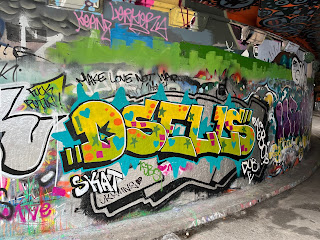
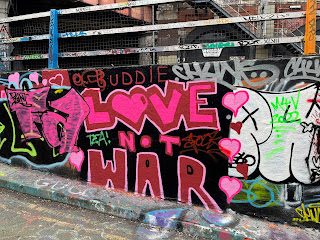
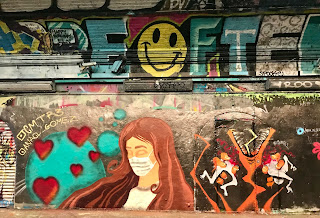
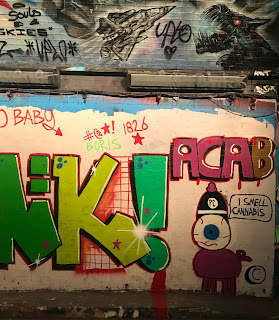
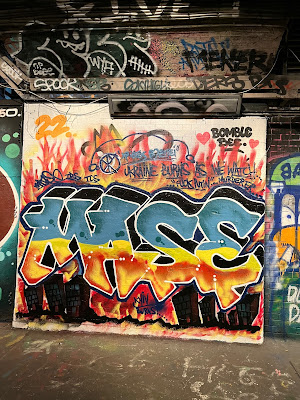
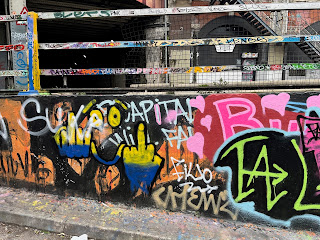
There are a few echoes of the war on the walls of London, including in the graffiti tunnel in Leake Street under Waterloo station.

'Ukraine burns as we watch. F*ck Putin Murderer'


'F*ck Putin! Make love not war'.

'love not war' - simplistic but true. Since almost everyone prefers the former to the latter why can't it be so?

[There was also lots of memorial graffiti there this week for drum & bass MC Skibadee, who was born in Waterloo]

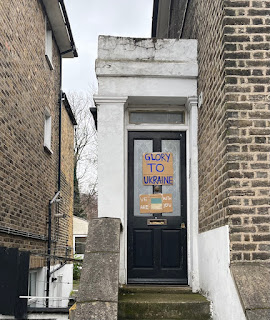
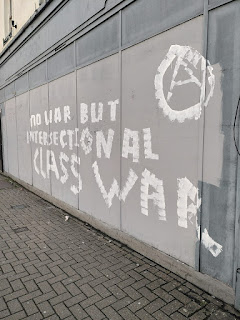
A couple more from elsewhere...

Noticed a few window signs going up including this 'Glory to Ukraine' near Brockley cross.

A friend sent this one from Greenwich High Road. A contemporary twist on the old anarchist slogan 'No war but intersectional class war'

Waterloo newspaper?

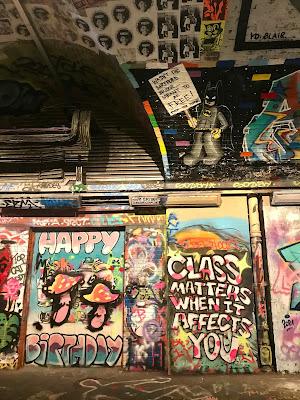
The graffiti in the Waterloo tunnels serve as a kind of wall newspaper, constantly changing in response to current cultural and social events. I took some photos there last year (June 2021) and at the time there was more about Covid, as well as the police off the back of the Black Lives Matters and 'Kill the Bill' demonstrations:


'class matters when it affects you'


Friday, August 29, 2014

South London marches on Westminster - John Henry Mackay on the World Metropolis in 1880s

John Henry Mackay (1864-1933) was a Scottish-born, German-raised individualist anarchist. His novel, 'The Anarchists: A Picture of Civilization at the Close of the Nineteenth Century' was written in German and published in English translation by Benjamin Tucker in Boston in 1891.

The novel draws on the author's time in London in 1887, and includes some great descriptions of the city. It opens with the author crossing from Waterloo on what must have been the Hungerford bridge:

'In the Heart of the World-Metropolis:  A wet, cold October evening was beginning to lower upon London. It was the October of the same year in which, not five months before, had been inaugurated those ridiculous celebrations which gave the year 1887 the name of the “Jubilee Year,” — celebrations of the fiftieth anniversary of the rule of a woman who allows herself to be called “Queen of Great Britain and Ireland, and Empress of India.” On this evening — the last of the week — a man coming from the direction of Waterloo Station was wending his way to the railroad bridge of Charing Cross through labyrinthine, narrow, and almost deserted streets. When, as if fatigued from an extended walk, he had slowly ascended the wooden steps that lead to the narrow walk for pedestrians running beside the tracks on the bridge, and had gone about as far as the middle of the river, he stepped into one of the round recesses fronting the water and remained standing there for a short time, while he allowed the crowd behind him to push on. Rather from habit than genuine fatigue, he stopped and looked down the Thames. As he had but seldom been on “the other side of the Thames,” notwithstanding his already three years’ sojourn in London, he never failed, on crossing one of the bridges, to enjoy afresh the magnificent view that London affords from them.

It was still just light enough for him to recognize, as far as Waterloo Bridge to his right, the dark masses of warehouses, and on the mirror of the Thames at his feet, the rows of broad-bellied freight boats and rafts coupled together, though already the lights of the evening were everywhere blazing into the dark, yawning chaos of this immense city. The two rows of lanterns on Waterloo Bridge stretched away like parallel lines, and each of the lanterns cast its sharp, glittering light, deep and long, into the dark, trembling tide, while to the left, in a terrace-shaped ascent, the countless little flames which illumine the Embankments, and the Strand with its surroundings, every evening, were beginning to flash'
John Henry Mackay

The novel includes an account of the 'Bloody Sunday' demonstration in Trafalgar Square in November 1887. The demonstration against 'coercion in Ireland' and unemployment ended in violent clashes which resulted in the death of Deptford's William Curner (buried in Brockley Cemetery). Mackay reports the arrival of the South London contingent across Westminster Bridge:

'Before him stood an English acquaintance. His collar was torn, his hat soiled. He was in a state of the greatest excitement. After a few hasty questions back and forth, he said that the long procession from the south had also been dispersed...

“We gathered at Rotherhithe: the radical and other societies and clubs of Rotherhithe, Bermondsey, etc., met on our way the Peckham Radical Club, the associations of Camberwell and Walworth, and in Westminster Bridge Road also those of St. Georges — it was an enormous procession, with numerous banners, music bands, adorned with green, accompanied by an endless mass of people on both sides, which in the best of order crossed the entirely vacant bridge of Westminster.

“As was agreed, we were to meet with the procession from Lambeth and Battersea in Bridge Street at Parliament House. Then we were to march in a straight line from south to north, up Whitehall, to this place. Just imagine: a single great procession of imposing length, representing the entire south of London, the entire section of the city on the other side of the Thames — from Woolwich and Greenwich to Battersea and Wandworth! ...

“But our two processions had not joined each other, we had not reached Parliament Street, when the battle began. I was pretty far in the front ranks. Ah, the brutes, galloping on their horses into our ranks, breaking and tearing our flags, knocking down whatever comes in their way!”

“It was fortunate you did not get farther,” Auban interrupted him, “for I have heard that the Life Guards were held in reserve in Whitehall. I am surprised that they are not yet here, for the situation is getting more serious.”

“But we defended ourselves,” exclaimed the other, “with my loaded cane I gave one —”'

Bloody Sunday 1887

As with much writing from that time there is a very strong sense of a class-based division between East and West London, with areas like Deptford and Rotherhithe treated as part of the former. Mackay writes in a chapter entitled 'The Empire of Hunger':

'The East End of London is the hell of poverty. Like an enormous, black, motionless, giant kraken, the poverty of London lies there in lurking silence and encircles with its mighty tentacles the life and the wealth of the city and of the West End: those on the left side extending over the Thames and embracing the entire Embankment on the other side — Rotherhithe, Deptford, Peckham, Camberwell, Lambeth, the other London, the South separated by the Thames; those on the right side stealing round the northern limits of the city in thinner threads. They join each other where Battersea runs into Chelsea and Brompton across the Thames...

The East End is a world in itself, separated from the West as the servant is separated from his master. Now and then one hears about it, but only as of something far off, somewhat as one hears about a foreign land inhabited by other people with other manners and customs...'

The final chapter sees its main character reflecting again on London, this time from London Bridge:

'Two immense human streams surged across London Bridge; back and forth rolled, rattling and resounding, two unbroken lines of vehicles. The black waters of the Thames flowed lazily. Auban stood against the railing of the bridge, and, facing the east, contemplated the grand picture which presented itself: Everywhere, on both sides of the stream, towers, pillars, chimney-stacks, church steeples rose above the sea of houses... But beneath him a forest of masts, poles, sails... On the left Billingsgate, the great, famous fish-market of London... Farther, where the four towers rise, the dark, dismal structure of the Tower. With a reddish glare the setting sun, the pale, weary sun of London, lay on its windows a few minutes; then also its light was suddenly extinguished, and a gray twilight drew its streaks around the dark masses of the warehouses, the giant bodies of the ships, the pillars of the bridge...

By the clock on the  Adelaide Buildings it was already seven, but still the task of unloading the great ocean steamer at Auban’s feet was not yet completed. Long lines of strong men carried boxes and bales over wavering wooden bridges to the shore. Their foreheads, heads, and necks protected against the crushing pressure of their heavy burdens by strangely shaped cushions, they looked like oxen in the yoke as they staggered along under their weight...

A strange feeling crept over Auban. Such was London, immense London, which covers seven hundred miles with its five millions of human beings; such was London, where a man was born every fifth minute, where one died every eighth... Such was London, which grew and grew, and already immeasurable, seemed to aspire to the infinite...Immense city! Sphinx-like, it stretched on both sides of the river, and the clouds of smoke, vapor, noise it belched forth, lay like veils over its panting body...

Lights after lights began to flash and mingled the warmth of their glow with the dampness of the fog. Their reddish reflections trembled through the twilight. London Bridge thundered and resounded under the burdens it bore. Thus day after day, week after week, year after year, raged that mighty life which never grew tired. The beatings of its heart grew ever more feverish, the deeds of its arms ever mightier, the plans of its brain ever bolder. When would it reach the summit of its aspirations? When would it rest?'
Thursday, February 13, 2014

Knocked 'Em in the Old Kent Road

Former Hollywood child star Shirley Temple (1928-2014) died this week. Once upon a long time ago she sang a South London song in 'The Little Princess' (1939), loosely based on the novel by Frances Hodgson Burnett. Fallen on hard times as a servant girl, she searches the Veterans Hospital for her missing father, entertaining the inmates along the way with a few verses of 'Knocked 'Em in the Old Kent Road'.


Others who have sung the same song have included Marlene Dietrich in the 1950s. In 1954, 'Dietrich swept on to the "Night of a Hundred Stars" at the London Palladium with Noel Coward. The glamorous pals faked a cakewalk to "Knocked 'Em in the Old Kent Road", a number neither of them really knew, but nobody minded, for they raised £10,000 for the Actors' Orphanage' (Marlene Dietrich: Life and Legend by Steven Bach, 2011):


...Julie Andrews (in 1973)- this is awful -


... and best of all Fozzie Bear as a Pearly King in the Muppet Show (1978):


If all this is a terrible mockney/cockernee caricature, you could say the same about the original song. It was written in the 1890s by music hall star Albert Chevalier (1861-1923), with music by his brother Charles Ingle. Chevalier was born in Notting Hill to a French father and Welsh mother, hence his rather wonderful full name of Albert Onesime Britannicus Gwathveoyd Louis Chevalier.


Previously a professional actor, Chevalier specialised in writing 'coster songs' (costermongers were street sellers, especially of fruit and veg), using the costers' cockney slang. The full lyrics, with its tale of a Camberwell donkey being left in a will, are as follows:

Last week down our alley came a toff,
Nice old geezer with a nasty cough;
Sees my Missus, takes 'is topper off
In a very gentlemanly way;
"Ma'am," says he, "I have some news to tell,
Your rich uncle, Tom of Camberwell,
Popped off recent, which ain't a sell,
Leaving you 'is little donkey Shay."

Chorus.
"Wot cher!" all the neighbors cried,
"Who're yer goin' to meet, Bill?
have yer bought the street, Bill?"
Laugh? I thought I should 'ave died.
Knocked 'em in the Old Kent Road!

Some says nasty things about the moke,
One cove thinks 'is leg is really broke;
That's 'is envy, 'cos' we're carriage folk,
Like the toffs as rides in Rotten Row;
Straight, it woke the alley up a bit,
Thought our lodger would 'ave 'ad a fit
When my missus, whose real wit,
Says, 'ates a 'bus because its low."

When we starts, the blessed donkey stops,
He won't move, so out I quickly 'ops,
Pals start whackin' him when down he drops,
Some one says he wasn't made to go.
Lor ", it might 'ave been a four-in- and,
My old Dutch Knows 'ow to the grand,
First she bows, and then she waves 'er 'and,
Calling out we're goin' for a blow!

Ev'ry evenin' on the stroke of five,
Me and missus takes a little drive;
You'd say, "Wonderful, they're still alive"
If you saw that little donkey go.
I soon showed him that 'e'd have to do
Just whatever he was wanted to,
Still I shan't forget that rowdy crew,
'Ollerin' Woa! steady! Neddy woa! -

Another Chevalier song, The Cockney Tragedian mentions The Cut at Waterloo, opening with the line 'I used to wheel a barrow for my father down the Cut, until I saw a drama at the Brit what turned my nut'.

Thursday, December 12, 2013

Transpontine Christmas Trees


Peckham Square

Waterloo station

My favourite so far - a 'tree' made of books made of trees in Goldsmiths library- the sharp eyed
may  spot Derrida's Of Grammatology, Jameson's  Postmodernism and Fanon's Black Skin, White Masks
contributing to the festive cheer!

Monday, November 11, 2013

Music Monday: Jesus Blood Never Failed Me Yet

The singing voice of an anonymous South London homeless man has moved people around the world long after his death. The composer Gavin Bryars built his piece Jesus Blood Never Failed Me Yet around a recording made in 1971. As he recalls:

'In 1971, when I lived in London, I was working with a friend, Alan Power, on a film about people living rough in the area around Elephant and Castle and Waterloo Station. In the course of being filmed, some people broke into drunken song - sometimes bits of opera, sometimes sentimental ballads - and one, who in fact did not drink, sang a religious song "Jesus' Blood Never Failed Me Yet". This was not ultimately used in the film and I was given all the unused sections of tape, including this one.

When I played it at home, I found that his singing was in tune with my piano, and I improvised a simple accompaniment. I noticed, too, that the first section of the song - 13 bars in length - formed an effective loop which repeated in a slightly unpredictable way. I took the tape loop to Leicester, where I was working in the Fine Art Department, and copied the loop onto a continuous reel of tape, thinking about perhaps adding an orchestrated accompaniment to this. The door of the recording room opened on to one of the large painting studios and I left the tape copying, with the door open, while I went to have a cup of coffee. When I came back I found the normally lively room unnaturally subdued. People were moving about much more slowly than usual and a few were sitting alone, quietly weeping.

I was puzzled until I realised that the tape was still playing and that they had been overcome by the old man's singing. This convinced me of the emotional power of the music and of the possibilities offered by adding a simple, though gradually evolving, orchestral accompaniment that respected the tramp's nobility and simple faith. Although he died before he could hear what I had done with his singing, the piece remains as an eloquent, but understated testimony to his spirit and optimism'.


Bryars first released a version of this on Brian Eno's Obscure label in 1975. Another version was recorded in 1993, this time with Tom Waits joining in the singing along to the original sample in the later stages of the piece.


Sunday, October 13, 2013

Jay-Z on the Jubilee Line

When playing at the O2 in Greenwich there's really only one quick way to and from central London - on the tube. Hence Jay-Z being spotted on tube at Waterloo last night on his way to gig (photo by GoodguyGoodguy). And yes that's Chris Martin from Coldplay standing behind him.


Rihanna also took the Jubilee line from London Bridge to North Greenwich when she was playing at the 02 in October 2011


Tuesday, April 23, 2013

'Mad Tracey from Croydon'

I used to love Tracey Emin. Her breakthrough exhibition at the South London Gallery in Camberwell 'I need Art like I need God' (way back in 1997) really blew me away, and I still think that she has brought some material into the art world boys club that has rarely found expression there before - young women's sexuality, abuse, abortion and growing up in unfashionable places: a 1999 documentary about her was famously titled 'Mad Tracey from Margate' (though we might note that she was actually born in Croydon May Day Hospital in 1963).

More recently she has become a bit of an embarrassing celeb, moaning about high taxes and, horror of horrors, publically admitting to voitng Tory in the last election (though she has subsequently criticised their art education policy). She has joined that select club with Morrissey and Jeanette Winterson of people whose younger selves' influence on my younger self can't be erased by their later baleful utterances - I guess you can't complain too much if you are drawn to professional contrarians and they end up acting in ways contrary to your own expectations of them.

I might not like Tracey Emin in her current guise,  but I can still admire the version of her who recalled walking through the Elephant and Castle in 1990 when Margaret Thatcher stood down as Prime Minister: 'I looked up at the buses, and people were banging on the windows and going 'Yeah!' And I noticed people were jumping up and down in the street...People looked so happy. I felt absolute jubilation' (quoted in 'Margaret Thatcher' by John Campbell, 2004).

As a homeless teenager, she ended up being  housed in Waterloo after six months of daily hassling Southwark Council . Later, she had a studio somewhere round the Elephant around 1990 though I'm not sure exactly where. In that period she worked for Southwark Council as a youth worker for a couple of years, and in 1992 she met her sometime collaborator Sarah Lucas when the latter had  an exhibition,'A penis nailed to a board', at City Racing - a former betting shop near the Oval (in a funny interview a couple of years ago, Lucas pointed out that she actually was a working class artist from a London council estate, whereas Emin's dad was a sometime businessman - not that Emin didn't have some very hard times).

 Emin has a new book out, My Photo Album, with some of the proceeds going to the no longer fashionable HIV charity The Terrence Higgins Trust. And I will also give her additional points for once donating some drawings to one of my favourite charities, Celia Hammond Animal Trust (of Lewisham Way, Canning Town and Hastings), from where we once secured two lovely cats - well nobody ever manages to come out of there with just one.

Come on Tracey, there's still time to dismiss those Cameron fan club moments as a terrible mid-life crisis and to grow old disgracefully.

Tracey Emin in her Elephant and Castle studio, 1990

Thursday, March 14, 2013

Revolving Torsion at St Thomas Hospital

I think my favourite piece of transpontine sculpture is this work on the South side of Waterloo Bridge, in the grounds of St Thomas' Hospital. 


'Revolving Torsion' by Naum Gabo was manufactured in steel to the artist's design by Stainless Metalcraft Ltd of London in 1972-3, and installed at the hospital with fountain in 1975. It was restored in 1987 and is currently in good condition.

Gabo, born Neyemiya Pevzner in 1890 to a Jewish family in Russia, grew up in Bryansk. As a teenager he was influenced by the anarchism of Peter Kropotkin, and involved in radical politics. In the aftermath of the Russian revolution he threw himself into the experimental work of the Soviet avant garde before leaving for Germany in 1922 disillusioned with the authoritarian direction of the Bolshevik regime.


Gabo continued to promote Constructivism in Germany until 1933, when he fled the Nazis, ending up in London in 1936 after three years in Paris. Gabo spent the Second World War in Britain, much of it in Cornwall where he had befriended British artists such as Barbara Hepworth and Ben Nicholson. In 1946 he moved to the United States where he remained until he died in 1977.

There's something vaguely poetic about the work of this sometime anarchist and later Knight of the British Empire sitting opposite Parliament.


The fountain is an oasis of calm amidst the emotional whirlwind of the hospital, and respite too from the neverending street circus on the South Bank. Like fountains everywhere, people have taken to tossing coins in and making a wish. When the sun shines through the shower of water drops and reflects off the stainless steel this is one of the finest views in London.

Wednesday, July 18, 2012

Woody Guthrie in London, 1944

It's the centenary of the birth of the great American singer/songwriter Woody Guthrie, born on 14 July 1912. As far as I know, Guthrie only visited London once, in July 1944. Guthrie had been a merchant seaman on board the SS Sea Porpoise, a ship transporting American troops to Europe. It left Boston on 7 April 1944 and arrived at Newport, Wales on 17 April 1944 with about 3,000 men on board.

photo of Sea Porpoise from Gippetti.com

The ship was torpedoed on 5 July after dropping troops at Normandy beach, and was towed back to England for repairs. Guthrie and fellow folk singer Cisco Houston, who was also on board, were dropped off and made their way by train from Southampton to Waterloo Station (as described in the book Woody, Cisco and Me by Jim Longhi). While in London Guthrie dropped into the offices of the BBC and secured himself a slot on BBC Children's Hour, where he sang two songs "Wabash Cannonball" and "900 Miles" - just a couple of days after being torpedoed at sea. After a brief stay in London, Guthrie got the train on to Glasgow to join transport home.

Sunday, November 13, 2011

City of Roses

Nice short film from people linked to South London's Youth Animation and Media project. In 'City of Roses' (directed by Boris Furlong), a masked figure spray paints a rose on to a wall- I think by Waterloo.

Tuesday, December 21, 2010

Gustav Holst

The composer Gustav Holst (1874-1934) is today best known for his Planets suite, but he also wrote numerous other pieces inspired by, among other things, English folk songs, Indian mythology and the poetry of Walt Whitman. Holst lived in west London for most of his adult life, including Barnes, Richmond and Hammersmith - for a period he conducted the Hammersmith Socialist Choir at William Morris's house.

Holst worked as a jobbing musician (playing trombone on Brighton pier) and then as a music teacher, including a long connection with two South East London institutions. His first teaching job was at James Allen's Girls School, the independent school in Dulwich. Holst taught there one day a week from 1904 to 1920, and according to the school's website: 'In 1905 the school performed Tableaux from Tennyson's Princess, for which Holst composed settings of the poems. The songs were sung from manuscript (some of which are in the school archives) and were published in 1907 as Songs from The Princess, Opus 20A, with the dedication 'to the girls of the James Allen's Girls' School. His Golden Goose, a ballet with chorus, also received its first performance in the gardens here'. There is now a Holst House at JAGS and a Holst Hall.

Holst was also Director of Music at Morley College in Waterloo from 1907 to 1924. The Morley Memorial College for Working Men and Women was established in 1889 to make adult education accessible to the less-well off of South London, and was based in the Old Vic until it got its own site in the 1920s. Holst involved the Morleyites (as he termed his students) in his wider musical endeavours, including a series of Whitsuntide festivals of music and dance in Thaxted in Essex from 1916 to 1918. These came about as a result of his friendship with Conrad Noel, the famed 'Red Vicar' of Thaxted.

In teaching his students, Holst 'made them believe in their right to make music as much as any professional. He spent nearly every evening at Morley College now, and much of his social life revolved round its weekend events, which included excursions into the countryside and long rambles, dances and tea parties. He also encouraged his music students to mix with the James Allen pupils and girls of St Paul's [in Hammersmith], often bringing them to perform at the schools and join in school events' (Holst: his life and times by Paul Holmes, 1997).

Holst's friend Ralph Vaughan Williams wrote to him in 1916 that: 'I sometimes feel that the future of musical England rests with you - because every Paulina who goes out, and for the matter of that every Morleyite, will infect 10 others and they in turn will infect 10 others - I will leave you to make the necessary calculation'.

Here's one of the Songs from the Princess (O Swallow, Swallow), which since it was written to be performed by young women at a school in East Dulwich Grove could at a stretch qualify for inclusion in the list of South London Songs:


(performed here by a choir from George Mason University in Virginia)

Friday, October 09, 2009

Dinner Against Deportations

The Stop Deportation network is holding a Dinner against Deportations in Waterloo on October 20th promising 'Delicious food and updates from community campaigns against deportations'. They say:

'Come to socialise & strategise. Come to meet groups and individuals campaigning against the Home Office's latest move to deport as many people as possible, share information and make useful links. Mass deportations are posing a new threat to communities in the UK. At least six mass deportation flights between 27 August and 22 September have deported people to Nigeria, DR Congo, Jamaica, Cameroon, Afghanistan, Iraqi Kurdistan. To protect ourselves against these attacks on our communities we need to be united, build connections, share information and support each other'.

Tuesday, 20th October, 6-9pm at Waterloo Action Centre, 14 Baylis Road, Waterloo, London, SE1 7AA. Free or donation . Contact 07506 904269 or stopdeportation@riseup.net for further details.