Sunday, January 24, 2021

British Homophone and the Black Vinyl Atlantic

Sandwiched between Surrey Canal Road SE14 (near to the Den) and Rollins Street SE15 is a run down set of buildings named the Excelsior Works. Once upon a time this place had a role in musical history as a record pressing plant from where some great records made their way around the world.

The site seems to have been farm land at the turn of the 20th century, but by the start of the First World War the Excelsior Works had been established, initially occupied by Thomas O’Brien and Company, wholesale ironmongers, and then from 1919 by M. Erdman and Son, portable house builders. 

From the early 1920s Ebonestos Industries Ltd, a plastics company specialising in electrical insulators, moved on site having previously been based in Pomeroy Street SE14. A 1923 report mentions 'A serious fire... at the Ebonestos Insulators Works, Rollins-street, Deptford. A district call had to be circulated, but before the firemen had the flames under control the building was gutted' (Pall Mall Gazette, 19 July 1923). The works faced on to the Surrey Canal, linking it to the Surrey Commercial Docks, until the canal was filled and the docks closed in the 1970s. 

Later in the 1920s the company seems to have started planning to diversify into another plastic product.  In 1928 a share prospectus inviting investment in a new record company Gramophone Records Ltd reported that  'arrangements have been made for the manufacture and pressing of 200,000 record discs per month by Ebonestos Insulators Limited, which company has facilities at its works in London for extension of output as and when required' (Scotsman, 27 March 1928). Shortly afterwards this company merged with another company, British Homophone, under the latter's name. British Homophone had grown out of another company (Sterno) originally set up to distribute records of the Homophon Company of Berlin.

There was however a whiff of scandal about this. John Bull newspaper (12 November 1932) termed the 'Big Gramophone Combine Sensation' an 'investment swindle'. It seems that the record production capacity of Excelsior had been massively exaggerated and it was in fact 'totally unsuited for the commercial production of records'. Shareholders complained that they had been misled.

Rollins House at the back of the site on Rollins Street

Nevertheless record production does seem to have commenced with British Homophone having its own record labels, Homochord and Sterno, putting out dance music and other popular music of the 1930s - including by Mantovani And His Tipica Orchestra. According to Discogs,  it became 'one of the first companies in Britain to process and press records directly for both its own labels (Homochord and Sterno) as well as for independent labels and customers'.  As 1920s/30s dance band enthusiast Michael Thomas has exhaustively documented, British Homophone put out a series of '4 in 1' records which unusually included four full length tunes on each record.


At this point, British Homophone had premises in Kilburn and Stonebridge as well as at New Cross so it may not be clear which records were manufactured where. In 1937 though British Homophone sold off the recording and commercial record label side of its business to Decca and EMI and closed down all of its premises apart from New Cross. 

From this point, British Homophone seems to have only pressed records under contract on behalf of other record companies. It shared the Excelsior Works with Ebonestos:  Sir Herbert Morgan was Chairman of both companies and explained in 1947 that  'the Homophone and Ebonestos companies should be regarded together in that the businesses were carried on in the same premises and, to a very large extent, under the guidance of the same personnel'.  Ebenestos was said to be 'primarily concerned in the manufacture of components for the electrical, engineering, radio and motor industries' (Truth, 3 October 1947).

There was some bomb damage during the Second World War and most buildings on site are believed to date from the period after the war (or possibly the 1930s). Both companies remained on site until the 1980s, when Ebonestos moved out of London. It continues to this day as Welwyn Components Ltd,  part of TT Electronics based in Bedlington, Northumberland. British Homophone is no more but as we shall see, records made there in its 1950-1980 hey day had a major cultural impact.

The Black Vinyl Atlantic

Paul Gilroy famously describes a transnational Black Atlantic culture, constituted by the circulation of black people and their cultural works between Britain, the Caribbean, the USA and Africa. Music 'comprises a central and even foundational element' of this black 'expressive culture' rooted in a common experience of the terrors of slavery and its legacies (The Black Atlantic: Modernity and Double Consciousness, 1993). In the second half of the twentieth century this culture was embodied in 7 and 12 inch circles of sound crossing the ocean in all directions - let's call it the Black Vinyl Atlantic. 

Concretely, songs might be composed and recorded in Jamaica, pressed on to vinyl in England, and the records exported back to the Caribbean.  Or as Lloyd Bradley describes in his excellent 'Sounds Like London. 100 Years of Black Music in the Capital' (2013) musicians from Africa and the Caribbean might travel to London to record tracks which were then distributed globally from Britain on labels like Emil E. Shalit's Melodisc. Some of these records might then have been brought back to Britain amongst the possessions of DJs, musicians and other migrants moving here. Other records that had already been released in Jamaica or the USA were licensed to be re-pressed in London. 

The British Homophone factory in New Cross was one of the points on this musical and cultural network - a place where the spirit was made flesh as songs were transferred to vinyl. The Discogs detectives have perfected a science of reading the runes and serial numbers on records to work out where they were pressed, and thanks to this have been able to compile an impressive British Homophone discography. This includes some of the great artists and recordings of the Black Atlantic, in particular ska, early reggae and soul.

There are tracks on the Bluebeat label, the ska label started by Shalit, and on R&B Discs and its various subsidiary labels such as Ska Beat and National Calypso (these were run by Jewish couple Rita and Benny Isen from their shop in Stamford Hill).  Tracks on Doctor Bird and Rio records, most of them recorded in Jamaica, including early releases by The Wailers and The Maytals 'Sensational Maytals' LP. And quite a few on Island Records and associated labels, including the famous 'Guns of Navarone' by The Skatalites and Bob and Earl's soul classic 'Harlem Shuffle' (on Sue Records, owned by Island's Chris Blackwell).

President Records

A new chapter for British Homophone started in 1971 when President Records executive Edward Kassner acquired a 50% stake in the company. Kassner, a refugee from Nazi Austria, had started his record company in 1955. In 1968 President Records had secured its first number one single with 'Baby Come Back' by The Equals, featuring Eddy Grant. In the 1970s, President signed Miami artists KC & The Sunshine Band and George & Gwen McCrae, releasing their records on its subsidiary soul label Jay Boy.  They had massive hits including George McCrae's Rock Your Baby (number one in 1974) and KC's  'Queen of Clubs', 'Get Down Tonight'  and 'That's the Way I Like It' (in 1974/5). By this point President was manufacturing its records at British Homophone, with Music Week in 1974 describing it as President's own pressing facility. So yes, it seems that these Miami disco classics, hits in the UK before the USA, were launched from New Cross.

Eddy Grant

By the end of the 1970s the British Homophone plant was in decline. It was bought in 1979 by Eddy Grant who had had a long association with President Records while with his band The Equals. Grant had opened his Coach House Recording Studio in Stamford Hill in 1974, and launched his own Ice record label. In buying the pressing plant Grant was establishing 'the first black-owned manufacturing facility in England' for records (Bradley). This was a busy time for Grant and for Ice, so presumably some of their output was pressed at Excelsior.  But in the music business conditions of the time it was to prove a stretch too far. Grant recalled: 'When it became critical was with the pressing plant, because the bastards at the major companies would use my plant for their overruns – Christmas is coming or Elvis’s birthday or something. They would use my facility and wouldn’t want to pay; there was a particular time when the music business was in such terrible straits that they wouldn’t pay me. So I had on the one hand the brothers who couldn’t pay me, and on the other hand the white companies who wouldn’t pay me' (quoted in Bradley). Grant sold up and moved to Barbados in 1981 and the factory seems to have closed for good by 1985.


The records made here had an international impact, but it's also intriguing to think about records made in New Cross being played locally on sound systems and in blues parties. And in fact we do know there was a direct link between the British Homophone factory and the area's best known sound system, Saxon Studio International - launchpad for the careers of Tippa Irie, Maxi Priest, Smiley Culture and many others. Co-founder Denis Rowe told reggae historian David Katz that his uncle worked at British Homophone 'which was off Ilderton Road in New Cross, so most people used to come to my house to get records; them days, people used to press records for Jamaica over here and American music was printed here and sent to America. So I grew up around records, and started to buy records at a young age.' Rowe's dad ran a shop in Malpas Road, Brockley where parties were held - no doubt playing some records manufactured a short distance away.


Today there are various workshops on a site that seems dominated by second hand/scrap cars.  There are also artist studios, though a few years ago there was a dispute with developers Renewal about their plans to redevelop the site - not sure of the current status of this. Maybe no music here, though elsewhere along Surrey Canal Road other former industrial spaces are being put to good use. By all accounts there have been some great club nights at Venue MOT Unit 18 on the Orion Industrial Estate, while  Digital Holdings on the Juno Industrial Estate has become an important music recording studio for grime and drill artists. Perhaps they are tuning in to the echoes of British Homophone and its outernational sounds. 


Neil Transpontine (2021), British Homophone and the Black Vinyl Atlantic. <http://transpont.blogspot.com/2021/01/british-homophone-and-black-vinyl.html>. Published under Creative Commons License BY-NC 4.0. You may share and adapt for non-commercial use provided that you credit the author and source.

Tuesday, January 12, 2021

Blood and Sugar - 'Deptford is a slaving town, is it not?'

'Blood and Sugar' by Laura Shepherd-Robinson (Pan, 2020) is essentially a murder mystery set in late eighteenth century Deptford - 1781 to be precise.  Without giving too much away of the plot, a slavery abolitionist is brutally killed and his friend sets out to investigate. He is obstructed in his enquiries by the local magistrate and by the West India lobby - the wealthy and powerful opponents of any changes to slavery, particular in the lucrative Caribbean sugar plantations.

'Deptford is a slaving town, is it not?' a character asks at the start of the novel, and over the course of the story it is shown that many do have an interest in the slave trade in one way or another. 

The author has done her local history research, correctly noting that 'the town comprised two separate settlements, joined by a road which cut through open field. Deptford Broadway was where the town's merchants lived... Deptford Strand lay nearly a mile to the north, on the banks of the River Thames, and comprised the Public  and Private Docks, the Navy Yard, and workers' housing'. Much of the action takes places in pubs and warehouses near the river front, but with forays into the wealthier houses of the Broadways where some slaves and former slaves work as domestic servants.


The full story of Deptford and slavery remains to be told, and even now there are some who would prefer that we pretend that the area's maritime history is just a lot of  unproblematic messing about on boats. This fictional work puts slavery front and centre, where it belongs.

See previously:

John Evelyn and slavery

Deptford's Runaway Slaves

Friday, January 08, 2021

P W Luton- a New Cross Photographer

Percy William Luton was a photographer in the early 20th century whose Carlton Studio was at 34 New Cross Road SE14.  Electoral Registers and Post Office Directories show that he was there from at least 1909 to 1930, with his wife Florence. 

Portraits taken by him show up on ebay and other sites, often with no information about the subject. Nevertheless they provide a window into the past and its fashions.


An exception to this anonymity is this photograph, from the US  Library of Congress  which includes the name J.Lemm as well as name and address of the photographer. Seemingly this is John Lemm, a wrestler and a weight lifter variously known as the “Swiss Mountaineer”, the  “Swiss Mountain Climber" and the "Swiss Hercules" (I think we can surmise he was from Switzerland). 


Lemm competed in Europe and the USA in the years leading up to the First World War, including for instance a contest in New York in 1911 and the Oxford Music Hall in London in 1909:


How Lemm came to be photographed in a New Cross studio is anybody's guess, but I wonder if there is any connection with this 1909 photo of the Swiss Gymnastic Society also taken by PW Luton. The London branch of this had its HQ off Shaftesbury Avenue in central London.


The  house at 34 New Cross Road still stands - the left hand building below. Along with its white painted neighbour at no.32,  it is a Grade II listed building as a good example of an early 19th century house of this type.


See previous posts:


Wednesday, December 30, 2020

Lewisham Unemployed invade Council Meeting, 1908

Times were hard in the Winter of 1908, with widespread unemployment. There were protests in many places demanding work and relief including a weekly unemployed demonstration from Tower Hill to the wealthier areas of Mayfair and Belgravia.

In Lewisham, the Council 'found its public gallery invaded... by a crowd. One councillor, the Rev. J.C. Morris, vicar of St Mark's, Lewisham, was told that he had a pebble where his heart ought to be; and when Councillor Trenchard looked up to the gallery cries of "Scamps" and "Rotters" were frequent. Others shouted: "Our wives and children are starving; you have got plenty: beware! look out! If you don't listen to us  you will know it. We don't want your half-sovereigns: we want work' (The Woman Worker, December 23 1908).

(Woman Worker, paper of the National Federation of Women Workers, December 23 1908).

The socialist paper Justice (26 December 1908) reported that there were similar scenes in other Council meetings including at St Pancras and Portsmouth, but in Lewisham 'the council went into the cowardly silence of committee and had the gallery cleared'.

(The Metropolitan Borough of Lewisham was created in 1900, and covered the Lewisham, Blackheath, Lee, Hither Green, Catford, Brockley, Forest Hill and part of Sydenham - but not Deptford and New Cross which were under the separate Deptford Council until 1965. Not sure of the political make up of the Council in 1908, but it would have been either Liberal or Conservative in this period)

Sunday, December 27, 2020

Winter windows and other seasonal treats

Lots of Christmas and other seasonal decorations around the area, including in Telegraph Hill SE14 as part of an Advent windows initiative with new ones being unveiled on each day during December - some of them very elaborate.

London skyline in Erlanger Road SE14

Waller Road SE14 -  Covid nativity scene

Bear on a bike in Erlanger Road SE14 - actual bike and life size bear!

Love, joy, hope, peace - Erlanger Road

Happy Chanukah!

Elsewhere, the first Santa spotted was this one in St Johns on 1st November! Well I guess normal rules have been suspended for this year.


The once (and possibly future) Nunhead Museum & Art Gallery in Gellatly Road SE14 has this fine temporary construction complete with Action Man Xmas fairy:


As usual several Nunhead houses have gone the extra mile with lights - this one in Carden Road SE15:


Covid never far away from our thoughts - this 'Christmas is Community' billboard in Malpas Road now has apparently added graffiti - 'Christmas in Contagious'.  The original posters didn't have the 'contagious' word, but as well as this one another in Queens Road has similar graffiti. Anyone know whether this is a genuine graffiti response or whether in fact it has been added by the poster creators?  - cynical me wonders at the suspiciously on brand use of colour. Think the poster is the work of Jack Agency who do music posters as part of the BuildHollywood brand.


Monday, December 21, 2020

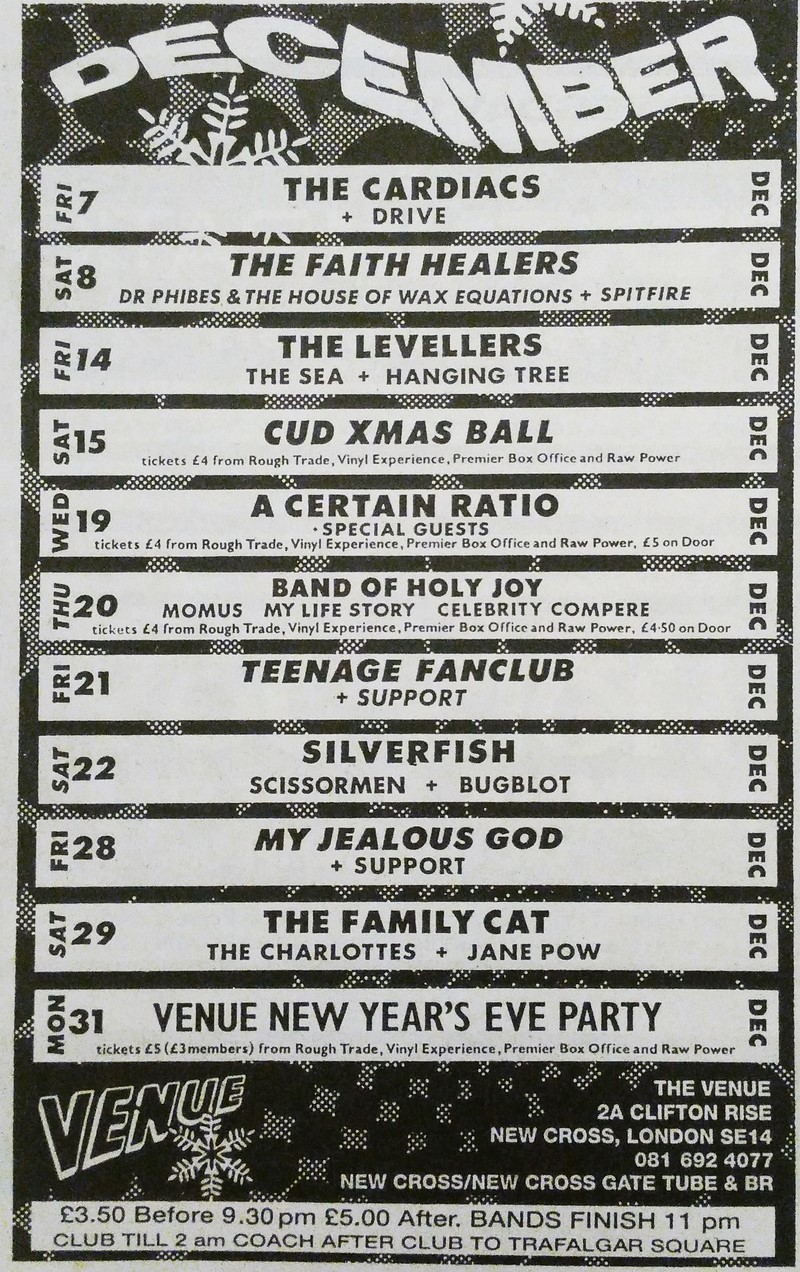
New Cross Venue, Christmas 1990 (and other 90s flyers)

Some more flyers from the New Cross Venue in the 1990s, when the place was a key indie venue.

December 1990 - A Certain Ratio, Band of Holy Joy and Teenage Fanclub (with the Pastels and BMX Bandits) on consecutive nights. According to someone who was at the latter, Bobby Gillespie from Primal Scream joined Teenage Fanclub on stage for an encore version of  'Get Back'.


Teengage Fanclub at the Venue Christmas Party, 21 December 1990 -
'bands finish 11 pm, club till 2 am, coach after club to Traflagar Square'

May 1990 with bands including Red Lorry, Yellow Lorry, Soho and The Oyster Band:


November 1991, including Therapy, Echo and the Bunnymen, The Pastels/Heavenly and Spiritualized (think I was those last two).


February 1992: Meteors, Godfathers, Planet Gong with Here & Now:


June 1992 - Pulp supporting Boo Radleys:


March 1993 - including Goats Don't Shave, Gang of Four and Dodgy:


May 1993 - Sheep on Drugs, The Lunachicks etc.:


October 1994 - Gary Clail, African Headcharge, Dreadzone, Ultramarine:


December 1994: Sleeper, Loop Guru, Shed Seven:


January 1995: Test Dept, King Kurt - also an early example of a tribute band 'English Rose' (Jam covers) which were to become the main acts at the Venue later in the 1990s.


May 1995 - Pale Saints, Cardiacs, Sidi Bou Said (a great South London band):


Friday, December 11, 2020

A short history of New Cross Hospital

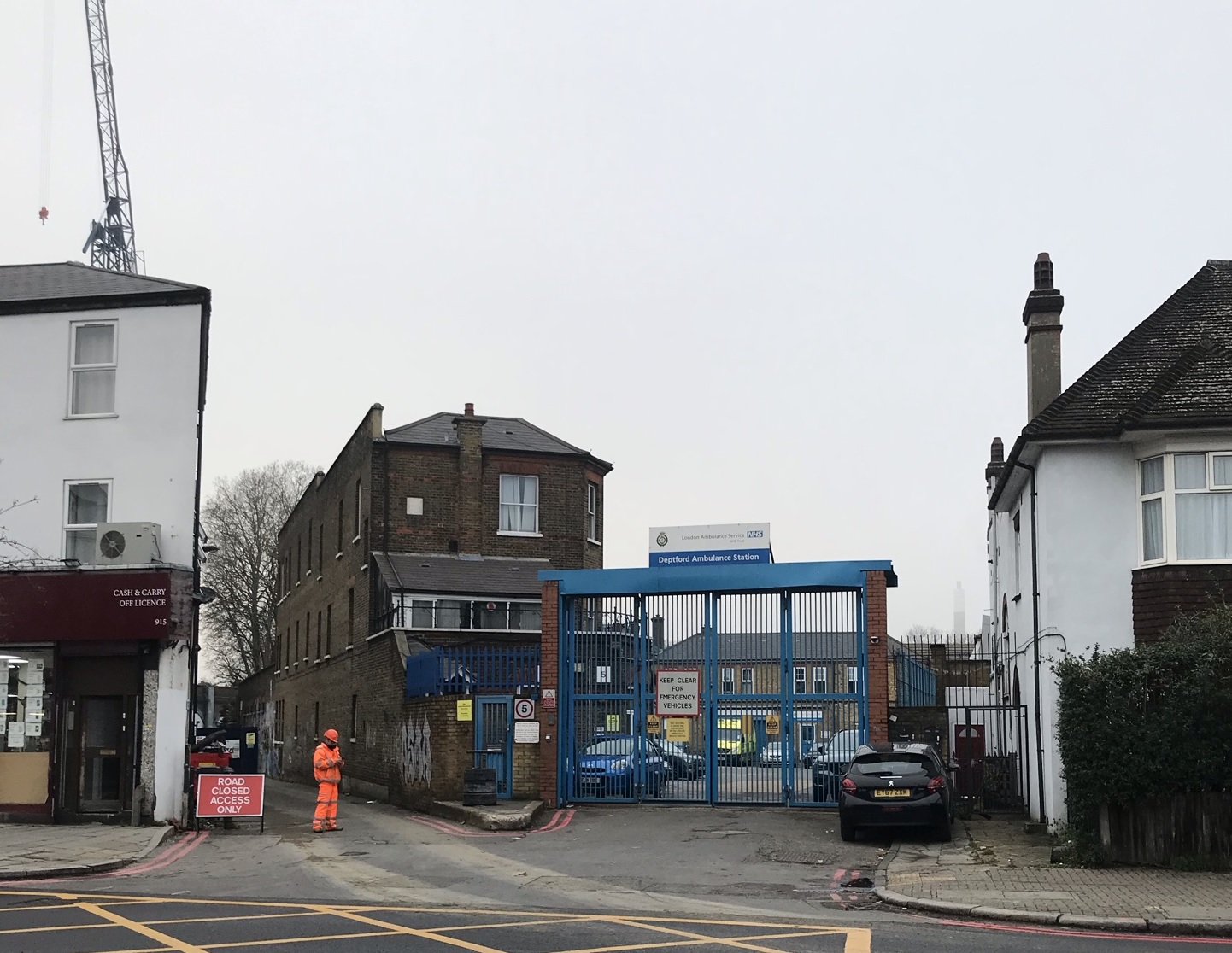
Heading south-east, the A2 changes its name from the Old Kent Road to New Cross Road shortly after the junction with Ilderton Road. On the north side, the change is marked by the entrance to Deptford Ambulance station - the last surviving health provision on what was once a substantial hospital site.


Epidemics of small pox in London in the 1870s led to the decision by the Metropolitan Asylums Board in 1876 to erect 'six temporary wards' to provide for up to 220 patients at Deptford (South London Chronicle, 9/12 /1876).  By March of the following year, the Metropolitan Asylum District Hospital, Deptford (or the Deptford Hospital as it was known) was taking patients.
 
As small pox cases declined later in the year the hospital was briefly closed and there was a proposal to convert it into a 'female imbecile asylum' (Morning Post, 22/10/1877). By early 1878 though a further outbreak of smallpox saw the hospital being reopened. Another smallpox epidemic in 1881 saw the hospital running out of space, and having to turn away hundreds of people 'perhaps to infect whole districts' (Birmingham Mail, 2 May 1881). The hospital was further expanded to 400 beds with its buildings occupying most of the space to the west of what was then Hatfield Road in New Cross (now Avonley Road). The site included an ambulance station  (opened 1883) and a nurses' home (from 1893). As well as smallpox cases it catered for patients with Scarlet fever and other fevers. Renamed the  South Eastern District Hospital in 1883 and then the South Eastern Fever Hospital in 1885, it continued as a fever hospital until 1941.

A vaccine for smallpox had been developed by Edward Jenner at the end of the 18th century, the first vaccine for a contagious disease, and the 1853 Vaccination Act had made smallpox vaccination compulsory for children. Nevertheless, then as now there was an anti vaccination lobby and not everybody was vaccinated. The vaccination did not always prevent infection but it did limit the severity of the disease - the Medical Superintendent of Deptford Hospital  reported in 1881 that 3% of vaccinated smallpox patients had died in the previous year, compared to 38.5% of those who had not been vaccinated (Express & Echo, 24/6/1881)

The existence of the hospital in this area, which came to be 'the largest small pox hospital in the Metropolis' ,was not universally popular. There were complaints that patients from all over London were being sent there and at a meeting of the Camberwell Board of Guardians in 1882, the hospital was blamed for the high levels of smallpox in nearby Peckham and for the fact that 'the value of property in that neighbourhood had gone down considerably' (South London Chronicle, 14/1/1882).

1890s map of site

The hospital denied that it posed any risk to the community. Strict rules were applied to prevent the spread of infection, with visitors only allowed if a patient was dying  and then all visitors were disinfected with 'all contact with the patients discouraged' (Evening Mail, 8/10/1877).  There was a risk though to those working in the hospital, highlighted in 1894 by the death of the Reverend J.B. Mylius, the vicar of the nearby All Saints church in  Hatcham, who lived at the Vicarage in Pepys Road. The young vicar - he was 32 when he died - acted as chaplain to the hospital 'paying daily visits to the patients' before he caught the fever himself and died at the hospital (Kentish Mercury, 19/1/1894). I presume that Mylius Close, off nearby Kender Street, is named after him.

The hospital continued in use through the First World War, when incidentally the artist and later psychoanalyst Grace Pailthorpe (1883-1971) worked there as a medical officer in 1917. She was to become a member of the British Surrealist Group with a particular interest in the unconscious and automatic writing and her work featured in the 1936 International Surrealist Exhibition in London. After the First World War, the hospital catered for ex-solders with TB.


In the Second World War the hospital suffered extensive bomb damage, being hit by 16 high explosive bombs and 300 incendiaries in 1940-41.  On 7 September 1940 - the first night of the Blitz - four nurses and a hospital porter were killed after a bomb hit the hospital. The porter, Albert George Dolphin, was awarded a posthumous George Cross for saving the life of an injured nurse as the building collapsed.  The hospital was closed in 1941, but buildings continued to be used for nurses training and day nursery provision.


Under the new National Health Service it was reopened as the New Cross General Hospital in 1953, closely linked to Guys Hospital who took over the control of New Cross Hospital in 1965. Various clinics and specialist units were based there such as the National Poisons Information Service, a chest unit, breast surgery etc. The hospital closed in 1988 though health provision such as the Medical Toxicology Unit and Drugs Research Library continued on site until the early 21st century.


Today only the Deptford Ambulance Station (1 New Cross Road) remains active, the rest of the site having been redeveloped for housing including the conversion of nurses' quarters into the flats of Mendip Court on Avonley Road (pictured below).


NUPE trade union leader Roger Poole joins ambulance workers at Deptford Ambulance Station, New Cross Road, during the 1990 ambulance workers dispute


Ambulance workers picket Deptford Ambulance Station in 2014 NHS pay strike


Thursday, November 26, 2020

Je Suis Music at The Paradise Bar (1999)

News this week that The Royal Albert Pub (460 New Cross Road) has changed hands - it is one of a number of pubs previously run by Antic which have been taken over by Portobello Brewing. The start of another chapter in the history of this long established pub and sometime music venue (see previous posts for some of its history)

I found this flyer for a night out there in April 1999 when it was in its incarnation as the Paradise Bar. A note in my diary records that I went there with my late friend Katy Watson for 'Je Suis Music' a 'self-proclaimed pop-retro kitsch night' with DJs Joe Egg and the Futurist Girls playing 'a never-ending stream of 1980s pop', lots of Fun Boy Three, Smiths, Heaven 17, Soft Cell and Aha. All with the lit up multi coloured disco dancefloor. It was one of a range of campy nights put on by Joe and Nervous Stephen, including French Disko and Pretty in Pink themed nights (not to mention the Belle & Sebastian fanfest 2000 Troubled Teenagers which I've mentioned before)


There was a Pop Culture Quiz which me and Katy won, she took the Suede CD prize. I would still get the music questions right but not sure about the TV ones!


(It was a strange weekend, on the Saturday I had been on a demonstration about the war that was raging in Yugoslavia and a nail bomb had gone off in Brixton, planted by a far right activist as the first of a series that also targeted Brick Lane and the Admiral Duncan pub in Soho). 

Monday, November 23, 2020

New Cross Fire Station: a short history

New Cross Fire Station, in Queens Road SE14,  was built in 1894 and has survived two World Wars and a threat to close it from Boris Johnson.

For much of the 19th century what fire service there was in London was privately run by the London Fire Engine Establishment or by local volunteers. Locally there was a Prince of Wales Volunteer Fire Brigade, based in Henry Street, Hatcham (now Briant Street SE14). An 1864 report noted that they had been called out 39 times between April and November of that year, showing 'how much a fire brigade was needed in this now densely populated neighbourhood' (Kentish Mercury, 19/11/1864).  The following year the Metropolitan Fire Brigade was established by the Metropolitan Board of Works before being taken over by the new London County Council in 1889.

New Cross was one of the first  fire stations to be built by the LCC. It is a grand building with what Historic England describe as a 'romantic, château-like exterior' (it is now a Grade II listed building). When it was built the practice was for all firemen (and in those days they were all men) to live on site. So the station included flats for the married officers and a dormitory for the unmarried ones. 


There was also a stable block for the horses that pulled the fire engines. Nowadays people tend to look back nostalgically to the days of horse drawn transport, but it could be just as dangerous as motor vehicles. A fireman from New Cross station,  E.R. Watts was killed after horses pulling his vehicle bolted on Old Kent Road (Hull Daily Mail, 26/3/1910).  In 1899 a cyclist was trampled to death after being knocked off his bike by horses pulling a bus in Queens Road opposite the fire station (Portsmouth Evening News, 5/9/1899).

With a permanent community on site in those early days, there was plenty of socialising as well as fire fighting. In 1903 for instance there was the fourth annual 'Firemen's Ball at New Cross' for 200 guests, with  dancing ' kept up with much zest until the early hours of the morning'. In the same week 200 children 'had tea at the station, and were afterwards entertained with cinematograph pictures and 'Punch and Judy' (Kentish Mercury - Friday 09 January 1903). A few years later 'An excellent evening's entertainment' at the station included dancing and turns from 'prominent vaudeville artistes' including Arthur Lloyd and W.P. Dempsey. Once again 'a right merry time was spent until the early hours' (Music Hall and Theatre Review, 7/4/1910).


A plaque outside the station, unveiled in 2018, commemorates George Arthur Roberts BEM (1890-1970). Born in Trinidad, he was lived through the Battle of the Somme as a First World War solider and later became one of London's first black firefighters, serving at New Cross Fire Station throughout World War Two.  In the 1930s he was one of the founders and a member of the Executive of the early civil rights organisation the League of Coloured Peoples (whose President, Harold Moody, lived at 164 Queens Road). 

Firefighters from New Cross took part in the first national fire brigades strike in December 1977 - a photograph from the time shows a New Cross placard saying 'we thank the public for all your support'


In 2013, New Cross was listed in a report of stations being considered to be permanently closed by Boris Johnson as part of his spending cuts while Mayor of London.  After much opposition, New Cross was spared though others at Southwark, Downham and Woolwich were closed.

Over 125 years countless fires have been extinguished and lives saved by the firefighters at New Cross, long may it continue.

(Banner at New Cross Fire Station, 2013)

'We save lives not banks!' - firefighters at New Cross during the national strike about pensions in November 2013


Thursday, November 05, 2020

Greentea Peng at Rivoli Ballroom

Greentea Peng is the latest singer to have graced the legendary Rivoli Ballroom in Crofton Park, recording a performance of her song Hu Man for the 'Later... with Jools Holland' show on BBC. She's following in the footsteps of other Rivoli artists like.... Florence Welch, Oasis, Elton John, Tina Turner, Kylie, Idris Elba, well everybody really (just check some of them out here).


Greentea Peng (Aria Wells) grew up in Bermondsey and I think may now live in the Brockley area, so this was home SE London ground.