New book out now - click on image for more details, including where to get it
Showing posts with label Telegraph Hill. Show all posts

Sunday, September 07, 2025

Cenotaph South - South London's poetic landscape

'Cenotaph South: mapping the lost poets of Nunhead Cemetery' (Penned in the Margins, 2016) by Chris McCabe is a remarkable book. Partly it is what it says on the cover – an exploration of some of the largely forgotten poets buried there including Marian Richardson and Albert Craig. But he also wanders over the wider South London poetic landscape, extending from Robert Browning's cottage on Telegraph Hill, through the cemetery and onto William Blake's Peckham Rye and then to Dulwich woods and village where the Crown and Greyhound pub ('the Dog') hosted poetry gatherings upstairs from 1940s to 1980s. He also mentions contemporary Peckham poets like Caleb Femi, performing at the Review Bookshop in Bellenden Road.

He goes in search of a hawthorn tree suitable for Blake's vision of angels on Peckham Rye and find the most appropriate candidate is to be a tree on the Rye Hill estate:

'Quaint English Bauhaus. There is a map of Peck Hill and Rye Hill Park Estate laid out in the colours of a Butlins map: south London joyland. I check the Rocque map, completed almost to the date that Blake was here: this would have been open fields, the edge of an enclosure separating the Rye from what was most likely private fields. I weave through the outskirts of the estate. The land around Frome House is lined with what look to be ancient trees, bark knotted in folds. The trees grow within yards of the windows of the flats, past the patched light that breaks through the skeleton of a scaffold. The trees are trying to grow inwards, towards the sun. There is what looks like a hawthorn here - gnarled and ancient-looking, awesome in scale, towering over the flats. This is a hawthorn to take on the oaks. A hawthorn worthy of any angel'.

We don't have to take literally that this is the tree - the details of Blake's childhood visions are sketchy to say the least - but I like the idea that it might be found not in the park itself but in nearby council estate. 

In 'mapping out the woods, pubs, colleges and houses of South East London's dead poets' he finds the area to be 'the richest landscape of poetic activity in London'. Is it something about the hills, home to the muses in classical times according to Robert Graves so why not here too? 

'The word muse, we are told, comes from the root mont, meaning mountain. I think of the high points around Nunhead cemetery, Telegraph Hill (where Robert Browning lived) and the higher neighbouring peaks of Sydenham Hill and Forest Hill. There is a pull to poets in these high points, an irresistible urge for the heights: light, perspective, space'.


Sunday, July 17, 2022

Telegraph Hill Welcomes Refugees

Telegraph Hill Welcomes Refugees is making plans to support a refugee family locally - can you help?


Sunday, December 27, 2020

Winter windows and other seasonal treats

Lots of Christmas and other seasonal decorations around the area, including in Telegraph Hill SE14 as part of an Advent windows initiative with new ones being unveiled on each day during December - some of them very elaborate.

London skyline in Erlanger Road SE14

Waller Road SE14 -  Covid nativity scene

Bear on a bike in Erlanger Road SE14 - actual bike and life size bear!

Love, joy, hope, peace - Erlanger Road

Happy Chanukah!

Elsewhere, the first Santa spotted was this one in St Johns on 1st November! Well I guess normal rules have been suspended for this year.


The once (and possibly future) Nunhead Museum & Art Gallery in Gellatly Road SE14 has this fine temporary construction complete with Action Man Xmas fairy:


As usual several Nunhead houses have gone the extra mile with lights - this one in Carden Road SE15:


Covid never far away from our thoughts - this 'Christmas is Community' billboard in Malpas Road now has apparently added graffiti - 'Christmas in Contagious'.  The original posters didn't have the 'contagious' word, but as well as this one another in Queens Road has similar graffiti. Anyone know whether this is a genuine graffiti response or whether in fact it has been added by the poster creators?  - cynical me wonders at the suspiciously on brand use of colour. Think the poster is the work of Jack Agency who do music posters as part of the BuildHollywood brand.


Tuesday, April 14, 2020

Covid-19 street art, volume 1

Covid-19 might have led to physical distancing but, as many have observed, the need for social communication and organisation has never been more apparent. In  this post I am focusing on one aspect of that - public expressions relating to the pandemic as seen on the streets of SE London (examples mainly from Brockley/New Cross/Nunhead area unless otherwise stated). There is a wave of spontaneous street/folk art bubbling up in windows, pavements, hoardings and many other places.

The first wave of creativity accompanied the launch of community self-help/mutual aid. The first public sign of this was the launch of the Lewisham Covid 19 Mutual Aid facebook group on March 12th, a good ten days before the Government implemented a lockdown. Soon flyers were dropping through letterboxes and posters going up all over the place, as people set up local groups at neighbourhood and street level. Today there are well established networks in most areas, there is lots of informal checking in on neighbours and co-ordinated responses to requests to pick up shopping and medicines, along with more ambitious efforts such as delivering food parcels to those who need it most (such as the scheme being run from Telegraph Hill area). If in some streets there hasn't been much need to go beyond setting up a whatsapp group, it is good to know that the support is there when required. Here's a couple of early examples of leaflets, from Telegraph Hill and Brockley respectively (click to enlarge).

'If you're self isolating you are not alone' (Telegraph Hill leaflet) 

'Need the support of your community during Covid-19? We can help' (Brockley leaflet)
The key visual image of pandemic street art has been the children's painting of a rainbow, displayed in a window as a general expression of hope. This seems to have started in Italy and spread internationally.


Some people have taken the rainbow on to another level - here's a balloon arch from Waller Road SE14:


Another international trend has been the bear hunt - strategically placed teddy bears for children to spot when they are out and about with their parents during their exercise stroll. This bear is giving thanks not to just emergency services but to food producers, shop workers, delivery people and... cats:


In Britain over the last couple of weeks the rainbow has merged  with another key trope - support for people working in the National Health Service. Here's some chalked examples:

Ravensbourne Park
Ivydale Road
'thank you NHS & Key workers - stay safe' (Ivydale Road)

NHS on Gellatly Road, opposite Skehans pub
 Elsewhere there have been banners, like this one:
'Thank you NHS' - Frendsbury Gardens, Honor Oak Estate (detail below)

Rushey Green - 'Care for each other'
The 'Trees on the Green' sculptures at Rushey Green have been decorated with pictures from children and staff at St John Baptist Primary School in Catford.


Similar sentiments have been expressed in street art pieces like these:

'We are blessed to have the NHS' - Geoffrey Road, SE4 (by Harry Blackmore)

NHS superhero, Hilly Fields
These graphic outpourings of support for NHS workers have been matched by public cheering on Thursday nights at 8 pm (for three consecutive weeks so far). In many places people have been clapping and generally making noise from their doors and windows. On my street in SE14 it has got busier and noisier over the three weeks, with banging of saucepans and even a couple of trumpets. It is both a gesture of solidarity and an affirmation of community, the only time in the week when we get to see our neighbours in any numbers.

I've seen some remarks online to the effect that what frontline workers in the health service need is better pay, more funding and Personal Protective Equipment, rather than cheers. But these need not be mutually exclusive. What is being shown appreciation on Thursday nights is not the limitations of the top down, under-resourced NHS with its various hierarchies and bureaucracies but the value of care and the principle that it must be there for all regardless of wealth. And of course respect for those shouldering the risk of providing this while many of us stay at home (not that this is limited to the NHS, let's not forgot teachers, social workers, care home staff etc.).

Many other people are having to travel to work and mix with colleagues because their employers have rather dubiously classed their work as essential. The reluctance of some companies to prioritise the health of their staff and customers by closing was highlighted at Wetherspoons pub chain, before they were forced to close by lockdown restrictions. This sticker from staff at the Brockley Barge highlighted their campaign for 'real sick pay now':

'Living wage for Brockley Barge staff'
Now with so many places closed we have become familiar with notices on doors explaining their position. This one is from the Old Nun's Head pub looking forward to reopening when 'this absolute bastard of  a virus has finally buggered off':


If ordinary politics seems to have been temporarily put on hold, it will no doubt return. A global pandemic affecting people everywhere might open the way for planetary humanist responses,  but equally it could be the precursor to a climate of blame in which various 'others' are held responsible. There are questions about what labour gets valued, how health and care services are resourced, what kind of 'normality' do we want to go back to? There has been some political graffiti locally but there will be a lot more political debate and controversy to come. 

'Pandemic to class war - don't trust Boris' - Lewisham town centre

'Covid futurism - economy of care - universal basic income - bury capital'
(the closed Black Horse and Harrow pub in Catford - most recently 'The Ninth Life')
And of course once again we are thankful for the success of our fight to stop the Government from closing Lewisham Hospital. The fallacy of reducing hospital services to a bare minimum with no capacity to respond to surges in illness has surely been exposed once and for all. Lives are being saved today at Lewisham as a result of the thousands who marched and campaigned back in 2013.

'Save Lewisham Hospital' campaign thanking NHS staff last month and
 calling for 'personal protection equipment for them now'
A message from some Lewisham staff - 'I stayed at work for you. Please stay at home for me!'

Wednesday, November 13, 2019

Deer in Brockley (2019) and Catford (1928)

I was delighted by reports over the summer of a muntjac deer being spotted in the Telegraph Hill/Brockley area. Specifically in August there were apparent sightings in Dalrymple Road, Endwell Road and in a garden on Telegraph Hill close to New Cross railway cutting from where Jack Cornish posted an image on twitter. One hypothesis is that the railway line acts as a wildlife corridor along which deer could move into the city from the countryside.


It would be great if deer could run wild and free in this part of the world Any deer at loose in London today would probably find it quite a frightening experience. Nothing really new in that – we mentioned here before about a deer jumping through a front room window in Hither Green way back in 1915. Here's another sad tale this time from 1928:

'Deer hunt through streets: London flower seller’s capture (Irish times, 26 March 1928)

A young deer, torn and bleeding, suddenly appeared in the streets between Catford Bridge and Rushey Green, London, last Saturday. Chased by dogs, it jumped over walls and railings, and ran through gardens in front of houses. It was eventually captured by a flower seller named Haylor who, carrying it under his arm, got on a bus and took it to Lewisham police station.

Because of the deer’s severe injuries, thought to have been caused by jumping through barbed wire, it was handed over to a butcher to be slaughtered'.

Wednesday, August 29, 2018

Gill Roth and Andrew Clarke - Make Believe (and 30 years of making things happen in London)

Opening this week at Lewisham Arthouse, Gill Roth and Andrew Clarke present their joint exhibition 'Make Believe'  Gill and Andrew 'make work that blurs the edge between abstraction and representation, where the observable world meets the environment of the imagination. While drawing forms the core of Gill’s practice, Andrew’s figures emerge through a process of collaging and assemblage. Both work on paper in a way that embraces intuition, accident and play with recurring motifs hinting at inner bodily functions or states of mind' (see website for further details).


I had a chat with Gill and Andrew last week. Apart from the intrinsic interest of the exhibition itself, I want to highlight their role as long term 'cultural activists' in London (for want of a better word), helping to make interesting things happen for more than 30 years.

Gill and Andrew met at Maidstone College of Art in the 1980s, where their contemporaries included Tracey Emin, moving up to South London - where Gill had grown up in West Dulwich - shortly afterwards. Andrew did a printmaking course at Morley College, where Gill worked for a spell too.


Gill and Andrew at Maidstone College of Art


Andrew (left) at Maidstone graduation - Melvin Bragg warns art students of the 'hostile world' of market forces
This was a time when cultural work was enabled by a (fast disappearing) economy of benefits, free/low cost adult education, cheap housing (they lived for a while in the Gypsy Hill Housing Co-op) and cash in hand jobs. Like many other art students before and since, Andrew subsidised his own work by life modelling including for the artist Maggi Hambling.

Andrew got involved with legendary Brixton club the Mambo Inn, which ran at the Loughborough Hotel from the late 1980s to 1996. The club was best known for its African and Latin American music but also had a jazz thread running through it which Andrew helped contribute as DJ ‘Danny Polo’. He also designed some of the banners which defined the club’s strong visual image (I had some great nights out there myself in my Brixton clubbing days). Andrew was also able to combine his musical and artistic interests in this period by doing illustrations for Paul Bradshaw’s influential Straight No Chaser magazine. His involvement in music has continued ever since, including singing in 1990s bands Matilda and Charm.
Andrew at Mambo Inn at Loughborough Hotel
Answering an advert in Time Out which asked ‘Why Work’in 1985 led to Gill and Andrew joining ‘Build Hollywood and Film It’, a film/theatre collective operating out of an empty school in Chelsea. Build Hollywood worked for a couple of years making a movie that was never released, but they did make short films including a promotional video for Brixton Cycle Co-op. They also put on events including a comedy night at the Hackney Empire featuring Jonathan Ross and his Last Resort sidekick Dr Scrote. Later the pair were involved with putting on the Umbrella Club at the Diorama Arts Centre near Euston (where Andrew DJ'd along with Charlie Gillett and others), and organising a fundraiser variety night featuring Vic Reeves and Jack Dee performing early in their careers.
Umbrella Club banners and 1991 flyer - 'funk/soul/house/African/jazz/reggae/Latin/raggamuffin/rare groove'
Andrew's own acting involvement led him to perform at that most prestigious of South London venues - the old Den, home of Millwall before its demolition in 1993.  As part of the Bargain Bucket theatre company, Andrew provided pre-match children's theatre. They also put on a children's circus on Ladywell Fields. Alongside his creative work, Andrew trained to teach English as a Foreign Language and has been working with refugees in this field for many years.

Having worked for spells at Morley College, Camberwell Arts College and as an Edinburgh Festival volunteer, Gill meanwhile pursued a career in freelance journalism and arts PR, working initially with Julia Hobsbawm (thanks to an introduction while showing Quentin Tarantino around town on his first visit to London - it's a long story). Over the years she worked for many clients in the arts and museum world including Artangel, the Victoria and Albert Museum and the Imperial War Museum

In 2005 they launched Cinetopia, a film night with a quiz, initially at the Crown and Greyhound pub in Dulwich. Later they moved it to the Hill Station Cafe on Kitto Road. This led on to them starting the popular New Cross and Deptford Free Film Festival, bringing their expertise in film, promotion and events.

Gill and Andrew had continued to practice their drawing and printing at various times through the 1990s, including exhibiting in an open show at the famous Cool Tan squat on Effra Road in Brixton (I went to some great parties there too but that's another story). Their relocaton to Telegraph Hill in the early 2000s with its thriving Open Studios scene inspired them to make more work and show it publicly.

Andrew Clarke mural at the Hill Station SE14  - Procession of the Manimals (2014)
Gill Roth paints scenery for Telegraph Hill Pantomime 'Babes in the Wood' (2012)

Andrew and Gill appreciate Lewisham Arthouse as one of the vanishing places offering cheap studio and exhibition space with a minimum of bureaucracy. While they don't have studios there, Gill has attended life drawing classes there for some time as well as more recently attending events organised by the London Drawing Group (who among other things run Drink and Draw sessions at Buster Mantis in Deptford). Gill says I have 'drawn people since I was a kid' but highlights the work of artists such as the London Drawing Group and Nicola Tyson who are doing interesting contemporary work in this medium and showing that 'you can draw in 2018 and still make sense)
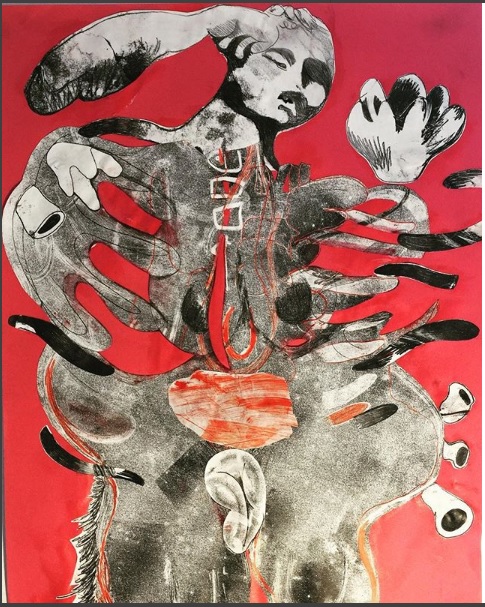
Gill Roth, 'Anatomical Venus'

Make Believe runs from Saturday 1st September to Sunday 9th September 2018 (Opening Times: Weds – Sun, 12 – 6pm), with the Private view on  Friday 31st August. 6 – 9pm. Lewisham Arthouse is on Lewisham Way, SE14 6PD. Full details here: http://www.lewishamarthouse.org.uk/project-space/make-believe/

instagram: @rothgill @clarkesville.art

Sunday, April 15, 2018

Skehans in London 'Cool List'

Slightly surprized, to say the least, to see my local featured in the Evening Standard magazine 'Cool List' of  'what's hot in the capital now' (11 April 2018). Skehans - once known as McConnells and before that the Duke of Albany - is on the corner of Kitto Road and Gellatly Road, SE14.


According to journalist Frankie McCoy, if you want a BNO (Big Night Out) you start by 'hitting Nunhead (go down to Peckham, then keep going down) for pints at Skehans, the old Irish pub now rammed with Central Saint Martins students before heading to disused pub The Rising Sun, home of a bunch of Goldsmiths students who make music, play music and throw some pretty wild parties'.
 
Don't worry folks, the pub hasn't changed - it's the same old Irish pub with Thai restaurant in the garden and sport on TV as before, but it has got a bit busier recently, which is generally a good thing because there was a time a few years ago when there would be just one or two people in the bar and I worried about whether it could survive.


But I think anybody following the Standard's tip and travelling across town might be a little  underwhelmed  unless they've never seen a pub before and I doubt they would pick up an invitation to a private house party down the road. Also not everybody under 25 in the pub went to Saint Martins... some went to Goldsmiths or Camberwell!


Also while near to Nunhead station, and close to the Nunhead/New Cross border at the edge of Telegraph Hill, the pub is in SE14 and the blue binned borough of Lewisham and I don't think most people would say it was in Nunhead.


Still  the pub does have a historic connection to Nunhead, and its Roman Catholic church of St Thomas the Apostle. The church was damaged by a bomb during the Second World War and 'For a time Masses were held in a room above the bar in the public house in Kitto Road' (see church history)


Monday, January 01, 2018

Music Monday: A View from a Hill - sounds from Telegraph Hill, Point Hill, Catford, Dulwich and beyond


Hither Green-based experimental/improvisational label Linear Obsessional Recordings has released its annual compilation album. 'A View from a Hill', released on Christmas Eve 2017, includes more than 100 artists from across the world each contributing two minute tracks. It was compiled by David Little, who records as smallhaus. Several of the tracks feature field recordings at South London locations, including the following:


Catford Gyrations - Bandstand
'The track was based around a recording I made while stood under the bandstand in Mountsfield Park, London SE6 – this also happens situated directly under a flight path, but despite the roaring jet planes, I still managed to capture some birdsong and barking dogs.I've also added some guitar, a Farfisa organ and a little bit of brass and Woodwind'


Alison Henning - A View from Point Hill
'Beautiful morning, rise and fall of piccolo sounds inspired by the A2, flight paths, Greenwich below and the early birds'.


Neil Gordon-Orr - Boney on the Hill
'Sound recording December 2017: Telegraph Hill Park, formerly Plow'd Garlick Hill, site of Telegraph during Napoleonic Wars; list of stations on the Admiralty shutter telegraph line (1795–1816), used to send messages between the Channel (Deal) and London; treated mandolin, 'Boney was a Warrior'


Z.AvTes – Le Scelte
'Written by Zuleika AvTes in London, December 2017. Original field recordings: Recorded at West Norwood Cemetery and Dulwich Park. Z.AvTes plays in Glass Isle and lives in South East London'.


Thursday, February 25, 2016

Telegraph Hill Festival 2016

It's the 22nd annual  Telegraph Hill Festival next month, with more than 120 events taking place from 5 – 20 March 2016 at various venues in the New Cross/Brockley border zone.  You can check out the full programme here, but for now here's a few of the events that caught my ere.


'Painting & Sound Improvised Performance – audio - visual action - interaction. First meeting of reknowned painter and performer Pauline Amos and English experimental improvising musicians Mark Browne and Richard Sanderson.

PAULINE AMOS - (painting and sounds) Pauline Amos is an internationally renowned artist. She has collaborated with William Orbit, Poppy Jackson and dancer Anna-mi Fredriksson amongst others. She says of her work: “The paintings are documents and a recording of an event that happened - the action, the performance, the life, the improvised and impulsive moment is the work.” Her work is dramatic, her subjects: the female body, feminism, war, global politics, the environment, women, sex and relationships – the human condition.  She has featured on YouTube and bill boards around the UK using her naked painted body to promote democracy.

British improvising musicians Mark Browne (saxophones and collected objects and Richard Sanderson (amplified melodeon and small instruments) have been playing together off and on for some 20 years, including in the quartet Fraction and the trio Browne/Thompson/Sanderson - creating instant and constantly changing music from instruments, objects and debris described as probing, adventurous, and uniquely textured exploration, haunting and fascinating. Together with Amos they will craft a totally immersive show.

This unique collaboration is presented as part of the Telegraph Hill Festival. The evening will include a discussion with Pauline Amos of her work. Admission £5 on the door.
Photos at The Hill Station Cafe


At the Montague Arms on Saturday 19 March, band My Midlife Crisis will be backing various singers having a go at songs from the golden age of punk. As they didn't have any Crass songs on the list, I have gone for 'Boys don't cry'.


Prefab Walking Tour -  Saturday 12 March 12 noon-1.00pm 'Meet at Brockley Station exit, Mantle Road Free but donation to museum funds gratefully received This moderate walk visits post war prefab locations past and present, derelict and inhabited. Finishing at the Ivy House, London’s first community-owned pub. Booking essential, email elisabethblanchet@hotmail.com'

Saint Patrick’s Day (17 March) 8.00pm-11.00pm Skehan’s, Kitto Road (Free) 'Skehans is proud to invite you along for bowl of our delicious Irish Stew with soda bread (while stocks last and daytime only). From 9pm The Clarkes will rock the joint in their customary style'

Friday, May 15, 2015

Folk on the Hill

Tonight - Friday 15th May at the Hill Station Cafe (Kitto Road, SE14) presents 'Folk on the Hill', with live music from Byron Biroli, Harry Dickson and Pigeon Heroes. Entry is free/donation, food and drink available.

Here's Pigeon Heroes in the Goldsmiths Music Studio, New Cross Road:

Monday, August 18, 2014

Divided by Race, United in War and Peace

On Friday 19th September (7:30 pm) there's a screening of ‘Divided by Race, United in War and Peace’ at St Catherine’s Church, Pepys Road, Telegraph Hill, SE14 5TY. Tickets are £5 / £3 (including snacks) and can be booked at www.thc.ticketsource.co.uk

'Divided by Race, United in War and Peace is a warm and life-affirming film, directed by Marc Wadsworth.   The film examines race relations in Britain during and after the Second World War and is a timely reminder of the contribution by overseas troops to the war effort.   Telegraph Hill Ward Community Weekend runs from Sept 19-21 and the film will be screened at St Catherine’s Church, Pepys Road, SE14 5TY as part of the weekend of events. At the core of Divided by Race, United in War and Peace are the testimonies of 13 surviving veterans, West Indian and African young men and women who volunteered to join the war effort and soon afterwards returned to live in Britain.   They risked their lives to serve under the British flag in times of war, then faced a second battle – their right to remain under that flag, as British citizens.   Until now their stories have not been properly heard'.


Friday, February 07, 2014

Deptford from Telegraph Hill in 1815

This illustration is entitled 'view of Deptford from Plow Garlic Hill, Brockley, AD 1815'. It is reproduced from 'The History of Deptford' by Nathan Dews, published in 1884. One thing that is unclear is whether this is a reproduction of an illustration from 1815, or an engraving done in the 1880s by someone imagining what the view would have looked like 70 years earlier (none of the illustrations in the book are credited or dated).

'Plow Garlic Hill' is what is now known as Telegraph Hill- and indeed by 1885 was already so-named, though probably both names co-existed for some time. Telegraph Hill Park was opened in 1895, and the semaphore station that had given its name was there from the late 1790s until 1816. The earlier named 'Plow Garlick Hill' does appear on John Cary's 1786 map of this part of London. Well for those who argue whether any of Telegraph Hill can be claimed for Brockley rather than New Cross, this illustration seems to be in their favour (I would say more of it is in SE14 but would concede that some of the lower southern slopes are in SE4!).

Not sure that the illustration is entirely accurate in terms of scale and perspective. St Pauls and St Nicholas churches in Deptford look bigger than I think they would appear to the naked eye. There's only one building shown on the hill amidst the fields and farm animals. This is not fanciful, an 1839 image of the area presents a similar rural picture.


Friday, January 10, 2014

Crisis Bring and Buy Book Sale SE14

There's a Bring and Buy Book Sale tomorrow (Saturday January 11th) in aid of homeless charity Crisis, at the Telegraph Hill Centre Lounge, Kitto Road SE14 - adjoining St Catherine's Church. The sale runs from 12 noon to 4pm, with prices from 20p (paperbacks mostly five for a £1) to £2 (hardbacks 50p to £2) or maybe a bit more for something really special. You can also bring donations on the day of the sale if you are worried about where you are going to put all those books you buy!

I know there's some really good books, because I've donated loads. It's been painful, but I've just run out of room for more books. I ended up running out of space to hang up clothes as I'd started accumulating piles of books in the wardrobe too. So I've decided to pass on some classics that I hope will find a good home, to make room for some new ones. Here's a few samples....

O'Neill's Music of Ireland - the classic collection of fiddle tunes,
I bought for my mandolin playing from Hobgoblin shop when it used to be in Cecil Sharp House, and I
was learning to play at the Working Men's College in Camden. I have far more tunes now than I am ever likely
to have time to learn.

'Reading Capital Politically' by Harry Cleaver - influential autonomist reading of Marx. In the early 1990s I went out for a meal with Cleaver in Brixton  (and a few others including Massimo de Angelis).  It was at the Satay Gallery, when it was in Vining Street where Fujiyama later opened. Nice food, good politics - but there's a pdf on libcom so I feel I can put it back into the stream.

'The White Goddess' by Robert Graves - never read this from cover to cover,
but great to dip into for its idiosyncratic take on mythology and poetry.
See books have histories and associations as material objects - where they came from, which rooms they furnished, who handled them - which digital documents lack. Now I've revisited all the memories attached to just these three examples, I know that I am at risk of buying back the books I donated. I must stay strong!