Showing posts with label racism. Show all posts

Sunday, March 30, 2025

Bobby Seale of the Black Panthers in Brixton (1992) - as reported by undercover police

Bobby Seale was one of the founders of the Black Panther Party in the USA and like many of its activists bore the brunt of repression from the American state. Infamously in the 1969 trial of the 'Chicago 8' Vietnam war protestors he was ordered by the judge to be bound and gagged to prevent him speaking.

In 1992 Seale came to London and spoke at a huge meeting to a mainly black crowd at Brixton Recreation Centre and I was one of the many who attended. I believe it was organised by Panther UK, a black organisation with links to Militant (later the Socialist Party)

This was a time when 1960s black radicalism was being rediscovered by a new generation. Public Enemy had adopted the Panther aesthetic and indeed recorded a track that name checked Seale (Party for your Right to Fight). They played a number of iconic gigs at Brixton Academy and I saw them there myself in 1993.  The Nation of Islam was also having a revival, I remember guys in suits and bow ties selling their paper The Final Call by Red Records in Brixton.

Not going to lie, this was a period of inspiring anti-racist mobilisation but also intense pressure (racist murders, heavy policing, political egos) which manifested itself in exhausting bad tempered arguments and splits. I recall that 'Panther UK' itself broke up into different factions, and I think Seale himself may have walked off at some point in the meeting due to the politicking. But the Brixton meeting was remarkable and certainly one of the biggest events of this kind I had ever attended. The hall was packed to capacity with many more being turned away.

As reported by Julian Kossoff in  the Independent (5 October 1992):

'The black beret and the leather jacket have given way to a woolly jumper, jeans and sensible shoes. Bobby Seale, the co-founder of the Black Panthers whose clenched-fist salute became a symbol of the late 1960s, is now 56 years old and a teacher, the pistol that once hung from his waist replaced by a paunch. But even so, a 2,000-strong audience crowded into the Brixton Recreational Centre in south London at the weekend to hear his message of black power.

The passion and anger of the Panthers endures. Mr Seale, invited to speak by a newly-formed group of black and Asian people, Panther UK, can still preach the evangelical message of black socialist unity. Stalking the platform, he expounded the movement's 'race-class line', emphasising that different peoples - black, brown and white - had similar experiences of oppression and should unite against their common oppressor, the exploitative capitalist system. 'Don't you get the connection?' he asked repeatedly. The ideology had not changed substantially since the new left hailed the Panthers as the first genuine American revolutionaries since 1776 and Herbert Hoover, the FBI chief, called them 'the number one threat to the internal security of the nation'.

When he remembered the past he preferred to recall when the Panthers had stopped snarling. Armed defence, the controversial concept that all black people have the right to bear weapons to defend themselves from the racist state, was outdated, he argued. 'We don't need guns in the USA, at the moment . . . co-operation, humanism and grass roots organisations is where it's at.'

But Kossoff wasn't the only one present filing a report. From the Undercover Policing Inquiry we can now see a report written by an undercover cop infiltrating radical groups at the time. Spycop HN78 (who went under the name of Anthony 'Bobby' Lewis) reported that 2100 had attended with 500 turned away and that Seale has held:

 'the more or less undivided attention of the audience for fifty minutes. He spoke of the reason for forming the Black Panther Party for Self Defence (BPPSD) back in the mid sixties, of its criminalization by the capitalist media and in particular of its infiltration and destruction by the FBI. He made it clear that the battle he had fought then bore little resemblance to that being fought in the USA today. The current right of activists to demonstrate peacefully had been won for the present generation by the BPP  amongst others, back in the sixties. Law books rather than guns must be their chosen weapon.

SEALE went on to stress that the BPP was a disciplined, community based movement, enthused in the belief that only self defence was permissible if black people were prevented from peacefully marching to obtain their civil rights. However,  should circumstances change and perhaps reflect those pertaining in South Africa at the present time, then he would again advocate the use of weapons. He spoke next of the part progressive whites had to play, reminding the audience of the international nature of the struggle against injustice and that racism from whatever quarter was not to be tolerated. He concluded with the words paraphrased from the title of his book published over twenty years ago 'Seize the time'' .

On a more sinister note the report went on to note the ' impassioned pleas for justice' of  speakers from contemporary campaigns including Clara Buckley of the Orville Blackwood Community Campaign and Nellie Fergus of the Ivan Fergus Campaign as well as 'George Silcott who asked people to sign the petition on behalf of his brother which was to be handed in to the Home Office during the forthcoming picket of that establishment on the 21st October'.

It is now well established that undercover police spied on family justice campaigns who posed no threat other than exposing Metropolitan police wrong doing.  Nellie Fergus was just a Peckham mum campaigning to prove the innocence of her teenage son who had been convicted of attacking somebody with very questionable evidence; Orville Blackwood was a black man who died in Broadmoor Hospital; Winston Silcott was one of the Tottenham 3 convicted of killing a policeman in the 1985 Broadwater Farm uprising, for which his conviction was ultimately quashed.


See also:


Thursday, August 08, 2024

Lewisham Stands Against Racism, again

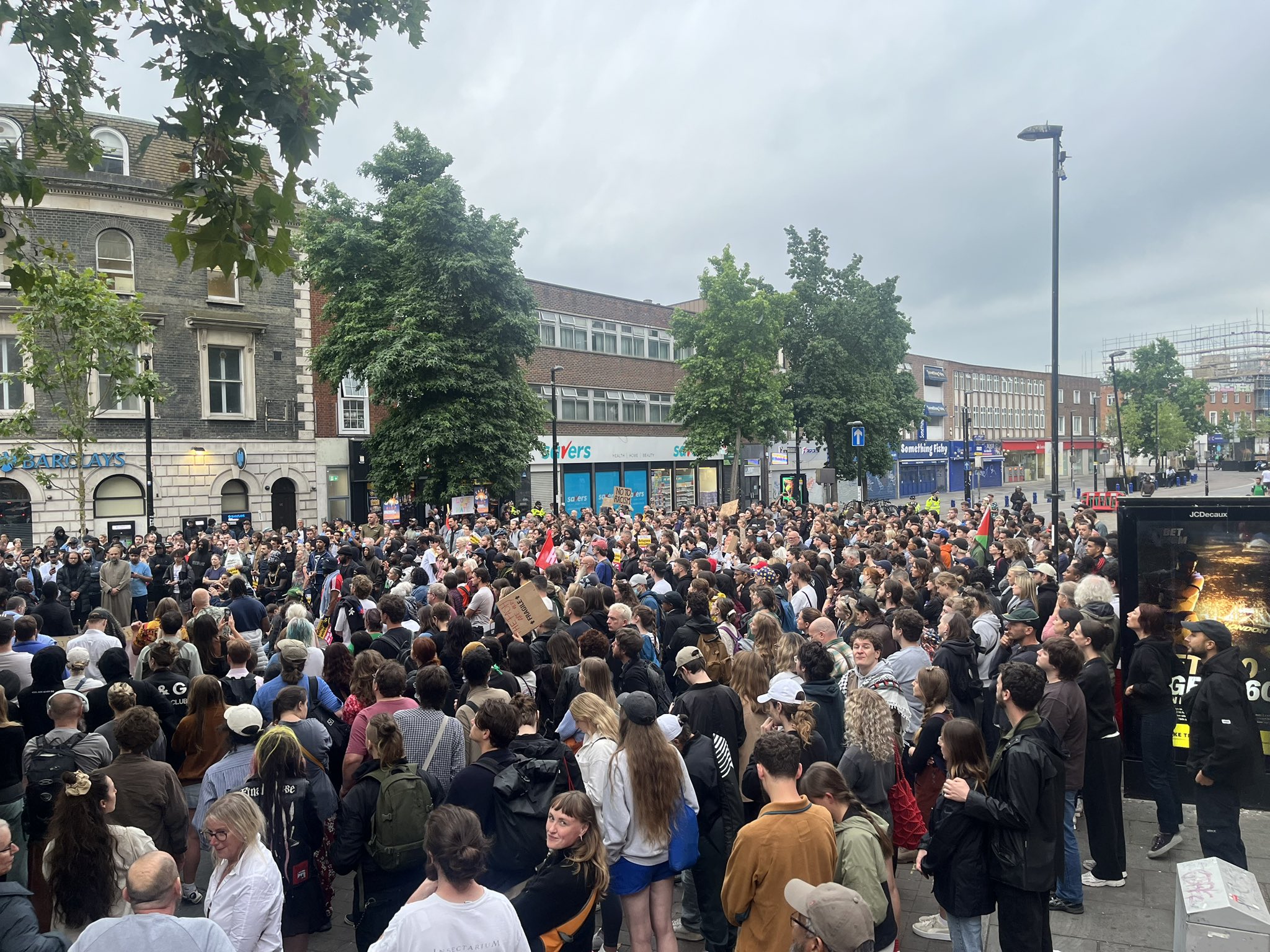
A great turn out at Lewisham clock tower last night for anti-racist rally, part of a big movement of similar actions across the country in response to threats of more far right attacks on mosques and asylum seeker accommodation. After a week of seeing racist mobs on the rampage, including fires starting at a couple of hotels, it it was a great relief to see such large numbers on the streets to oppose them.


In Lewisham there were about 500 people, with banners from Lewisham Trades Council and Stand up to Racism, who called the event. Despite untrue rumours spreading earlier in the day of riots in Lewisham, it was pretty calm with no sign of any far right presence other than a couple of guys spotted wandering around earlier in the day.

Speeches in Lewisham including Stand Up to Racism, local trade unions, Lewisham Islamic Centre etc. One thing that struck me was how often people referred to the local history of racism and anti-racism. Mentions of Lewisham 1977, when the National Front were defeated in street battles, always get a cheer, but there were also references to the movements around the New Cross Fire and the Stephen Lawrence murder. There is a lot of memory and experience in SE London to mobilise, as well as the fresh outrage of a new generation of anti-fascists.


The far right haven't got away and there are challenges ahead, but perhaps a sense that momentum has switched away from them for now.

(I posted a clip of Harold Wilson of Stand Up to Racism speaking on twitter/insta, saying 'If you want to see a migrant go to Lewisham Hospital, we are the ones that are doing the graft'. It went semi-viral getting more than 50k views, which also meant it got some unwanted attention with racists from across the world having something to say about the state of Lewisham of which they know nothing). 

See also some other posts on racism, fascism and anti-fascism in South London:

Pro-fascist Tory MPs in 1930s Lewisham

Fighting Fascists in Deptford 1933

'Jews in Lewisham Fight': a 1936 punch up with Hitler fans

Fighting Fascists in Peckham 1937

Southwark Spain Shop, Walworth Road 1937

A racist riot in Deptford 1949


Defending Drag - opposing the far right in Honor Oak, 2023


Tuesday, August 06, 2024

A racist riot in Deptford, 1949

 In July 1949, there was a racist riot in Deptford. A large crowd of white men attempted to storm Carrington House, a London County Council lodging house in Brookmill Road where a group of around 40 black men from Africa and the Caribbean were staying. What seems to have started out as a clash in the high street was followed by hundreds of white men attempting to force their way into the hostel.   Those under attack barricaded themselves in and defended themselves and when the police intervened some of them were arrested as well as their assailants. After two nights of clashes, a third night drew a crowd of 1500 outside the hostel but the night passed off peacefully. 

'Crowd of 800 tried to get at negroes'


The men from Africa and the Caribbean had faced racism including colour bars in local pubs, and there were later suggestions that one motive for the violence was that some of them 'had befriended white girls'.  As usual in such cases the attackers justified their violence on the grounds of defending women and children from an imaginary threat.  Many of the actual women seem to have had different ideas.  Mrs Lilian Carrigan of Kings Grove, Peckham wrote to the local paper that 'The coloured boys of Carrington House, Deptford, don't get a fair deal... There are quite a lot of snobbish people about here who still feel themselves above the level of coloured people, and the colour bar in Peckham is very strong'. Another woman living opposite Carrington House told the South London Observer: 'They're persecuted. You'll find plenty of sympathisers for them round here'.

As is often the case with such outbreaks of racist violence there were predictions of ongoing race war which did not materialise. The very language of 'race riot' is misleading as it can imply an equivalence - two groups fighting like two rival football firms, rather than people from a dominant group violently harrassing minorities. 

Outbreaks of collective racist violence - what some have termed 'whiteness riots' - have periodically occurred in South London as elsewhere reflecting a deep current of racist hostility to 'others' within British popular culture. But there are other counterveiling tendencies at work including the presence of decent people who develop friendships and other social relations with people different from them and don't go along with the racist mood. Organised opposition to racism and fascism has also been important. In this instance Les Stannard of Deptford Communist Party was quick off the mark to argue that 'Incidents of this kind are the result of official policy and the Fascist mentality of some undesirable elements in the borough'.

 Following the events a conference to discuss the situation was held at Goldsmiths College with the involvement of Deptford Trades Council, Deptford Council of Christian Churches and the National Council of Civil Liberties. The 'colour bar' was denounced and there were speeches from Carrington House residents including Alghali Sillah, a lorry driver from Freetown, Sierra Leone who asked 'why he and his friends were shunned by white people living in Deptford. In particular he criticised the local police and said "They arrest the coloured boy and let the white man go"'.

Another Carrington House resident mentioned in the reports was a 'young West Indian Clinton Pius' who is credited with halting 'race war' by encouraging people to stay inside. As the 40 residents were outnumbered by 1500 people outside plus a hostile police force it seems extraordinary that they should be seen as the threat to peace.


'Coloured man asks: why am I shunned?'


(note on sources - most of these are from the local press,  I found copies of some in Lewisham archives a few years ago where they were in a file on racism. In some cases the date was written on the cuttings but not the source - I assume they would be from South London Press/Kentish Mercury/South London Observer)

Monday, October 18, 2021

An Anti-Slavery Speech in Deptford, 1830

In November 1830 one B.C. Challis gave a lecture that was published shortly after as 'The Substance of a Speech on Negro Slavery. Delivered at the Rev. Mr. Barker's Chapel, High Street, Deptford, on Tuesday Evening, 2nd November, 1830'. The whole text is available to read online and while some of the language is archaic, it is a passionately argued case for the abolition of slavery.

Modern historians of slavery are quite rightly critical of a narrative of British 'white saviours' leading the abolitionist fight, and there is scepticism about the motives of some who may have been concerned for instance with wider colonial interests (such as undermining the French in the Caribbean who were arguably more dependent on the slave trade continuing).

It is important to recognise that slaves themselves continually resisted slavery and in this sense were a key driving force in its abolition.  There is an echo of this within this speech, with a reference to the successful slave revolution in Haiti (described as Saint Domingo here): 'Who can for a moment doubt that this great island, under the dominion of a free negro population, situate in the very centre of the West Indies, and contiguous to the large and populous islands of Cuba and Jamaica on the one side, and Porto Rico on the other; who I ask, can doubt that the government of that island, will take every occasion to stir up the surrounding slaves to insurrection?'. The author uses this threat to argue that the abolition of slavery is actually in the interests of the 'white inhabitants' as the alternative is that 'the lives and immense property of the colonists be thus exposed to destruction'.

Some of the specific proposals put forward here seem rather feeble now, such as the suggestion of gradually abolishing slavery by starting with young women (whose children would then be born free).

Nevertheless it is also important to acknowledge that rank and file slavery abolitionists were putting forward what was, in the context of the growing British Empire, a principled and radical assertion of equality and opposition to racism. 

Of course there is criticism of how slaves are treated:  'And, now then ye degraders of humanity ! -the best of your slaves are allowed but one pint of corn meal for their day's allowance, which is no more, and no better, than that which every gentleman's sporting dog has in England. They are flogged - abused and mutilated, whether feeble, decrepid, or lame, - spurred on to a laborious task, in a sultry climate, without encouragement or reward'. 

But more than this there is a recognition that slaves are people with the same rights to liberty as anybody else: ' although the system of negro slavery demands all the force of intellect in its defence, yet it requires only a sense of justice , an universal sentiment of execration, and a determined intention to do unto others , "as we would they should do unto us ”.  It requires I say, only the belief and practice of that one golden precept of our holy religion, to induce us, at once, to hate, to despise, and to abolish it [...] I am sure you must all feel such a just sense of horror at the thraldom, which is entailed upon the black, by his merciless owner, who differs from him only in the colour of his skin, and an anxious desire of breaking their bonds?'. 

At the end of this meeting in Deptford, 'Several resolutions were then read and carried, and a Petition praying the Total Extinction of Colonial Slavery adopted'. Those involved obviously wanted to disseminate the message further as they took the trouble to print it. We are told that it was available in Deptford 'sold by Warcup, Broadway; Ellis, Lower Road' and W. Brown, printer, High Street; also by J. Cole, London Street, Greenwich'.


Barker's Chapel in Deptford High Street, 1839 - I believe location was approximately where the Poundland shop now stands, next to the former Mechanics Arms (now Tomi's Kitchen restaurant). The 
(picture from British Library). The building was replaced by a substantial Congregational Church in the 1860s.

1850 sketch showing the chapel next to pub and railway line


Saturday, April 10, 2021

Fenton Ogbogbo- murdered by racists in the Old Kent Road, 1981

Fenton Ogbogbo was a 25 year old man who was murdered in a racist attack on the  Old Kent Road in June 1981.

 Three white youths aged 15 to 17 from the Peckham area were jailed at 'Her Majesty’s pleasure' in  a trial at the Old Bailey in the following year.  The court heard that on 21 June 1981 after an incident in a pub on the Old Kent Road, 'Other white youths were recruited and they went after him. But Mr  Ogbogbo of Nunhead Grove, Peckham,  was rescued by young whites he had been playing pool with' in the pub. A few minutes later the three murderers 'who had described the rescuers as “n* lovers”, caught Mr Ogbogbo alone in a fish shop' and stabbed him  repeatedly (Times 23 February 1982). Fenton has been watching a  boxing match on TV in the Senol Fish Bar in Old Kent Road. He died at Guys Hospital.

Fenton had come to London from Nigeria in 1969 and gone to schools in Peckham before working assembling computers, but he had lost his job and was unemployed.

Bizarrely the police suggested that he may have considered suicide earlier that day having supposedly 'pulled back from jumping from the balcony of a block of flats'. This was denied by his family, and in any event was irrelevant to his brutal racist murder later in the day (Times, 23 June 1981)

His father Isiah Ogbogbo, an electrical engineer, said: 'I have lost a child because of the racial trouble in this country. Why should somebody kill a quiet innocent boy like him? [...] It is these skinheads with their hated of black people. That is why my child died. We have a lot of English people living in Nigeria but we do not kill them'.

The report below mentions that another black man had been stabbed in a racist attack in Peckham in the previous week, and that in the same period there were clashes between the police and black youth in the area:

'The Saturday night of Fenton‘s murder hundreds of black youth, joined by some white youth, had fought for two hours with the police in Peckham Rye. “It looked like they were seeking confrontation with us“ said Superintendent Staplin in charge of the police on the scene. He couldn’t have been more right. Wooden stakes were torn up from fences and used as spears to throw at the police, police vehicles were attacked, and such money grabbers as Currys, Boots and British Home Stores were broken into. The BP petrol station narrowly escaped destruction.…

A few miles from Peckham in Lewisham shopping centre, in just two forays by the police, 20 black youths were picked up on 4 and 5 June. These youths, the youngest of which was 13, were held for hours in Ladywell police station. A pregnant teenager among them was attacked and given a black eye. All were subjected to a constant barrage of racist abuse. When one young girl asked how she was supposed to get home when she was released late at night with no money she was told “you can swing on trees“. She was left as an easy target for the kind of racists who killed Fenton Ogbogbo that the police allowed to roam the streets' (Fight Racism! Fight Imperialism!, July/August 1918 - sourced from the Splits and Fusions archive)


Friday, February 26, 2021

Harold Moody & W.E.B. Du Bois - Queens Road SE15 as international anti-racist clearing house

A blue plaque at 164 Queens Road, Peckham, commemorates its status as the one time home of Dr Harold Moody (1882-1947). Moody moved from Jamaica to London to become a doctor, and established his first GP practice at 111 King’s Road (now King’s Grove), Peckham, in 1913. In 1922 he moved to nearby 164 Queens Road, where he lived and worked until his death in 1947.


 An information board outside the house includes further details of his life, including his work as an anti-racist campaigner. Moody founded the League of Coloured Peoples in 1931 to  oppose discrimination. They published a journal, The Keys, and organised social events as well as campaigning against the 'colour bar' in the workplace, the military, housing and elsewhere. Its 1944 'Charter for Coloured Peoples' demanded that: 'The same economic, educational, legal and political rights shall be enjoyed by all persons, male and female, whatever their colour. All discrimination in employment, in places of public entertainment and refreshment, or in other public places, shall be illegal and shall be punished'.


While the main focus of the League was on discrimination in Britain, it also aimed to promote the 'Welfare of Coloured Peoples in all parts of the World' and maintained contact with similar organisations internationally such as the National Association for the Advancement of Colored People in the USA.  According to historian Stephen Bourne 'In the 1920s and 1930s, Dr Moody’s home on Queens Road became a popular meeting place for famous Black people who visited London. They included the American singer and activist Paul Robeson; the Trinidadian historian and novelist C.L.R. James; Kwame Nkrumah, who later became president of Ghana; Jomo Kenyatta, who later became the founding president of the Republic of Kenya; and the popular cricketer Learie Constantine, also from Trinidad' (The Life of Dr Harold Moody).We know too that Moody met Kenyan independence leader Jomo Kenyatta at Sylvia Pankhurst's house in Woodford Green. The League's Una Marson - a sometime lodger at Queens Road and editor of The Keys - met Haile Selassie when he arrived at Waterloo station in 1936 on a visit to rally support following the Italian fascist invasion of Abyssinia/Ethiopia.

The League's international signficance is attested to in some of the Harold Moody material available in the online W.E.B. Du Bois archive hosted by the University of Massachusetts at Amherst. Du Bois was a founder of the NAACP and the pre-eminent American Black intellectual of his time. His correspondence with and about Moody largely concerned plans for a Pan African Congress to be held in Britain at the end of World War Two. The Congress went ahead in Manchester in 1945 bringing together opponents of British colonial rule and campaigners against racism in the USA and elsewhere. Moody did not personally attend, but does seem to have been involved in formulating and developing the idea. 

In April 1944, Du Bois  wrote to singer and actor Paul Robeson seeking his support, stating ''I have had within the last month two interesting communications. One was from Amy Jacques Garvey, widow of the late Marcus Garvey living in Jamaica; the other was a telegram for Dr Harold Moody from London. Dr Moody as perhaps you know is a black West Indian, long resident in London and recently elected Chairman of the old and celebrated London Missionary Society. Both these communications asked for my cooperation looking toward a post-war conference to consider needs and demands of Negroes'. In the same month Du Bois wrote to Moody in Peckham about plans for the Congress:


A Letter from Moody to Du Bois (July 27 1944) signs off ''We are successfully negotiating the flying bombs on this side, although they do cause some inconvenience'. In November 1944, Moody was to be one of the first doctors on site of the V2 explosion in New Cross Road, when a German rocket hit Woolworths killing 168 people.


There is a also a letter from Amy Jacques Garvey to W. E. B. Du Bois  (January 31, 1944) in which the widow of Marcus Garvey recommends Moody to Du Bois and provides his address. This is a remarkable letter in many ways - Marcus Garvey and Du Bois did not get on, but Amy Garvey saw the bigger picture: 'Why should I above all people, write to you as I do? Because personal feelings must be forgotten in the unity of effort that is being forged for Africa, and our people...  My people you are no longer Negro rings to strengthen the fingers of your exploiters; you are no longer Negro studs to cover the sinful breasts of alien persecutors. you are precious African links of a mighty chain'.


164 Queens Road was not the only house on a south London residential street that functioned as a significant international anti racist/anti-colonial clearing house. Listening recently to an  interview with Leila Hassan Howe (on the Surviving Society podcast), she recalled how the Race Today collective HQ (at 165 Railton Road SE24) performed a similar function in the 1970s and 1980s. C.L.R. James was living upstairs, and people like the Grenadian revolutionary Maurice Bishop and Walter Rodney from Guyana would pop by for a chat.  Of course C.L.R. James is the common thread as he is of much of 20th century radical history in Britain, the Caribbean, African and the United States - he also knew Moody and wrote an article in 1936 for The Keys about “Abyssinia and the Imperialists”. 

Wednesday, September 09, 2020

Hither Green 1988: a strike against the far right

I guess everyone knows about the 1977 anti-fascist Battle of Lewisham, less remembered is the 1988 fight by a group of  workers against the employment of a far right activist in a local unemployment benefits office. Malcolm Skeggs had been a long term leading activist in the racist National Front (including standing for them as an election candidate) and then in the British National Party. After apparently being sacked from a job in Lewisham Council, he got a job at the Hither Green office of the Department of Health and Social Security. When workers there got wind of this they raised objections about somebody with his views working there and having access to claimants' personal records. They were threatened with disciplinary action for refusing to work alongside him.

In April 1988, members of the Civil and Public Servants Association (CPSA) at Hither Green walked out on indefinite strike. There were daily pickets of the office, and a 1,000 strong demonstration in support of the strike in May. A regional day of action called by the union saw 20,000 CPSA members go on strike at DHSS offices and job centres across the London area on 26 May 1988. The strike came to an end in June after DHSS management moved Skeggs from Hither Green to a staff training centre at Hinchley Wood in Surrey.

Here's a few contemporary reports found via Sparrows Nest archive and Marxists Internet Archive:


Monday, July 27, 2020

Black Lives Matter - Croydon

Some more Black Lives Matter-themed graffiti/street art, this time from the skatepark in Wandle Park in Croydon.


'Stop killin' the mandem'


the River Wandle (more of a stream at this stage) in Wandle Park

Croydon has seen a number of Black Lives Matter protests in recent weeks, including this one at Park Hill on 13 June:

photo by @jamieaudsley
See previously:


More local Black History:


Saturday, July 25, 2020

Black Lives Matter in South London- 2 months on

Two months after the police killing of George Floyd in  Minneapolis on May 25th, the global wave of  Black Lives Matters protests continues to make an impact around the world. This is a quick overview of the last eight weeks in South London, where the current phase of the Black Lives Matter movement in the UK started in Peckham on 30 May 2020 with hundreds of people marching across the Common and down Rye Lane.

Peckham Rye, 30 May 2020 (photo by @katyG_LSL)
Probably the largest demonstration so far took place a week later on Sunday 7 June, with a huge crowd gathering by the American Embassy in Battersea before crossing over Vauxhall Bridge and marching on to Whitehall. It was one of the biggest demonstrations seen in London in recent years, perhaps in the region of 50,000 or more.  On the way there I saw streams of people walking towards it from different parts of London due to the limited Covid 19 public transport. 

Vauxhall Bridge, 7 June 2020
A feature of the protests has been the wearing of face masks and the predominance of home made cardboard placards, well everybody seems to have a cardboard box to hand in these days of endless deliveries due to shop closures. But there were some banners to be seen, and I was pleased to see a proud Millwall anti-fascists banner at Vauxhall.

Millwall anti-fascists, Vauxhall Bridge

It seems that most local parks and public spaces have had some kind of Black Lives Matter gathering, usually 100-200 people taking the knee - a sign of the reach of the movement beyond the usual places where protest happens. I mean it's not every day (or decade for the that matter) that there is a protest in Hilly Fields or Telegraph Hill Park.

Lewisham Police Station, 3 June 2020 (photo by Mark Thompson)

Hilly Fields, 13 June 2020
(photo by Melissa Jacques full report at EastLondonLines)

Burgess Park, 14 June 2020

Ladywell Fields, 27 June (photo from SUTR)

Telegraph Hill Park, 4 July 2020 (photo from @avocadamn)

Protests have also taken place in Mountsfield Park (Catford) and outside the Deptford Lounge, among other places.

Firefighters take the knee at Lewisham Fire Station (photo from @itslukecharles, 3 June 2020)
Black Lives Matters signs can be seen in many local houses, following the recent trend for NHS rainbow window signs. Here's a few examples from around SE14.


There's also some BLM/anti-racist street art and graffiti. 

'Black Lives Matter', Waldram Park Road, Forest Hill

'Fight racism, build unity' - Thames path, Greenwich peninsula

'Racists still not welcome' - Thames path, Greenwich peninsula
What will happen next remains to be seen, in terms of  public protests all movements have ebbs and flows in their momentum. But away from the streets, this phase has kicked of a widespread questioning in workplaces, homes, sports clubs etc. There is a sense that something has to change and that is not going away. 

See also:


More local Black History:


Monday, June 22, 2020

Deptford Colour Bar 1958

Today is Windrush day, commemorating the arrival of Jamaican migrants in Britain on the Empire Windrush on this day in 1948 and the wider impact of people of Caribbean origin in this country.

The recent plight of some of these migrants in the Windrush scandal has rightly been condemned, but the fact is that generation faced racism from the moment they stepped onto British soil. This shameful, but not untypical example, is from Deptford in 1958. The landlord of The Robin Hood and Little John pub, Peter Sparkes defended his policy of a  'no drinks for coloured people' on the basis that 'My customers just don't like coloured people'. Condemning this 'pub colour bar', Deptford Labour MP Leslie Plummer noted that there were 'several hundred West Indians living in Deptford' (The People,  13 July 1958).

The pub was in Deptford Church Street. It closed in 1970 and was demolished in 1977.

This was not an isolated example - as late as 1965 there were demonstrations outside the Dartmouth Arms in Forest Hill against a similar ban on serving drinks to black people (see previous post on this).


Saturday, June 06, 2020

Black Lives Matter at Telegraph Hill Park

The railings around Telegraph Hill lower park in New Cross - specifically on Erlanger Road and Kitto Road SE14 - currently feature cardboard placards from the latest phase of the Black Lives Matter movement that has exploded worldwide following the police killing of George Floyd in Minneapolis.


It's not just in the USA that people of colour have died at the hands of the state, which is why the movement has gained such global traction. A whole section of the fence in Erlanger Road includes placards each with the name of somebody who has suffered in Britain.


The names include, among others,  South London reggae MC Smiley Culture who died in disputed circumstances in a 2011 police raid and Cherry Groce who was disabled for life after being shot during the 1985 police raid that sparked the Brixton riots of that year. 


Remembered too is Jean Charles de Menezes, the Brazilian electrician shot dead by police at Stockwell station in 2005.


The current wave of protests in Britain really got going last Saturday (May 30th) when hundreds of people marched down Rye Lane and on to Peckham Rye. The movement returns to South London tomorrow, Sunday June 7th, with a planned demonstration at the US Embassy in Battersea from 2 pm.