South East London blogzine - things that are happening, things that happened, things that should never have happened. New Cross, Brockley, Deptford and other beauty spots. EMAIL US: transpontineblog at gmail.com Transpontine: 'on the other (i.e. the south) side of the bridges over the Thames; pertaining to or like the lurid melodrama played in theatres there in the 19th century'.
Friday, May 09, 2014
UKIP's vanishing poster in New Cross
Tuesday, May 21, 2013
Save our Fire Stations
- Lewisham, Wednesday, 22 May 7-9pm at Sydenham School, Dartmouth Road, London SE26 4RD
- Bexley, Bromley and Croydon, Thursday, 23 May 7-9pm at Bromley Central Library, High Street, Bromley BR1 1EX
- Greenwich, Wednesday 29 May 7-9pm at Lecture Theatre 315, King William Building, University of Greenwich, 30 Park Row, Greenwich, London SE10 9LS
So get along and say your piece to try and save New Cross, Downham, Southwark, Woolwich and the other stations under threat.
(h/t to Trinketization for the heads up on this).
Sunday, January 29, 2012
Lewisham Fuel Poverty Protest Report
![]() |
| 'Bring down the Bills! Energy for our needs! Not corporate greed' Banner at Lewisham Town Hall |
Wednesday, December 21, 2011
Roger Moore: South London James Bond
As recalled in his autobiography My Word is My Bond, Moore was born in 1927 at the Maternity Hospital in Jeffreys Road, Clapham. He lived in Aldebert Terrace, then in Albert Square in Stockwell (number 4, then number 14). He went to Hackford Road Elementary (later Durand Primary) and then Vauxhall Central School.
As a teenager he hung out at the Astoria in Brixton and the Locarno ballroom in Streatham, snogging on Streatham Common afterwards. With his first wife Lucy Woodward (also known as Doorn Van Stein) , the daughter of a Streatham cab driver, Moore moved into a room in her family home at 16 Buckleigh Road, Streatham in 1946.
By 1952 Moore had started acting, and was invited to a party in St Mary's Mount, Bexley at the home of Dorothy Squires. At the time Squires was one of the biggest singing stars in the country, and 13 years years Moore's senior. Before long, Moore had divorced Doorn and moved in with Squires (Moore and Squires pictured below). Moore went on to star in the Saint as Simon Templar, then took on the role of James Bond in the 1970s - starting with Live and Let Die in 1973.
By this time Moore had long since moved on from South London. Squires - who he left in 1961 - stayed in Bexley until her mansion burned down in 1974.
Thursday, April 28, 2011
Injuries in Police Car Accidents
In that time, the Metropolitan Police has been in involved in 7,649 collisions in London, which have led to the deaths of 21 civilians. On average there are four accidents a day. Westminster is the worst area for accidents, with Lambeth coming second (see article in Guardian).
The full data set for London boroughs, 2005-10, is also available. I have done a quick analysis for South East London boroughs and the figures break down as follows:
Lambeth – 71 civilian injuries;
Southwark - 57 injuries;
Croydon – 47 injuries, 1 death;
Greenwich - 43 injuries, 2 deaths;
Lewisham - 39 injuries, 1 death;
Bexley - 25 injuries;
Bromley - 25 injuries.
Across those six boroughs that's a total of 307 injured and four killed in the five year period.
Saturday, December 18, 2010
Misfits
Much of it is filmed on the Tavy Bridge Estate in Thamesmead, with the Southmere Lake featuring...

Thursday, November 05, 2009
November the 5th 1888
'Some attempt to keep up Guy Fawkes' Day was made in London; but the original object was completely lost sight of. Such effigies as were carried about were those of persons who have recently made themselves popular or notorious. Amongst a few political "guys" there was a large sprinkling of stuffed figures labelled "Jack the Ripper" or "Leather Apron." Sir Charles Warren also came in for some attention. At Hampstead the usual bonfire was lighted on the heath, in the presence of a crowd of visitors. There was also a procession of masqueraders. The annual carnival of the "bonfire boys" was held at Lewisham amid a good display of coloured lights, but the bonfire was dispensed with. At Eltham Mr. Parnell and other Irish members of Parliament were "guyed."...
Unfortunately some accidents are reported in connection with the celebration. At Swanley a set piece was accidentally ignited, and a youth had one of his hands blown off. At Crayford a young man was discharging a pistol when it burst in his hand and injured it. A rocket was let off at Bexley with the result that it put out the eye of a young lady named Jephson'.
This took place at the time of the Jack the Ripper murders, hence the reference to the subdued celebrations. Interesting reference to the Lewisham 'bonfire boys' carnival would like to know more.
Saturday, February 07, 2009
BNP in Bexley
(h/t 853)
Saturday, January 31, 2009
Kate Bush in Brockley
She actually grew up in a farmhouse in the similarly named Wickham Lane in Welling, where she famously wrote some of her later hit songs while still a child. She went to St. Joseph's Convent Grammar School (later the St Joseph's Campus of Bexley College).
In her late teens, having already been signed by EMI, she moved to Brockley where she lived in the middle flat at no.44 Wickham Road, sandwiched between her two brothers' flats.
In 1977 she fronted the KT Bush Band in local pubs, particularly the Rose of Lee in Lewisham (now Dirty South), as well as the Royal Albert in New Cross Road (later the Paradise Bar, now back to being the Royal Albert). The following year she released her first album, The Kick Inside, with her first single (Wuthering Heights) going to number one. That was the end of her playing down the pub, and in fact after a tour in 1979 she pretty much gave up live gigs altogether apart from the occasional appearance. Later she lived for many years in Court Road, between Mottingham and Eltham.
Thanks to Fred Vermorel for confirming the address; there are some references elsewhere (e.g. on Wikipedia) to Kate Bush living in Tressillian Road in Brockley - I don't think this is right, unless somebody is clear that she lived there as well as Wickham Road - the latter is definitely correct. By the way, I have heard that another well known musician lived in the same flat after Kate Bush, but not sure who - anybody know?
See Also: Kate Bush - The Brockley Demos - yes, she wrote Wuthering Heights in Wickham Road
Tuesday, August 19, 2008
Thamesmead Big Cat?
A Beast of Bexley-type creature is believed to have been spotted in Thamesmead. The sighting happened at around 3am on Saturday morning (August 9) in Goldfinch Road when a man was woken up by something screeching. He looked out of his window and saw a small animal racing along the pathway followed by a larger one.
The man, who did not want to be named, said: "I saw a black animal rolling on the grass between two trees. I thought to myself, 'Bloody hell! That's the biggest moggy I've ever seen', and then thought, 'It must be a dog'. However, its head was cat-like and its tail was very long. It walked to the left to some bushes and I moved the other curtain but couldn't see it."
The sighting was reported to Neil Arnold, the founder of the Kent Big Cat Research group, which studies eyewitness reports of large exotic cats. He believes the creature, which has become known as the Beast of Bexley, is a black leopard. The Beast' has also been seen at Welling, Erith, Bexleyheath, Belvedere, Bromley, Abbey Wood and towards Dartford.
More Transpontine big cat stories
Tuesday, August 05, 2008
William Morris and South London
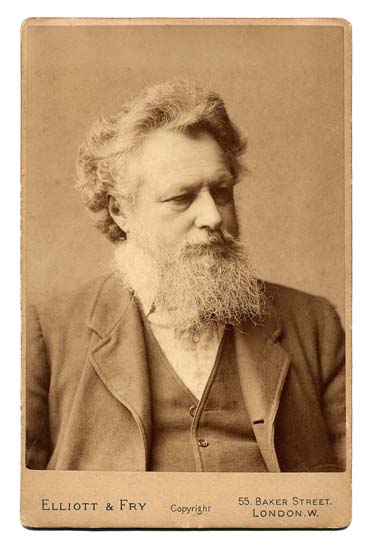
William Morris was an active socialist as well as artist and writer. His well-documented life gives an insight into the extent of socialist and radical movements in South East London during the 1880s and 1890s, as well as artistic and musical scenes. The following extracts from The William Morris Internet Archive : Chronology cover his South London engagements in this period (I have not included his house in Bexleyheath or his workshop in Merton).
22 February 1884: Morris was scheduled to deliver 'Useful Work versus Useless Toil' before the Invicta Club at the Club's rooms in William Street, Woolwich. 9 May 1884 : Morris wrote to Henry Cornelius Donavan declining his request to stand as a candidate for the board of Greenwich Zoo [where was Greenwich Zoo? - sounds like a case for the Phantom]. 8 September 1884 : Morris delivered 'Misery and The Way Out' before the Borough of Southwark Branch of the Social Democratic Federation (SDF) at the Queen's Bench Coffee Rooms, 23 Southwark Bridge Road, London. 25 January 1885 : Morris gave an unnamed lecture to the Woolwich Branch of the SDF in Woolwich. The Daily News printed an article in which it was stated that `Mr. William Morris, the poet of English Socialism - and of other things besides - will issue the first number of his new journal The Commonweal next Wednesday.' 22 February 1885 : Morris was scheduled to deliver 'Useful Work versus Useless Toil' before the Southwark Branch of the Socialist League (SL) at the Forester's Arms, 62 Blackman Street, London. 29 October 1885 : Morris was scheduled to give a lecture at a meeting sponsored by the South London Branch of the Socialist League at the Camberwell Radical Club, Gloucester Road, Peckham. It is unlikely that this lecture was given as he was still suffering from gout. 7 January 1886 : Morris was scheduled to deliver 'How We Live and How We Might Live' at a meeting sponsored by the South London Branch of the Socialist League at the Camberwell Radical Club, Gloucester Road, Peckham. 12 January 1886: Morris delivered 'Socialism' before the Peckham and Dulwich Radical Club at 144 Rye Lane, Peckham. 12 May 1886: Morris was scheduled to give a lecture at a meeting sponsored by the Woolwich Branch of the Socialist League at Woolwich. 9 February 1887 : Morris delivered a lecture before an unnamed 'goody-goody literary society' at a schoolroom on Peckham High Street. The meeting started with prayers and ended with a blessing. Canon Ripley was chairman of the meeting. 31 March 1889 : Morris was scheduled to deliver 'Equality' at a meeting sponsored by the Southwark and Lambeth Branches of the SDF at the Nelson Coffee Tavern, Westminster Bridge Road, London. 4 June 1889 : Morris was scheduled to deliver `Monopoly' at a meeting sponsored by the Northern Radical Club and the Southwark and Lambeth Branches of the SDF at 108 Westminster Bridge Road, London.
7 January 1894 : Arnold Dolmetsch had lunch with Morris and Burne-Jones to discuss the prospect of the Kelmscott Press publishing an edition of early English songs (this project was never completed). Dolmetsch introduced Morris to early instrumental music around this time. He wrote: 'One memorable day, in 1894, Burne-Jones brought Morris to one of my old English performances in Dulwich. He understood this music at once, and his emotion was so strong that he was moved to tears! He had found the lost art! (c.f. 21 September 1896).' 14 January 1894 : Morris lectured on 'Early England' at a meeting held at the South London Art Gallery, Peckham Road, London.
Sunday, June 15, 2008
Pre-Raphaelite South London (1): Elizabeth Siddal
Who is the most famous female face from South London? Most people would probably answer Kate Moss, but there is another contender whose face has been seen by millions staring out from paintings and their poster and postcard reproductions.
Elizabeth Siddal (1829 -1862) was the model for many of the most famous Pre-Raphaelite paintings. Millais painted her as Ophelia (above), for which she had to lay in a bath of cold water while he painted. Her lover (and eventually) husband Dante Gabriel Rossetti painted her many times, perhaps most notably after her death in Beata Beatrix (below).
Siddal was born in Holborn but lived in South London from an early age, at Upper Ground in Lambeth and then 8 Kent Place (this no longer exists, but was on the Old Kent Road, close to the present day flyover). Her father ran an ironmonger's business from their home at the latter address. Siddal recalled that one of her family's landlords was James Greenacre, executed at Newgate, 2nd of May, 1837, for murdering and mutilating a woman. Greenacre was arrested in his lodgings at St Alban's Place, Kennington Road, and convicted of killing Hannah Brown. Her torso had been found in Edgware Road, and later her legs in a ditch in Coldharbour Lane, Camberwell.
Siddal was living in Kent Place and working in a hat shop when she started modelling. She was also a painter and a poet in her own right, and was taken up by John Ruskin who acted as her patron. She visited him at his home in Camberwell (Denmark Hill). Siddal and Rossetti were also regular visitors to the Red House, the home of William Morris in Bexleyheath.
Source: Lizzie Siddal - The Tragedy of a Pre-Raphaelite Supermodel by Lucinda Hawksley.
Saturday, May 24, 2008
Racists in the area
Still overall the vote for the far right was not as big as they had hoped and minute in some areas. Brockley Central has done a detailed analysis of Mayoral election votes in four local wards - Brockley, Ladywell, Telegraph Hill and Crofton Park. The numbers voting for the far right here were very small. In Telegraph Hill ward for instance, the BNP candidate for Mayor only received 47 first preference votes out of 3642 votes cast and it was a similar proportion in the others.
Let's not imagine that there is any chance of the BNP coming to power. The real risks as I see it are (1) that a bigger vote for the far right can increase the confidence of racist thugs and spill over into more racist attacks and (2) that their success shifts the wider political spectrum to the right, with other parties putting in place increasingly more hysterical anti-immigrant policies on the premise that they have to stop people drifting off to vote BNP (see for instance Labour plans to build new detention centre places, including at Yarl's Wood where children and families are locked up). People who want to seriously challenge racism (including its institutional forms) need to consider this this rather than imagine that all racism in London is embodied in the laughable figure of BNP London Assembly member Richard Barnbrook.
Anyway there's a National March Against Fascism and Racism starting in South London next month: 'On Saturday 21st June there will be a national demonstration and carnival parade against fascism and racism in London celebrating the diversity of our society and making it clear that racism and fascist organisations like the BNP will not be tolerated. There will be a march and carnival parade, with floats, marching bands, speakers and banners from every organisation opposed the BNP's racist hate... Saturday 21st June 2008, Assemble: 12 noon, Tooley Street, London SE1(behind Greater London Assembly building, near Tower Bridge, nearest underground station London Bridge).March to Trafalgar Square, W1... Called by Love Music Hate Racism and Unite Against Fascism, supported by trade unions and other organisations'.
Wednesday, May 14, 2008
Woolwich Photos

Sunday, April 27, 2008
Humphrey Lyttelton & Camberwell Jazz
'“When I got out of the army I was 25 and didn’t feel like going back to anything very academic, so I went to Camberwell School of Art for a couple of years and round about the same time started playing jazz in various low dives,” he recalled. “I’m sure there was a buzz in the family going round about me, but I was oblivious, sloping off to places like the Nuthouse on Regent Street with my trumpet and a dirty mac over my uniform.” He soon found the required subjects at the School of Art tiresome and concentrated on the comic drawings that came so naturally to him. But his devotion to the trumpet grew ever stronger. Wearing his army battledress, now dyed navy-blue, and sporting a beard and sandals, he played at jam sessions with professional dance-band musicians and began to travel to the Red Barn, a pub in Bexley in Kent, where the pianist George Webb’s band played every Monday night'.
In March 1947 he joined the George Webb Dixielanders and his professional career as a jazz musician was underway. Also in the Dixielanders was another ex-Camberwell student, Wally Fawkes, with whom Lyttelton formed the first Humphrey Lyttelton Band in 1948. Incidentally another important figure in the post-war trad jazz scene, clarinetist Monty Sunshine, went to Camberwell School of Art too.
(picture shows Lyttelton, right, at the Hammersmith Palais in 1951)
Thursday, April 24, 2008
Deptford Soul City
In autumn 1966 the first specialist soul records shop in Europe opened at no. 21 Deptford High Street, with a speech about freedom by novelist Brigid Brophy. The shop, Soul City, was the brainchild of 'an Esperanto-speaking vegan-anarchist from Bexleyheath, Dave Godin' (see here) and his friends David Nathan and Robert Blackmore.The shop attracted enthusiasts from all over the country in search of soul obscurities, and later in 1967 (apparently after a burglary in the Deptford shop) it moved to Monmouth Street in Covent Garden).
Dave Godin (1936 -2005) was a key figure in promoting soul music in the UK through his shop, record labels and writing in Blues and Soul magazine. Born in Peckham and raised in Lambeth and Bexleyheath, he has been credited with introducing soul music to Mick Jagger at Dartford Grammar School and with coining the term 'northern soul'. As well as the record shop, Soul City was also a record label for a while.

The image above of the Deptford shop is reproduced from 'The In Crowd: The Story of the Northern and Rare Soul Scene' by Mike Ritson and Stuart Russell. The bottome picture shows Trevor Churchill, later of Chiswick and Ace Records (left) and Dave Godin (centre) outside the Deptford shop.
As with all our history material on this site, we'd love to hear more - anybody out there remember the Deptford shop?
Saturday, April 05, 2008
Heathrow Expansion
There is a public meeting happening happening in Blackheath about this, with speaker John Stewart from aircraft noise campaigners HACAN. It takes places on Wednesday 23rd April, 7.30 pm, Recital Room, Blackheath Halls, 23 Lee Rd, SE3 9RQ. In the meantime as my contribution to the campaign to Stop Heathrow Expansion I would like to put forward an alternative vision for Heathrow - the picture below is from London Marches On (1947):
Sunday, March 30, 2008
Big Cats in London
The next South East London Folklore Society event is a talk on Big Cats Around The Capital by
Neil Arnold. Neil is the author of Monster! the A to Z of Zooform Phenomena as well as maintaining Beasts of London, 'a chronicle pertaining to strange creatures and out of place animals in the capital'. The latter was recently selected by Time Out as one of London's top 50 websites.
In other words you must get to The Old King's Head, Kings Head Yard, 45-49, Borough High Street on Thursday April 10 2008 at 8:00pm (see Facebook event).
Monday, January 14, 2008
Boy George and Jeremy Healy
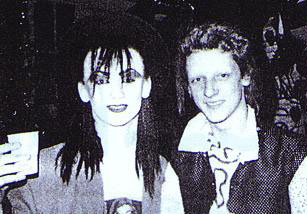
(Boy) George O'Dowd’s parents met at the Duchess of Wellington, Woolwich, where his mum was working as a barmaid, and he was born in 1961 at Barnhurst Hospital, Bexley. His family lived at 29 Joan Crescent, Eltham, and later at the top of Shooters Hill by Oxleas Wood. He went to, and was expelled from, Eltham Green School. He became friends with Jeremy Healy, who lived in Kidbrooke and 'attended St Joseph's Academy in Blackheath where the Christian Brothers called him 'Satan's Imp' after he appeared at school with green hair.
Like many other soon-to-be punks, George was inspired not only by Bowie but what he terms the ‘freaky disco’ end of the soul scene in London. He went to soul nights at Greenwich Town Hall and The Black Prince in Bexleyheath where, in 1976, 'Some of the more full-on types were starting to wear plastic bags and trousers, feather earrings, safety pins on their clothes and in their ears'.
George and Jeremy Healy got jobs at Chingford Fruit Packers on the Woolwich Industrial Estate for three weeks but 'When they refused to let us leave early to see Patti Smith at the Roundhouse we all stormed out'. By the early 1980s Boy George was the world’s favourite cross-dressing pop star with Culture Club while Jeremy Healy had had hit records with Haysi Fantazee. In the 1990s they both became successful DJs – I remember seeing Boy George (who is a big guy) towering above the crowd at Turnmills and Jeremy Healy in a gold skirt on the beach outisde Cafe Mambo in Ibiza. The latter is now in line to be the next Mr Patsy Kensit.
Picture of Boy George (left) and Jeremy Healy
Monday, March 19, 2007
The Beast of Bexley Returns
The Beast of Bexley may have been spotted again reportedly scaring a paddock full of horses. Over several years there have been scores of sightings around the borough of a panther-like creature. Neil Arnold, founder of the Kent Big Cat Research Group, said a black creature was seen around two weeks ago in Cold Blow Crescent. He thinks the animal could have been a black leopard.
An eyewitness saw all the horses in a field behind his house appearing spooked and bunching together. He then claims a big, black cat with an overly long tail appeared in the field, stopped, then turned around and walked back towards trees and bushes. Mr Arnold, who has been monitoring big cats for 15 years, receives around 280 reports of sightings every year from across the county.