Showing posts with label Battle of Lewisham 1977. Show all posts

Monday, April 01, 2024

Women in Revolt at Tate Britain

'Women in Revolt! Art and Activism in the UK 1970-1990' at Tate Britain features a huge amount of archive material from different 1970s/80s feminist currents alongside the art works which taken together give a strong sense of the visual culture and politics of the period. 

Lots of South London content included, here's a few I spotted:


'Shrew - Women's Liberation Workshop' (1970)- I noticed on the cover that this copy was at one time held in 'The Fawcett Collection, temporarily at 67 Barry Road SE22'. The Fawcett Collection later became the Women's Library. Barry Road in East Dulwich just across the road from Peckham Rye, where as discussed here previously one of the first London Women's Liberation groups was formed, a group that was involved in the production of Shrew.

'In Print' - newsletter of Peckham Black Women's Group, at one point ran Peckham Black Women's Centre, 69 Bellenden Road SE15

Leaflet for a demonstration from Brockwell Park called by the Groce Family Support and Community Defence Campaign. Cherry Groce was shot and seriously injured by police during a raid on a house in Brixton in 1985, sparking off a riot.


'Defend the black community! fascists off the streets' - a leaflet mobilising for the anti-National Front demonstration in New Cross/Lewisham in August 1977, that became known as the Battle of Lewisham. Would like to see the back of this leaflet to see who produced it.


The exhibition includes issues of Rock Against Racism zine 'Temporary Hoarding', one of which features this picture of Adam and the Ants playing a RAR gig at Elephant and Castle'. This was at South Bank Poly (now Uni) on 17 June 1978.


Chain Reaction at the Market Tavern in Vauxhall, 1980s women only SM/fetish club 


Quite a few visitors delighted in spotting images of themselves or friends, or things they had been involved with and by the end I was doing the same with pictures from the Clause 28 demonstrations and copies of Shocking Pink zine which my friend Katy Watson was involved with and which was based for a while at the 121 Centre in Brixton.


The exhibition closes on 7 April 2024.

Sunday, August 15, 2021

Music Monday: The Battle of Lewisham 1977

Long time New Cross balladeers Ceri James and Mark Sampson have collaborated on a new single, 'The Battle of Lewisham 1977', released last week on the anniversary of the historic anti-National Front demonstration in New Cross and Lewisham (see lots of previous posts here for background to this)

Syd Shelton's iconic image from the 'Battle of Lewisham' show Darcus Howe with megaphone standing on toilets on Clifton Rise with the (now mostly demolished) Milton Court Estate tower blocks behind him

 Ceri says: 'Our single The Battle of Lewisham 1977 is out today on the 44th anniversary of the protest. Big thank you to everyone who helped out with this track. Lead vocals/guitars Mark Sampson/myself, bass Nathan Persad and drums Andre St. Clair Dyer. Bvs from Nathan, Andre, Alice Renouf, Caffy St Luce, Daryl Castillo, Clare Portman, Mark Salmon, Robert Robertson. NoNameKid for editing and Pat Collier mixing/mastering. Photography by Syd Shelton. All profits go to Love Music Hate Racism'.

The accompanying video features various local faces and was filmed at locations significant on the day, including Clifton Rise SE14 and the Lewisham Clock Tower.

'In Clifton Rise and New Cross Road, many decent people showed, 

to oppose their racialism and far right fascism...

The people united won't be defeated'

Saturday, November 30, 2019

New Lewisham 1977 Mural (and the Clifton Rise toilets)

A new mural was unveiled last month at Goldsmiths commemorating the August 1977 'Battle of Lewisham' when anti-fascists mobilised to oppose a march by the far right National Front from New Cross to Lewisham. Designed by Ted Low in collaboration with local community groups, the mural is a montage of images from photographs taken on the day - including the 'All Lewisham Campaign Against Racism and Fascism' banner and clashes in New Cross Road and Lewisham town centre.


At the centre of the mural, holding a megaphone, is Darcus Howe. At that time editor of Brixton-based Race Today magazine, he was to play an important role in the movement after the New Cross Fire a few years later in 1981. The image comes from a photograph by Syd Shelton showing Darcus Howe standing on top of the public toilets on Clifton Rise.


Another photo taken around the same time facing in the other direction shows the crowd on New Cross Road, with New Cross Inn behind the speaker and across the road the site of what is now The Word Bookshop on corner of Laurie Grove (somebody in front row holding up a cassette recorder - would be great if tape of speeches still exists!).


The toilets get a mention in an Irish Times (13/8/1977) report on preparations for the demonstration : 'A public convenience in Clifton Rise, Deptford is to be used as a cell-block if there is widespread violence, the attendant, Mr Ron Edwards, has been told. Right-wingers would be led to the Gentlemen and Left-wingers to the Ladies'. The same report mentioned that 'For the first time police will have the use of special riot gear, heavy duty plastic shields and helmets'. The mural includes an image of the riot shields in use in Lewisham town centre, their first deployment in the UK outside of Northern Ireland. But with thousands of anti-fascists blockading Clifton Rise, any plans to use the toilets (if true) must have been abandoned.

The mural launch at Goldsmiths on 26 October 2019 also included a reception with reggae DJ set from Tessa Pollitt, former bassist with The Slits. 


There were a view veterans from 1977 present, including photographer Homer Sykes whose work is also featured in the mural. A collection of his photographs from the day has been been published by Cafe Royal Books.


According to the radical philosopher Alain Badiou, a feature of a historically significant Event is that it inspires a kind of 'fidelity' amongst those inspired by it, a loyalty to its purposes that is ongoing rather than a historical memory of a frozen past. Lewisham '77 has certainly inspired such fidelity, with a series of local events to mark its 30th anniversary (in 2007) and 40th anniversary (in 2017) explicitly relating the 1977 demonstration to contemporary struggles against racism and the far right.

Dr John Price, Head of the Department of History at Goldsmiths, said: “This vivid public artwork, commemorating an important event in the history of anti-fascism and anti-racism in the UK, will stand as a permanent reminder of what can be achieved when communities come together to resist and oppose bigotry in all its forms. The Battle of Lewisham was south London’s Battle of Cable Street and it is fitting that both events are now marked with commemorative plaques and major pieces of public art.” The mural is displayed on the side of the Goldsmith library on Lewisham Way.

There's lots about Lewisham 1977 on this blog, my main reflections on it are in an article I wrote for Datacide magazine: Lewisham '77: myth and anti-fascist history. For everything else at Transpontine scroll through here

Sunday, February 17, 2019

Balwinder Singh Rana recalls the Battle of Lewisham 1977

Interesting recent article by James Rippingale at Al Jazeera. In  'Lewisham, London 1977: Notes on fighting fascism' (24 November 2018) 'Balwinder Singh Rana, a 71-year-old anti-fascist, recalls the day he and thousands of others took on the National Front' in the August 1977 'Battle of Lewisham'. Here's a few extracts:

'"It was the only time in my life I thought I'd probably die. I couldn't breathe," says 71-year-old Balwinder Singh Rana. He recalls the mass of bodies pressed together as police separated anti-fascist protesters from 500 National Front marchers gathered at the bottom of Clifton Rise in the South-East London borough of Lewisham...

[At Ladywell]  "One of my comrades from the SWP approached me and gave me a couple of flares which I wrapped up in a newspaper and hid in my belt," recalls Rana. "He asked me to take a dozen people quietly and make our way here," he adds, gesturing towards Clifton Rise, now awash with pigeons. Then we noticed hundreds of other people were trying to do the same... We let the police pass, we let the [National Front] honour guard pass and when they got to about here," he says, motioning to a space on Pagnell Street, "we started chucking everything we could. Rocks, bottles, flares".

Several of the adjacent houses were derelict. Antifascists concealed on the upper floors and behind garden walls threw bricks at the marchers. Rana chuckles to himself as he recalls members of the National Front cowering in doorways.

[in Lewisham town centre]  'police equipped with riot shields and batons descended upon the protesters "People who were sitting in their own homes were suddenly involved - young or old. People who'd been watching TV. They came out ... I even saw some black old ladies from upstairs windows throwing cauliflowers at the police"'.


Balwinder Singh Rana took part in our commemorative events in 2007 to mark the 30th anniversary of the Battle of Lewisham, we did a walk around the route together which also included Red Saunders, founder of Rock Against Racism.

There's lots more information about the Battle of Lewisham here at Transpontine - to read all the posts see here.

Monday, August 13, 2018

Lewisham '77: Myth and Anti-Fascist History

Another year, another anniversary of the anti-National Front 'Battle of Lewisham'. I am posting this on 13 August 2018, the 41st anniversary of that momentous day. The following article was written last year to reflect on the day's significance in the aftermath of a series of events to commemorate its 40th anniversary. It was published in Issue 17 of the excellent Berlin-based 'Datacide: magazine for noise and politics'


Lewisham '77: Myth and Anti-Fascist History - Neil Transpontine (2017)

Forty years ago this summer [2017], one of the most decisive events in 1970s UK anti-fascism took place in South East London.

On 13 August 1977, the far right National Front (NF) set off on a march from New Cross to Lewisham in what was intended to be a major show of strength. Lewisham NF organiser Richard Edmunds had promised the NF’s ‘biggest-ever rally… Everybody will know that the Front is marching’, while national organiser Martin Webster had talked of the march as part of its racist and anti-communist struggle: ‘The Reds have had it all their own way and the only way you can fight Communism is to confront it. We believe that the multi-racial society is wrong, is evil and we want to destroy it’. Earlier that year the NF had won over 119,000 votes in the Greater London Council elections and, although it did not succeed in winning any seats, the party had cause to believe that it was a growing force.

In the event, thousands of people mobilised to oppose the march, and as it started from New Cross there was hand to hand fighting as anti-fascists broke through police lines and seized NF banners. The local paper reported:‘Suddenly the air was filled with orange smoke, and a hail of bricks, bottles and pieces of wood fell onto the Front from demonstrators and householders leaning out of their windows… At one point the Front marchers stopped. Half the marchers remained in Pagnell Street, afraid to walk into the hail of missiles… One young man, perhaps 16 years old, rushed into the Front ranks and grabbed a flagpole from one of them, broke it in half and held the pieces up while the crowd cheered. Others hurled dustbins and fence stakes into the Front column from close range’ (Kentish Mercury 18.8.77). In later clashes in Lewisham town centre, police used riot shields for the first time in England as they confronted anti-fascists and local young people. More than 200 people were arrested and many injured.

This year the 40th anniversary of what has become known as the ‘Battle of Lewisham’ was marked with a series of events in the local area initiated by the History department at the nearby Goldsmiths University. There were film shows, history walks, gigs, a photography exhibition and the unveiling of a plaque on Clifton Rise where anti-fascists gathered in 1977. The plaque read ‘Remembering the Battle of Lewisham – thousands united here against racism and fascism’. Ten years ago a similar series of commemorations was held to mark the 30th anniversary – clearly Lewisham ‘77 is not going to be forgotten, and many people in this part of London are rightly proud of its historical significance.

Its contemporary relevance is clear enough, with the far right resurgent in many parts of Europe and North America. In fact the unveiling of the plaque on 13 August 2017 took place on the same weekend as the white supremacist rally in Charlottesvillle, USA, and the murdered anti-fascist Heather Heyer was mentioned in the New Cross speeches.

Days like these should be remembered and can inspire us in the present. If people like us could inflict a defeat on fascists in 1977, we can do the same again. But contemplating seemingly unconditionally successful mass movements in history can also be demotivating. Measuring ourselves against the imagined actions of our semi-mythical ancestors, we can end up agonising about not being able to match their numbers let alone their deeds, lost in a daze of radical nostalgia for when times were apparently simpler and victories easier to grasp.

If we are not to be permanently disillusioned, we do need to think critically about the past and try to understand as far as we are able what really happened rather than settle for over-simplified myths. In the case of Lewisham in 1977, there have certainly been some of the latter.

While the anti-fascists clearly had the upper hand in the Battle of Lewisham, the extent of their success can be exaggerated. A common myth is that the National Front were prevented from marching that day. Socialist Worker declared in the immediate aftermath ‘They did not pass! The Nazis remained in the back street cowering behind massive police lines until they were finally forced to abandon their march before it was half completed’ (27 August 1977).

It is certainly true that the NF’s plans for a triumphant show of strength were fatally undermined, with the march starting in a chaotic shambles. But the demo was not entirely abandoned. Eventually, police, including some on horses, managed to clear a path for the bedraggled NF contingent to continue on its way through deserted streets with the opposition held back by police road blocks. Instead of a victorious mass rally in the town centre, their day finished with speeches in a car park. The NF did, however, make it to Lewisham, a testament not to their strength but to the determination of the police to allow them to march.

While the National Front were no more successful over the next few years in mobilising big numbers on the streets, they were not vanquished after Lewisham either. In fact, in April 1980 several hundred NF supporters staged another march in the area, heading from Forest Hill to Catford. As in 1977, they were protected by thousands of police who launched violent attacks on anti-fascist counter-demonstrators. A month before, on 2 March 1980, around 1000 people took part in an NF demo in nearby Peckham with racists chanting ‘the National Front is the white man’s Front, join the National Front’. By this point though the NF’s active support was identified primarily with young racist skinheads, and it is arguable that the association of its events with violence, as at Lewisham, did discourage a wider range of people from getting involved.

It is important to recognise that the NF did have some support in this period, even if this did not translate into a mass street presence. It is another myth that the entire community, black and white, came together to oppose the National Front in South East London in 1977. Accounts from the time and photographic evidence do show that there was an impressively diverse crowd in New Cross, made up of locals and others who travelled from across the country to be there. But the NF had chosen to march in that area precisely because it hoped to capitalise on simmering racism amongst some local white people. In a 1976 Deptford council by-election the National Front and its splinter National Party had achieved a combined vote of 44.5%. In the following year’s Greater London Council elections their combined vote in Deptford may have been only 14%, but part of the context of the Battle of Lewisham was that the NF was looking to regain momentum in that area. Then as now, treating fascism as some kind of alien virus risks ignoring the swamps of everyday racism where it can grow, including in working class communities.

Smoke bomb by the New Cross Inn, 13 August 1977

In the past few months, much of the debate about anti-fascism in the USA in particular has become polarised around the question of the role of violence. In Lewisham in 1977 there were similar arguments, and this is sometimes presented as being primarily a dispute between the Socialist Workers Party, who advocated attempting to physically prevent the NF from marching, and the Labour Party and Communist Party, who tried to persuade the Government to ban the march and then, having failed to do so, encouraged people to demonstrate in a different part of Lewisham and avoid confrontation.

It would surely be rewriting history to ignore the significant role of the SWP in Lewisham; they did argue strongly from the start that anti-fascists should meet in New Cross and attempt to prevent the NF from marching, and they established an ‘August 13 Ad Hoc Organising Committee’ to put this into effect. On the day they mobilised their supporters effectively, but a range of other radical groups did likewise with a similar perspective. Photos from the time, for instance, show banners from Socialist Challenge (paper of the International Marxist Group) and the Anarchist Black Cross in New Cross Road, as well as Darcus Howe of the radical black Race Today Collective.

The other main mobilisation was the march organised by the All Lewisham Campaign Against Racism and Fascism (ALCARAF), which did start some distance away and included local political and religious leaders. It would be a mistake, however, to see this as simply a liberal diversion from militant anti-fascism. ALCARAF was affiliated to the All London Anti-Racist Anti-Fascist Co-ordinating Committee (ARAFCC), made up of locally-based groups, (another was SCARF – Southwark Campaign Against Racism and Fascism), some of which were very militant. The ALCARAF march did provide space for those who wanted to demonstrate peacefully, but many within were determined to move on to New Cross afterwards to confront the NF. The route of the march was planned to finish near the NF meeting point in New Cross but, as expected, the police blocked it. However, ARAFCC had planned in advance for this and its stewards helped guide most of the march around police lines and on to New Cross.

One group associated with ARAFCC, Women Against Racism and Fascism, mobilised one of the largest contingents on the day. As Jenny Bourne recalls, ‘hundreds of us… met up at London Bridge to take the train to Ladywell. I remember the atmosphere – slightly nervous, slightly hysterical, lots of bravado and showing off as to who was wearing the hardest boots’. After taking part in the ALCARAF march, they headed to New Cross where the WARF contingent sat down in the main road to block the planned NF route – they were attacked by ‘mounted police, who from horseback, with long batons drawn, rained down blows on head after head – scattering us, beating us as they went, drawing blood and creating mayhem’.

So in Lewisham there was a range of different approaches to taking direct action against the fascists, and to making alliances, that cannot be reduced to a simple for or against violence equation. And of course many people who attended did not mobilise on the basis of a particular political line but responded to events as they unfolded. This included local black youth who were on the streets in large numbers in Lewisham town centre. For them, everyday racism at the hands of the police was as much an issue as fascist attacks and they took the opportunity to express their anger against them.

Even within the ranks of the SWP there were emerging differences about tactics. The party had initially encouraged the development of anti-fascist squads to defend meetings and paper sales against fascist attack, and these were in action in August 1977. In Manchester, a coach carrying NF supporters was attacked before it even set off to London. But in the aftermath of Lewisham, as the SWP prioritised the development of the broader Anti Nazi League with its Labour MPs and celebrity supporters, such activity was downgraded. Some of those who advocated it were to be expelled and denounced as ‘squaddists’ in 1981/2. This was the origin of the group Red Action who in turn played a key role in the foundation of Anti Fascist Action, carrying forward the militant anti-fascist approach into the 1990s.

13 August 1977 became known as the ‘Battle of Lewisham’ more or less immediately – it was described as thus in both The Guardian and the Daily Mail in the following week – but the notion of a Battle arguably does not do it justice. It implies a military encounter between two armies, with their generals and foot soldiers, not to mention their attendant mythologies of blood, heroism and glory. Physical fighting was a significant aspect of the day, but it was not the only one, and those taking part in it did so with various perspectives. While the Leninist/democratic centralist myth holds that movements are most effective when everybody moves in the same direction under one leadership it could equally be argued that what lifts days like Lewisham ‘77 above the usual routine demonstration is that they involve large numbers following different approaches which have a combined effect greater than the sum of their parts.

The point of subjecting events like these to historical scrutiny, and to a certain extent demystifying them, is not to diminish their importance or indulge in revisionist contrarianism. It is to recognise that in the past, as in the present, those resisting fascism have had to deal with contradictions, partial victories, and setbacks. The ‘Battle of Lewisham’ dealt a blow to the prestige of the National Front, and deserves to be commemorated as such, but it could not have vanquished the far right and it did not vanquish it. In different ways that battle has to be constantly refought. Fighting racism and fascism in 1977 was complicated! It still is.

(Sources for most quotes and facts cited above can be found at http://lewisham77.blogspot.co.uk)

For a detailed chronology of events in New Cross and Lewisham that day see: http://transpont.blogspot.com/2012/08/battle-of-lewisham-1977.html

For other previous posts on Lewisham '77 (there have been quite a few!), see: http://transpont.blogspot.com/search/label/Battle%20of%20Lewisham%201977


'NF Demo Alert... The National Front are all set to parade their scummy views around South East London' - Phil McNeill in New Musical Express, 13 August 1977
[picture added to post, November 2022]

Saturday, August 12, 2017

318 New Cross Road - a little shop on a big day, 13 August 1977


The currently empty shop at 318 New Cross Road, next door to the New Cross House, was an important location in the 'Battle of Lewisham' forty years ago this weekend, when anti-fascist demonstrators confronted the far right National Front as they marched from New Cross to Lewisham.


The shop, most recently 'The Allotment' which closed earlier this year, had been empty too in 1977 when, shortly before the demonstration, it was occupied in the name of the Lewisham 21 Defence Committee. This was a campaign to support local young black people arrested in  police raids as part of an 'anti-mugging' operation and whose march through New Cross in July 1977 had been attacked by the National Front (the arrest of NF members on that day in turn prompted the NF to call their 13 August demo). As the local paper the Mercury reported (4 August 1977) the Alcoholic Recovery Project was due to move in:

'Squat  shock at a shop for charity


Squatters have taken over the new home of a charity for alcoholics. The squatters, members of the Lewisham 21 defence committee. took over an empty shop in New Cross Road, New Cross, last week.They broke in and cleared the place up to serve as campaign headquarters. But when they heard the shop was to become a centre for Lewisham's Alcoholic Recovery Project, the squatters said they would leave… shortly.


The project, a council-adied charity, had been negotiating the lease of the property for four months and was preparing to move in next week. It wants to use the shop as a reception area where alcoholics could go to receive advice and encouragement. The present owners of the property, Courage Breweries, sent a representative to speak to the squatters. He said "we will pursue our normal course of action was squatters, which is to go through the legal channels".

But it would take at least six weeks for the court order to go through, and the defence committee is prepared to "leave quietly". Members have agreed to get out after August 13, the date of the National Front demonstration in New Cross. The house is close to where the Front is due to congregate.


The committee is "defending" a number of young people charged with conspiracy to steal and loitering. It was named after the original 21 picked up in dawn raids by police on May 30'.


With the NF assembling in Achilles Street by Fordham Park, the shop overlooking Clifton Rise was a perfect place to act as HQ for anti-fascists on the day of the demonstration. It was probably for this reason that the police raided it on 13 August, sparking the first clashes of what was to be a long and violent day. According to the Mercury (18 August 1977),  at ten past noon police 'moved in to evict SWP squatters occupying a shop opposite Clifton Rise. An incident that lit the fuse for an explosive timetable of violence.... The SWP were occupying a derelict shop next to the New Cross House pub. Police broke down a door and evicted the squatters, arresting 7 people and taking a quanity of propaganda and banners' (not sure whether all those arrested were members of the Socialist Workers Party,  press reports from the time tended to label all the militant anti-fascists as SWP when in fact they were members of many groups and none - though the SWP did play a significant tole in the demonstration that day).

The Alcohol Recovery Project did move in to the shop later and remained there for at least the next twenty years.

Friday, August 11, 2017

Remembering the Battle of Lewisham weekend

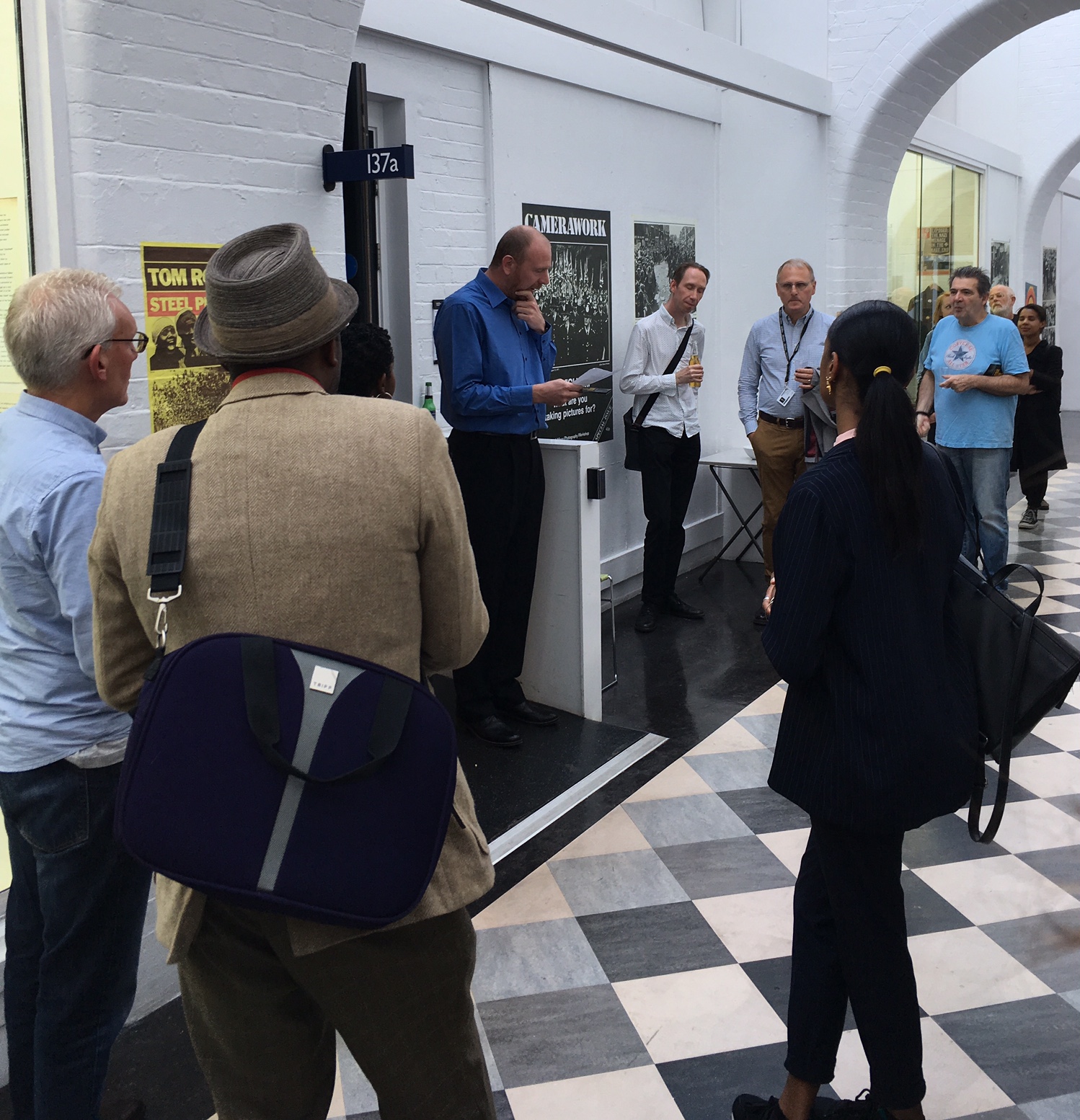
I went along last week to the launch of  What Are You Taking Pictures For? an exhibition of photographs documenting the events of 13 August 1977,  a day of riotous demonstrations against the far right National Front often referred to as the 'Battle of Lewisham'. There are some great images and archive material, so do get along and take a look. The exhibition is open from 9 am to 9 pm for all of August in Goldsmiths Kingsway Corridor in the main old building on Lewisham Way.


This weekend sees a whole series of events to mark the 40th anniversary, organised by Goldsmiths in partnership with Lewisham Council, the Albany and Lover Music Hate Racism. All events free unless otherwise stated, full details here: http://www.gold.ac.uk/events/battle-of-lewisham/full-events-programme/

Friday, 11 August 2017

Spirit of '77: protest poetry and song
A night of protest music and poetry featuring Attila the Stockbroker, Robb Johnson, Mark ‘Mr T’ Thompson, and more.
6:45 - 11pm | The Stretch, Goldsmiths SU | £5 in advance, £7 on the door

Saturday, 12 August 2017

Walking the Battle of Lewisham
Historian Dr John Price leads a history walk taking in key locations from the Battle of Lewisham.
11am - 1pm & 2 - 4pm,  Goldsmiths.

Spirit of ’77: Protest films
Screening of newly rediscovered documentary, AUG 13, produced by the Albany Video Project chronicling the events of the Battle of Lewisham. Followed by 'The Depiction of Blackness', a new film by Nacheal Catnott. Screening followed by a Q&A with the film-makers and DJ set from Lezlee Lyrix. 7 - 11pm, The Stretch, Goldsmiths.


Sunday, 13 August 2017


Battle of Lewisham plaque unveiling
Lewisham maroon plaque unveiled on Clifton Rise in New Cross (by New Cross Inn), gathering point for anti-fascists on the day. 12pm |Further information
 
Battle of Lewisham 40th Anniversary Community Festival,
from 1 pm to 6 pm at the Albany, Deptford, including:
DJ sets
Featuring Rock Against Racism co-founder, Roger Huddle, and the Deptford Dub Club’s Soft Wax joined live by Tim from Top Cats (South London's favourite Ska band ) and Setondji Spirit.
1pm – 6pm | FREE
Exhibits
Goldsmiths presents a history of the Battle of Lewisham, including rarely seen photographs, first-hand accounts, and community led designs for a new public mural
1pm – 6pm | FREE
Marketplace
Food, drink and local organisations presenting their work. Including Indian street food from Hulabaloo, Love Music Hate Racism, The Word Bookshop, Bookmarks, Lewisham Anti-Racist Action Group, Lewisham Local History Society and Lewisham Pensioners Forum.
1pm – 6pm 


Remembering the ‘Battle of Lewisham’ panel discussion
Hear first-hand accounts and explore the contemporary relevance of the Battle with Dr John Price, John Rees and John Lockwood.
2 pm, the Albany
 
The legacy of Rock Against Racism panel discussion
Featuring:
Roger Huddle, Co-founder of Rock Against Racism
Rhoda Dakar, lead singer of The Bodysnatchers (performed at RAR/ANL carnival in Leeds with The Specials)
Saskilla, Grime artist (performed at Love Music Hate Racism events)
Zak Cochrane, Love Music Hate Racism

4pm , the Albany 
 
Battle of Lewisham 40th Anniversary Gig
Love Music Hate Racism presents a night of rebel music to mark the 40th anniversary of the Battle of Lewisham. With live music from Afro B (Hit track ‘Juice & Power’), IQ (Afro Beats), YGTV & Guests (Hosted by Saskilla), & Smokey Joe (Beat London Radio).
7 – 10pm, £10


John Price launches the photography exhibition at Goldsmiths


Monday, July 31, 2017

What are you taking pictures of? - Lewisham '77 photo exhibition

As mentioned here before, there's a whole series of events led by Goldsmiths coming up in next couple of weeks to mark the 40th anniversary of the 'Battle of Lewisham'  when, on 13 August 1977, the far-right National Front (NF) attempted to march from New Cross to Lewisham town centre, leading to violent clashes with counter demonstrators and the police.


For the whole of August there will be a photography exhibition 'What are you taking pictures for?' in the Kingsway Corridor  of the Richard Hoggart Building at Goldsmiths (that's the main old building on Lewisham Way):


'For the first time, photographs documenting the events of 13 August 1977 are exhibited alongside ephemera and newly discovered archive material. This exhibition brings together striking images featured in radical photography journal Camerawork and rarely seen photographs taken by some of the most important photographers documenting life in Britain in the late 70s.

Featuring work by Mike Abrahams, Peter Marlow, Chris Schwartz, Syd Shelton, Chris Steele-Perkins, Homer Sykes, and Paul Trevor.

Opening event with drinks reception: 6pm on Thursday, 3 August. All welcome'.


Image below by Chris Schwartz, I think this is New Cross Road taken from Clifton Rise - building on left is New Cross House, the car place (The Motor Way Centre) opposite is on corner of Laurie Grove is now the Word Bookshop. Banners visible include a couple of anarchist ones ('Struggle' and 'Anarchist Black Cross - Oxford Group') and 'Socialist Challenge' (newspaper of the International Marxist Group).


Friday, April 28, 2017

1977 'Battle of Lewisham' plaque

August this year sees the 40th anniversary of the demonstrations and clashes of the 'Battle of Lewisham' when thousands of people turned out to oppose a racist march from New Cross to Lewisham by the far right National Front. Goldsmiths is leading on a number of events to commemorate the 1977 protests which are recognised as a turning point in the fight against fascism at that time.

Among the initiatives is the installation of a commemorative maroon plaque on New Cross Road. But how should the plaque be worded? You can have your say by voting on a number of suggestions or indeed coming up with your own idea before midnight, this Sunday 30th of April.


I was involved in a similar commemoration on the 'Battle of Lewisham' 30th anniversary in 2007. This included a conference at Goldsmiths and a history walk which I helped lead and that included different perspectives from people who had been involved on the day. There were some great material produced and collected from all this - see the Lewisham 77 blog -  and Goldsmiths historian John Price hopes to build on it for this August's events.

To find out more about the project including how you can get involved and upcoming events, visit www.sites.gold.ac.uk/Battle-of-Lewisham

Photo of police atempting to clear anti-racist protestors from Clifton Rise, 13 Aug. 1977 (© Peter Marlow) - in this photo you can see the New Cross House in the background and the corner of the New Cross Inn on the right. The protestors are clustered round what was then the public toilets on Clifton Rise.

Sunday, March 12, 2017

Stan Firm inna Inglan at Tate Britain


 Tate Britain gallery is currently displaying 'Stan Firm inna Inglan: Black Diaspora in London, 1960s-1970s', featuring images by 'eight photographers who documented Black communities in London: Raphael Albert, Bandele 'Tex' Ajetunmobi, James Barnor, Colin Jones, Neil Kenlock, Dennis Morris, Syd Shelton and Al Vanedenberg'.


There are a number of outstanding South London images to be seen, including Syd Shelton's photographs from the New Cross/Lewisham anti-National Front protests of 1977...


A smoke bomb in New Cross Road, August 1977 © Syd Shelton


..and Neil Kenlock's early 1970s photographs of the British Black Panther movement, particularly in the Brixton area, including this one of girls with Black Panther bags.


© Neil Kenlock

Wednesday, August 10, 2016

More Lewisham 1977 Photos from Anti-Fascist Demo

The London Metropolitan Archives Collage London Picture Archive, 'Collage' has lots of great photos from across the capital. The Lewisham section includes some photographs by Chris Schwarz from the anti-National Front mobilisation of August 1977 (sometimes  referred to as  the 'Battle of Lewisham'). Here's a couple of details from  the photos, full set here.
 
This is from the demonstration organised by the All Lewisham Campaign Against Racism and Fascism (ALCARAF), which gathered on Ladywell Fields - banners in photo include Indian Workers Association, Morning Start and Campaign for Homosexual Equality (Lewisham):
 
 
The march progressed down Ladywell Road and into Lewisham High Street. The 'Lewisham 24' graffiti on the railway bridge refers to the arrest of young black men in police raids in May 1977 - an action that sparked the cycle of events leading to the National Front march (see chronology here). Demonstrators are carrying 'One Race- the Human Race, Unite to Fight Racialism' placards, which I believe were produced by the Communist Party of Great Britain.


Monday, June 22, 2015

Cornelius Cardew in New Cross, and a ballad of East Street

'Cornelius Cardew (1936-81): a life unfinished' by John Tilbury (Copula, 2008) is a monumental biography of the radical composer by one of his closest collaborators. Its 1100 pages document in close detail Cardew's musical and political life, cut short at the age of  45 when he was hit by a car in East London.


Cardew became involved with the musical avant-garde in the late 1950s, working for a while as an assistant to Karlheinz Stockhausen in Cologne. He helped introduce the work of American and other experimental composers into British musical circles. For instance in in July 1963, Cardew was involved in organising a Little Festival of New Music at Goldsmiths in New Cross with performers including John Cale (later of the Velvet Underground), Enid Hartle, Fred Turner, Griffith Rose, Robin Page, Tomas Schmitt and members of the Fluxus group George Macunias and Emmett Williams. Two concerts, one in the afternoon and one in the evening, including pieces by La Monte Young, Nam June Paik and Williams' 'Counting Song', which consisted of him counting the audience.

In 1966 Cardew joined the improvisational group AMM, founded the year before by  Lou Gare, Keith Rowe and Eddie Prévost  (Prévost had been to Addey and Stanhope school in Deptford, and been introduced to percussion in the 19th Bermondsey Boy Scouts marching band).

In 1968 Cardew began an Experimental Music class at Morley College in Lambeth. Many of those attending  'were later to form the nucleus of the Scratch orchestra' including Michael Parsons, Howard Skempton, Carole Finer (a lecturer at London College of Printing and later at Camberwell College of Art) and Psi (Peter) Ellison (who for 'some months... squatted in a clothing shop in Deptford'). The Scratch Orchestra's approach to music was playful and inclusive (see Stefan Szczelkun's participant account) but this was soon to be rejected by Cardew as he came under the influence of the 'Maoist' Communist Party of England (Marxist-Leninist).

The last ten years of Cardew's life were dominated by his involvement in this group, and musically he turned away from experimentalism towards didactic political song aiming to put across the party's line to the masses through vehicles such as People's Liberation Music. His earlier collaborators were denounced as bourgeois in texts such as Stockhausen Serves Imperialism.

In October 1975, Cardew started an evening class at Goldsmiths, 'Songs for our Society', its participants including 'composer Howard Skempton (occasionally), a homeopathic nurse, a lady on day release from a mental hospital, a young German called Holger, a retired railway worker' and others. Afterward 'the class would adjourn to a nearby pub, usually the Goldsmiths Tavern, occasionally the Marquis of Granby, and there would be a further two hours of intense political discussion'.

One outcome of the class was a gig for prisoners at Brixton Prison Medical Wing in 1976, where a band including Cardew, Eddie Prevost and Keith Rowe treated the audience to songs including Up and Over the Wall and The Ballad of George Jackson - the latter written and sung by a member of the class, Jim Ward, who recalled it as 'rather strong.... with its references to racist pigs and fascists in the prison service'. Later, in June 1981, Cardew organised a concert at Goldsmiths to commemorate the deaths in the New Cross Fire that year, though as Tilbury recalls there some controversy about the event being used to push the party line.

Cardew and his comrades were frequently in conflict with the police - he was arrested in the anti-National Front 'Battle of Lewisham' in August 1977, and in another anti-NF demonstration in Camberwell in 1980. In the latter case, Cardew was already on a suspended sentence following a previous arrest,  and he was jailed for a month in Pentonville after an appearance at Newington Causeway Magistrates Court.

Cardew's song/piano piece 'Four Principles on Ireland' was inspired by another local confrontation. According to Tilbury, it  'related to a demonstration in East Street market in South East London in 1972. The Party comrades who were leafleting were "brutally attacked" by the police and several received prison sentences' - Cardew's subsequent song was based on the leaflet.


For me the devotion of Cardew and others to the tiny maoist sect seems rather tragic. Their sectarian, dogmatic rhetoric had little impact other than contributing to the image of radical leftists as ridiculous fantasists - their grandiose sounding front organisations such as South London Revolutionary Youth and South London People's Front no doubt inspired the 'Tooting Popular Front' of late 1970s sitcom 'Citizen Smith'. One of the more comic touches in Tilbury's book is a reference to Cardew taking part in 1980 in a delegation to Germany as part of the 'Stalin Youth Brigade'- at the time Cardew was 44 years old and the other 'youth' delegates were aged 33 and 'mid twenties'!

While Cardew may have been on the right side of history in fighting against fascists in the 1970s, he was also an apologist for mass murderers like Stalin and Mao, and you have to wonder what atrocities he would have been capable of countenancing if his unlikely fantasy of the party taking power had been realized. No doubt other kinds of radicals - denounced as social fascist  - would have been first against the wall - a 1972 letter talks of  'Revisionism, Trotskyism, Anarchism, Reformism,Terrorism, the Labour Party etc' as lines to be struggled against: 'isolate them and wipe them out, so that we can achieve the necessary unity to go forward'. Those with the wrong musical line would probably also find themselves having to 'work harder with a gun in your back for a bowl of rice a day' (to quote the Dead Kennedys 'Holiday in Cambodia'). In 1977, the party's Progressive Cultural Association published an infamous 'Punk Rock is Fascist' article in its journal Cog and Wheels. I'm sorry but give me The Clash any day over Cardew's late period songs such as “Revisionist Somersaults And The Opportunist Opposition”

Tuesday, October 28, 2014

The boots of history - an 'anti-sexist' response to the 'Battle of Lewisham' 1977

An interesting online archive has recently been assembled from the 1970s/early 80s libertarian Marxist group East London Big Flame. Feminism was a big influence on the group, including the men within it, some of whom were involved in establishing the magazine/group 'Achilles Heel: for a men's anti-sexist politics'. The site includes a special issue of the magazine (no.5) on the theme of 'masculinity and violence'. One of the articles in it is a personal account of the 1977 anti-National Front demonstration in New Cross, sometimes referred to as 'the Battle of Lewisham'


Published a little while after the events (the magazine isn't dated, but believe it was published in 1979/80), it's interesting because the author, Andy Metcalf, uses his experience to reflect on the wider issues of political violence and masculinity.

Thank God I Remembered my Boots! by Andy Metcalf (Achilles Heel, no.5)

I drove the car fast up the outside lane into New Cross, looking for a place to park. I was late for the demo, and it looked like being a big one. Up at the junction, nothing much had happened yet: the big crowd blocked the road causing a traffic jam; on the speakers’ stand, Darcus Howe was winding the temperature up . . . “The black community will not allow the National Front to mount these sort of provocative actions - make no mistake about that." As he finished, the chant roared out: “The National Front is a Nazi Front. Smash the National Front." I looked at the punters in their cars; they just wanted to get home for Grandstand, that's all. But this was our reality, not theirs, and for once they were trapped in it.

Near the crash barriers, where the road divides, I asked a black guy if he knew where the Front was. He didn't know but showed me his preparation - a long steel chain wound round his waist. There was going to be some heavy action going down this afternoon.  Later, much later, a man ran down New Cross Road, shouting, “They're lining up to march through.” I couldn't see a thing. Another false alarm probably. Suddenly a mass of police appeared a hundred yards away. “Block the road — form a line."

Christ, where is everyone? They look as if they've got the whole force out for this. Nobody's getting it together — who’s meant to be co-ordinating this anyway? They’re going to march them right through us. “Link arms." Who said that? Was that my voice? Shit, I'm in the front row . . . a woman to my left, man to my right. We look so small. Still, zip up the jacket, no loose clothes; check boot laces and hold on tight. One figure in blue advances:

“This is a lawful march. Disperse from obstructing the road at once. This is your last warning — if, you do not disperse, the police horses will he sent in.” The riders leant into their charges, shouldering them forward. The horses, high stepping all the way, accelerated as they came close to us. One moment it was link arms, the next I was knocked sideways by a horse breaking our line. Its massive chestnut thigh, rich with a thick gloss and wider than a man's frame, surged past my me; It was big, animal, and unpredictable. And I discovered, when I found myself on the pavement panting, it had just STOOD ON MY FOOT. The leather had a fresh gouge, the imprint of a hoof, taken out of it. Thank God l remembered to wear my boots.

Political violence is a serious issue; it's been at the heart of much debate between socialists for along time; reform or revolution, armed struggle or peaceful road, Allende or Ho Chi Minh. But the discussion has echoes beyond that of strategy. The gestures, the tones, the postures, all imply the choice is between milk and water suburban-safe reform and red-blooded steel-hearted revolution. If you’re man enough, revolution is the road for you. A host of masculine meanings attends the debate. But, like gate-crashers at a private function, they are acknowledged but never directly addressed. 

All too often, what has been lost in this little world, is the sense that whether you like it or not, politics is about violence.  At its core, a political practice revolves around the control and authority of ruling groups and the rebellion and revolt of subordinate ones. Oppression will always engender revolt. And those who have chosen the “peaceful road” may well find  themselves on a battlefield, with the rhetoric of violence, but with none of its tools. There is a photograph of Allende on the last day of his Presidency. All his efforts to appease the Chilean Military had come to nought. He had let the army crush dissent within its own ranks, disarm militant workers, and prepare for a coup, and still they wanted to overthrow him. He is entering the Moneda Palace for the last time, surrounded by a few young men - his bodyguards. On his head, a steel helmet, and strapped to his waist, a leather hand gun holster. Not really enough against tanks, artillery, Hunter jets, and a battalion or two of assault troops. But at least he died like a man. Precisely, exactly, like a man.

After the horses, in trooped the marchers, dwarfed by their police escort. And with the Front’s appearance came the rocks, half bricks and pieces of timber from the other side of the road. The marchers, crouching under this hail, holding bleeding heads, looked thin and rneanly fed. Terrified, they scuttled along, shying away from the brick throwers, so that they were only three or four yards away from us. All the while, the chanting poured down on them: “Fascist scum! Smash the National Front!”

Could this ragged crew be the principal threat to life, liberty, and multi-racialism? Next to rne a gangling white man had his own private message: “See, see, see how it feels." He screamed. “How do you like that, eh? Hurts, doesn’t it? How do you like a taste of your own medicine. Next time you go round beating up Asians, you'll know how it feels, won't you.” This was it. Vengeance is mine. I reached down for a brick. The NF were only spitting distance away.

It must have been 1969-70. The union meeting was packed eight or nine hundred people. I could hardly see her from the back. A small woman with black hair; the Representative of the People's Revolutionary Government of South Vietnam. She spoke quietly and in Vietnamese, translated by a man. Outlining the present stage of the struggle and the PRG’s platform, her words absolutely lacked any rhetoric. The hall was quiet, but here and there little eddies of disquiet spun up, searching for some inspirational phrase to latch on to.

Against the pulp of my finger tips, the brick had a rough grainy feel. A scurry of movement caught my eye as three policemen banged through the crowd to pounce on a man a few yards away. Arm lock, knee in the nuts, and they were gone with him. Shitting hell — they’ve got snatch squads out. It's getting more like Belfast every day. My fingers held the brick, my eyes watched the Front, my mouth shouted, but my arm wouldn't throw. They were close, so close. I put it down. Picked it up after a moment, and then put it down again. OK. So I chickened out. I could have thrown it but I didn't. I was scared, sure. But couldn't overcome the fear. They were just too close. And a police horse had just trodden on my foot.

Zing sing, like ice along the veins, the stream of clarity poured out of his mouth. Our power, the hot beauty of its crystalline analysis. History in his hands. Hands pounding, fingers jabbing; he stood at the rostrum, denouncing police harassment, decrying a state within a slate. He pulled this thin thread of thought from clenched teeth and concluded: “comrades, we must never forget that the state will inevitably block the transition to socialism with all the violence at its disposal.” It stirred: it was right.

Outside, a big sky dwarfing the street, I felt confused. Riots may come and riots may go, but the labour movement remains silent. Demonstrations are met with bullets in Derry, but parade through London in ritual peace. The police intelligence computers whirl on untroubled by socialist activity. There was something missing . . . was it an AK47 machine gun under the stairs or a sense of myself?

In this confusion words take on different meanings. Political violence can never only be a question of political strategy. Between head and hand there can be an echoing void, that no amount of theoretical debate will fill. Into such hollows, the rhetoric of the left swirls and buffets, but leaves unmoved a strange gallery of scenes. Family tableaus of anger and authority; the corridor outside and duty master's office; father carves the Sunday joint, his sons finger their knives; the brotherhood of playground rites.

I've kept the boots. I'm very fond of them. You can still see the mark on the side of them. I'm convinced it's the mark of history.

Thursday, October 23, 2014

The Specials at Lewisham Odeon

Nice piece in the Guardian today by Jon Dennis on the Specials as 'the music that changed my life': 'The Specials' Gangsters symbolised the fight against the fascists at my front door'. The author grew up in Lewisham, and recals:

'London was drab and frightening in the late 70s, nowhere more so than Lewisham, where I lived. In 1977, Lewisham had been the scene of a riot when the National Front attempted to march. There were coaches full of far-right thugs parked outside my house. My adopted sisters are black, and so for my family the NF represented an existential threat. Racism was rife among my predominantly white classmates. The Lewisham march represented a political awakening for me. I was glad of any ally, and the Specials defined themselves against the far right...

In December 1979 I attended my first gig: the Specials at Lewisham Odeon. The support acts were the Selecter and Dexys Midnight Runners. The audience were frenzied, dancing continually, with frequent scuffles breaking out. For years afterwards I assumed that violence was a normal part of going to gigs. The experience was frightening, but also exciting. It illuminated a world that was violent and hard, shone a light on the grimness of late-70s London, but also provided gleeful escape...'

That gig at Lewisham Odeon was on 1 December 1979 - quite a line up! The Selecter also played there in March 1980 (there's a recording of that gig out there somewhere)


Thursday, September 18, 2014

Lewisham '77 photos by Chris Schwarz

I have mentioned the Deptford photographs of Chris Schwarz  (1948-2007) here before. The Albany has now created a digital archive of his work, Every Picture tells a Story. Lots of great images from the 1970s and 1980s, including some from the 'Battle of Lewisham'  in August 1977, when anti-fascists mobilised against a National Front march from New Cross to Lewisham (see detailed account here)

The first image shows the anti-NF crowd in New Cross Road. The speaker is standing near the Clifton Rise corner, the buildings opposite are on New Cross Road, including corner of Laurie Grove:


This shot shows New Cross Road looking up to bottom of Lewisham Way - building on left is Marquis of Granby pub:


Police in Lewisham town centre, where clashes continued at the end of the march. This was the first time police had used riot shields in Britain.


Friday, June 27, 2014

Sham 69/Lewisham 77 - punk and (anti) fascism

The riotous anti-National Front demonstration in New Cross and Lewisham in August 1977 has been covered here before (see this chronology of the events). Jon Savage's classic book 'England's Dreaming: The Sex Pistols and Punk Rock' notes that an image from that day taken by rock photographer Jill Furmanovsky featured on the sleeve of a punk record released in the following month - 'No I Don't Wanna' by Sham 69 (the band's name sadly refers to Hersham in Surrey, not Lewisham). The single - the band's first - was released on Step Forward records, Sham having been signed by Deptford punk Mark Perry (of ATV and Sniffin' Glue zine fame).


Sham went on to have a number of hits including 'If the Kids are United' and 'Hersham Boys'. They had quite a skinhead following, including for a time some racists, and there were fights at their gigs as a result. The band played for 'Rock Against Racism' to try and distance themselves from this.

Savage suggests that the fight against the National Front was a turning point for Punk, in the early stages of which there were some flirtation with swastikas as part of a mostly apolitical shock the elders strategy. In this context, he sees the August '77 events as a watershed: 'The events at Lewisham also helped to break Punk apart under the weight of its own contradictions. In superseding Punk's rhetoric with reality, it showed the apparent lie behind the antinomian heresy: freedom was not in the mind or the imagination, but to be fought for here and now'.

'England's Dreaming' includes an account of the events by Angus McKinnon of the NME, who took part in the anti-fascist mobilisation. He recalls that the fighting started in New Cross, where the NF were assembling to march to Lewisham: 'We were contained up by the New Cross area. The Front was a small march: there must have been about a hundred and fifty of them, all ages... They were eventually escorted onto the man street which goes towards Greenwich, and as they came out, there were mounted police, and things started to get vary scary very quickly. People started picking up bricks and stones. Some of the NF has sticks already, they threw bricks back at us. Someone close by went down with a brick in their face, the police horses came towards us. Police horses are very frightening indeed, the crowd was surging forward and back. Basically the police were saying, you have to clear away, these people are going to march. The crowd got very angry and there was a lot of brick-throwing'.

Later many of the marchers headed to Lewisham town centre. McKinnon remembers that 'There were baton charges, orange smoke everywhere. People throwing things through shop windows... Marchers and police up and down Lewisham High Street, and all over it was this enormous pall of orange smoke, very thick, acrid and very unpleasant. I slipped down the side of the High Street to get away, and then we were stuck, seven or eight of us in a cul de sac at the back of a supermarket by the delivery bay, huddled in absolute terror. Right down the end of the High Street, we were rounded up and put by a police bus to be shunted off. We weren't, only because someone started throwing stones and bricks at the police bus, which withdrew. We were denied the dubious pleasure of being detained at Her Majesty's Pleasure for rioting'.

Sunday, May 11, 2014

Ex-Dulwich College 'fascist' seeks your protest vote

Channel 4 news reported this week that when UKIP leader Nigel Farage was a pupil at Dulwich College in the early 1980s teachers complained about his appointment as a prefect on account of his apparent 'fascist' sympathies. A letter written in June 1981 to the college head by teacher Chloe Deakin states that the matter had been discussed at a staff meeting where: 'Another colleague, who teaches the boy, described his publicly professed racist and neo-fascist views; and he cited a particular incident in which Farage was so offensive to a boy in his set, that he had to be removed from the lesson. This master stated his view that this behaviour was precisely why the boy should not be made a prefect. Yet another colleague described how, at a Combined Cadet Force (CCF) camp organised by the college, Farage and others had marched through a quiet Sussex village very late at night shouting Hitler-youth songs'.

Some other interesting details in that report- the letter states that the head often told the 'senior boys' that they were 'the nation's future leaders' - what a horrible thought in this case. It also mentions that during the Brixton riots - just 6 weeks before this prefect row - Dulwich College 'offered its facilities freely to the forces of law and order'. Apparently parts of the College grounds were used as a base by police in April 1981.

Whether Farage has moderated his views since or just got better at concealing them I don't know, but his publicly professed position is still essentially that of the most reactionary, Powellite fringes of the old school establishment. The kind of thing you imagine old generals, Monday Club Tory MPs and public school headteachers coming out with while drunkenly fantasising about a military coup in the 1970s.


Yet somehow this privately educated right wing stockbroker with his very big house in the country gets to be presented as some kind of 'common man' alternative to the status quo. Writer Tony Parsons has said that:  "I've felt that politicians are just completely removed from any kind of life experiences in a way they weren't when I was growing up" and complained about the lack of opportunities for social mobility for working class kids. Fair enough, but what's that got to do with Farage and UKIP, who Parsons says he will be voting for in forthcoming elections

I can only assume Parsons has taken too many blows to the head down at the boxing gym to think straight. Back in 1977, he was a bit clearer, coming to New Cross to oppose the National Front march in what became known as the 'Battle of Lewisham'. He once said that his relationship with Julie Burchill started that day- "I gave her a flick knife and my telephone number. I think she threw away the number and kept the knife.". His 2005 novel 'Stories we could tell' includes an account of that day, with Parsons writing:

'Flags waving, bricks flying, policemen on horses riding into the crowds, the battle lines ebbing and flowing - screaming, righteous chaos all around. Orange smoke bombs on Lewisham High Street, the air full of masonry, dustbins, bottles and screams, taunts, chanting. The sound of plate-glass windows collapsing.... This wasn't about some little style option - the choice between long hair or spiky, flared trousers or straight, Elvis or Johnny Rotten. It was about a more fundamental choice.... the choice between evil, hatred, racism, xenophobia, bigotry, and every­thing that was their opposite'.