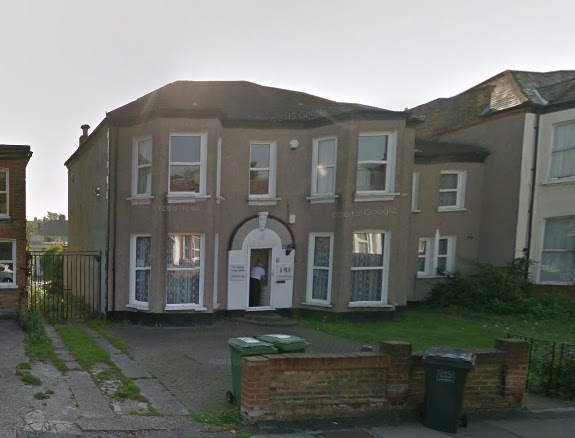
Today's revelations about the so-called 'Lambeth Slavery' case have linked those arrested to the remnants of a small Maoist group that operated in Brixton in the 1970s. The central allegation seems to be that supporters of the group formed a collective that degenerated over time into an abusive scenario where several women felt themselves to be controlled and unable to leave the house of their own free will for many, many years. Two people were arrested in a Lambeth Council flat at Peckford Place, Angell Town in Brixton - with press reports identifying them as Aravindan Balakrishnan and Chanda Balakrishnan, formerly leading members of a group called the Workers' Institute of Marxism-Leninism-Mao Zedong Thought.
Unless and until this case comes to court and all the evidence is out there, it's probably best not to speculate too much about the details. It is pretty clear though that this would be a unique situation arising from very particular circumstances - and certainly no basis on which to generalise about slavery in modern Britain. Clearly there are disparate cases of extreme exploitation, abuse and servitude but maybe
Frank Furedi has a point about the inadequacy of the term 'slavery' to describe them.
Tempting too to draw general political conclusions about Marxist-Leninism as
Bob from Brockley does. I have some sympathy with this approach, but again we probably can't deduce too much from this pathological case study. Once a political organisation is small enough to fit in one household we are really talking about small group interpersonal dynamics rather than political ideology, even if ideology can justify all kinds of behaviour that most people would find appalling.
But the case has thrown a spotlight on a largely forgotten dead end in twentieth century radical leftist politics - British Maoism. In some parts of Europe, such as Germany, Italy and France, groups inspired by the Chinese revolution and its aftermath formed a large part of the extra-parliamentary left in the late 1960s and early 1970s. In Britain, it was never more than a tiny minority current made up of a number of competing sects. 'Maoist' is a term they rarely used to describe themselves, preferring the term 'Marxist-Leninist', but their key distinguishing feature was to believe that Mao's China offered a way forward for world revolution as an alternative to the mainstream pro-Soviet Communist Parties. Whether their beliefs bore any relation to what was actually happening in China, and later Albania, is another matter.
Many of these groups had a presence in South London. A hostile account from the 1970s claimed that Maoist 'influence has been felt in London and in particular in the less prosperous parts in an arc from Camden in the north going eastwards around to Brixton in the south... The decaying Victorian surroundings, the depressed environment, the mixture of peoples and the hostility to the authority encourage a spirit of radicalism and provides the revolutionary with a relatively favourable social milieu and a base for development' (Peter Shipley, Revolutionaries in Modern Britain, 1976).
The
Workers’ Institute of Marxism-Leninism-Mao Zedong Thought opened its Mao Zedong Memorial Centre at 140 Acre Lane, Brixton,in October 1976, running evening lectures, study groups and film showings. The Centre also operated as a
residential commune: 'The role of the Communist Collective in the Mao Zedong Memorial Centre plays a backbone role in the work of our Institute. Of the thirteen comrades living in the Centre seven of us work in factories, shops and a hospital very near the Centre while six of us are doing full-time revolutionary work'. They published a 'South London Workers Bulletin' and boasted in 1977 that they had 'undertaken the unprecedented task of BUILDING A REVOLUTIONARY STABLE BASE AREA in and around Brixton, a poor and oppressed working-class area in South London'. In March 1978,
the centre was raided twice by the police - apparently on the basis of drugs allegations - with 14 arrests. Six women were remanded in Holloway Prison for six months awaiting trial as they refused to recognise the courts. Bala (Aravindan Balakrishnan) and Chanda were sentenced to six and three months respectively (though nobody was convicted in relation to drugs). If they already had a fairly paranoid world view which saw fascism at every turn, this experience no doubt accentuated it.

This group had split away from another group, the Communist Party of England (Marxist-Leninist), which relaunched itself as the Revolutionary Communist Party of Britain (Marxist-Leninist) in 1976. Its 'unique selling point' was to side with Albania when it denounced the Chinese Communist Party in the 1970s. Its best known member was the avant-garde composer Cornelius Cardew. They too had a South London base, with a bookshop at 569 Old Kent Road in the early 1970s called Progressive Books. Later, in around 1975, the bookshop and HQ was moved to 170/172 Wandsworth Road, SW8, where it continues to this day I believe. In the 1970s they stood candidates in a number of elections, including as the South London People's Front in the 1978
Lambeth Central Byelection (they got 38 votes - as
Ian Bone observes, that election was also contested by Trotskyist groups the Workers Revolutionary Party, the Socialist Workers Party/Flame and Socialist Unity).
Another grouping was the Marxist Leninist Organisation of Britain. In 1974 their mailing address was 17b Brindley Street, New Cross SE14. Their members led the League of Socialist Artists which ran the
Communard Gallery at 18 Camberwell Church Street in the early 1970s. A Tooting GP and Spanish Civil War veteran, Alex Tudor-Hart, was one of the founders of yet another group: the Working People's Party of England. No doubt there were many more local connections to such groups.
The history of this current ranges from the comic (the absurd pretensions of tiny groups to be the vanguard of 'the people') to the tragic (the support for murderous dictatorships such as North Korea and the Khmer Rouge in Cambodia - we could mention here too the
case of Malcolm Caldwell, a sometime member of Bexley Labour Party and Khmer Rouge apologist who was killed in unexplained circumstances in Cambodia in 1978).
No doubt many good people sincerely committed to fighting racism, colonialism and inequality passed through these groups, but their practice was generally the opposite of emancipatory, with their personality cults, authoritarianism and closed intellectual worlds where everybody who disagreed with them was a fascist or imperialist lackey. As Keith Flett says they were
mostly harmless - even though you wouldn't have wanted to end up working in a rice field with them in charge. The recent Lambeth news reads like a sad footnote to this late, and not particularly lamented, episode in London political life.