Showing posts with label disasters. Show all posts

Monday, May 21, 2012

Robin Gibb and the Hither Green Disaster

Many of the obituaries for Bee Gees singer Robin Gibb, who died at the weekend, mention that he escaped death  in the Hither Green rail crash. On 5 November 1967 a  Sunday evening express train from Hastings to London derailed shortly before the train crossed the St Mildred's Road railway bridge, between Hither Green and Grove Park railway stations. Most of the carriages overturned, two of them having their sides torn off. 49 people died.

Robin Gibb was on the train, along with his fiancee Molly Hullis. They were returning from visiting her parents in Hastings. Gibb recalled 'the carriage rolled over and big stretches of railway line came crashing in straight past my face'.  At the time he was only 17, but the Bee Gees had already had their first big international hit earlier that year - New York Mining Disaster 1941. He reflected: 'If our hits were not making so much money, I would not have been able to buy first-class tickets. Most of the people who died were in the second class compartments, which had no corridor to protect them'

Recovering immediately after the crash, Gibb wrote the song 'Really and Sincerely':  'It doesn't mention anything about a train crash but it does reflect the mood I was in' (quotes from The Bee Gees: Tales of the Brothers Gibb by Andrew Hughes).

Later in 1967, The Bee Gees played in Lewisham at  a charity show in aid of the Hither Green train disaster fund.


Wednesday, January 12, 2011

New Cross Fire: the bleakest moment

My first memory of New Cross comes from around 1981, years before I lived here. I was in the back of a car being driven by a friend's parents across London to Kent, in the days before the M25 made it possible to drive around London instead. In the traffic jam we stopped by the haunting burnt out shell of a house, which we immediately recognised from the TV coverage as the scene of the terrible New Cross Fire.


On Saturday 17th January 1981, a 16th birthday party was held at 439 New Cross Road for Yvonne Ruddock. In the early hours of the next morning, a fire broke out and 13 young black people, all between the ages of 15 and 20 years old, were killed. Yvonne Ruddock was among the dead. One survivor killed himself a couple of years later, so the death toll is often given as 14.

There's an excellent BBC Windrush Years documentary about the fire, first broadcast in 1998, which you may be able to find online. It describes the New Cross Fire as ‘the bleakest moment in a decade of alienation and bitterness', and includes interviews with people who were at the party. Sometimes the actual event gets lost behind its political and cultural significance - we must never underestimate the horror of the night, with the terrible injuries, physical and mental, suffered by the survivors, and the dreadful scenes that greeted emergency services and others when they arrived at the house. Harry Powell, a witness, recalled: ‘I lived on Alpha Road... as I turned the corner I realized there was kids ... jumping out of the window, fire was blazing, screaming’.

Shocking too was the racist response to the fire, with abusive letters sent to victims’ families. In this climate, it is not surprising that many believed that that the fire was the result a racist attack and the police initially suggested that it may have been caused by a firebomb – a theory they later rejected in favour of claiming that the fire had been started following an argument in the party.

Local black people recalled that there had been other racist arson attacks in the area. In November 1977 a newspaper reported that a National Front meeting had included talk of burning down the Moonshot, a New Cross youth club popular with young black people. On December 18th, it was indeed gutted in a firebomb attack and had to be rebuilt.

The Albany in Deptford was a centre of local anti-racist activity, including ‘Rock Against Racism’ gigs, a three day ‘All Together Now’ festival, a benefit to scrap the suss laws and a successful anti racist show called ‘Restless natives’. On the 14th July 1978 the Albany (then at 47 Creek Road) was gutted by fire. The next day a note was pushed through the door of the building saying ‘GOT YOU’.

Back in January 1971, in nearby Ladywell, three petrol bombs had been thrown into an African-Caribbean party in Sunderland Road, seriously injuring several people. Two white racists were later jailed for the attack, and as with the New Cross Fire ten years later, the police were accused of inaction. In fact in the following week, the police arrested eight members of the Black Unity and Freedom Party in a fracas on their way home from visiting the fire’s victims at Lewisham hospital. A march by 150 black people and supporters to Ladywell police station a few weeks after the fire saw further arrests.

Throughout the 1970s there had a significant far right presence in south East London. In 1976, the National Front and the National Party achieved a combined vote of 44.5% in a Deptford council by-election. And on 13 August 1977, a National Front March to Lewisham started in New Cross, in Achilles Street by Fordham Park. The clashes between the NF, anti-fascists and the police on that day became known as the Battle of Lewisham.

But it wasn’t just the possible racist attack that inflamed anger. While local community activists like Sybil Phoenix rallied round to support those affected, there was little or no official support, not even the usual messages of condolence from the Queen or the prime minister. The police interrogated party goers as if they were criminals rather than victims, and the press reporting was largely unsympathetic. As Linton Kwesi Johnson recalled ‘a lot of people were angry... not just about what happened, but about the way the whole business was handled by the police and the way it was reported in the press and the media'.

On the Sunday following the fire a mass meeting was held at The Moonshot Club, attended by over 1000 people. From that meeting there was a demonstration to the scene of the fire, which blocked New Cross Road for several hours. A New Cross Massacre Action Committee was established and organised weekly mass meetings in New Cross. It also called the Black People's Day of Action on Monday 2nd March 1981.

On a wet working day, at least 15,000 (some say 20,000) marched over a period of eight hours from Fordham Park to Hyde Park with slogans including: 'Thirteen Dead and Nothing Said', 'No Police Cover-Up', 'Blood Ah Go Run If Justice No Come' – the largest single political mobilization of black people ever seen in the UK. LKJ was a steward on the march, and remembers that 'all along the march we kept on picking up more people... school children were climbing over fences to come and join the demonstration in Peckham'. Other walked out of their workplaces to join in.

The march passes Clifton Rise in New Cross

Although the march was mainly peaceful, The Sun reported it with the headline: ‘The Day the Blacks Ran Riot in London’, with other press reports featuring headlines like 'Black day at Blackfriars' and 'When the black tide met the thin blue line'. Paul Gilroy, who took part, relates that 'we were deeply disappointed that the justice in our claim and the tragedy itself was still considered to be secondary to the sensation'.

Black People's Day of Action - the New Cross Massacre Action Committee banner on the march

Thirty years later the families of those who died still have no answers. A second inquest in 2004 recorded an open verdict, and nobody has ever been charged. Many now query the racist attack hypothesis, but the sense of injustice remains. Playwright Rex Obano, who is helping to organise the memorial event at the Albany on Friday, was featured in an article in The Guardian this week. He stated: "To me, the New Cross fire, the fact that no one in authority seemed to care, forced the black community to unify, to find its voice in a way it hadn't before. This politicised people from all over the country. They marched in protest: thousands of people on a workday. I was 13 at the time and I always thought the older generation was comparatively passive. New Cross shows it wasn't like that at all. They dealt with so much. There had been other uprisings. But this was a line in the sand."

It is no coincidence that in the month following the New Cross Fire demonstration, Brixton erupted in the first of what was to be a long hot summer of riots in cities across the country.

See also: New Cross Fire remembered at the Albany and on Radio 4

(updated post, March 2016 - the original post included clips from the BBC documentary mentioned, but these have now been taken down from youtube)

Thursday, July 02, 2009

Lewisham and Hither Green rail crashes

Newsreel footage of the Lewisham (1957) and Hither Green (1967) rail disasters:


The Lewisham rail crash occurred on 4th December 1957 just outside St Johns railway station. Ninety people were killed and 173 injured.


The Hither Green rail crash occurred on 5 November 1967 opposite Hither Green Traction Maintenance Depot, between Hither Green and Grove Park railway stations. A Sunday evening express train from Hastings to London derailed shortly before the train crossed the St Mildred's Road railway bridge. Most of the carriages overturned, two of them having their sides torn off. 49 people died.

Thursday, January 01, 2009

Tate Modern as Disaster Shelter

'It has been raining for years now, not a day, not an hour without rain. This continual watering has had a strange effect on urban sculptures. They have started to grow like giant tropical plants, and become even more monumental. To stop this growth it has been decided to store them inside, among the hundreds of bunk beds which, night and day, receive refugees from the rain. Turbine Hall/2058/London'.

The current installation in Tate Modern's Turbine Hall, TH.2058 by Dominique Gonzalez-Foerster, imagines the building fifty years hence, in use as a shelter from some kind of catastrophe that has also mutated artworks - hence the large scale reproduction of pieces such as one of Louise Bourgeois's spiders. Meanwhile clips of various science fiction movies (including Planet of the Apes) are screened at one end of the hall, while the bunk beds have appropriate books such as Ray Bradbury's Fahrenheit 451 and Megacities by Mike Davis (when the exhibition opened these were liberally scattered around the hall, but so many of them got taken that the last few copies are now attached to the beds).

In the accompanying book, the artist points to the previous transformation of the building from a power station to a gallery:‘what happened to this space is in fact some kind of science fiction. A hundred years ago it’s impossible to imagine that the people working there could conceive of what it would become. This shift says more than any other about the art inside the building. So I though this was also a strong starting point. And then to imagine that there was one shift and what could be the second? And so I was imagining possible futures, something set firty or a hundred years in the future’.

The curator, Jessica Morgan, links the installation to other stories of drowned London: 'London has been subjected to near constant fictional attack over the last century. Destroyed or under siege in nov­els and films, it has been the victim of fire and invasion, but perhaps most frequently, of flooding. Many such tales of dev­astation were inspired by the very real London flooding of1953, which resulted in the construction of the Thames Barrier. While others, some of which precede this event, are influenced not only by documented events but also by the Ur-myth of the bib­lical flood and the accompanying notion of a cleansing of excess or evil- a dystopia common, it seems, during the In­dustrial Revolution.

In Richard Jeffries's After London; Or, Wild England (1885), a Victorian tale of industrially inspired gloom, London is retributively submerged in compensation, it would seem, for the woes of the new commercialism and its accom­panying toxic effect. Jeffries writes of this flood: 'Upon the surface of the water there was a greenish-yellow oil, to touch which was death to any creature.' Sidney Fowler Wright's Del­uge of 1927 is similarly influenced by scepticism in industrial and technological development, and his bleak vision has the whole of England reduced to a few small islands after an un­explained storm. The better-known J.G. Ballard's The Drowned World (1962), a prescient tale of solar radiation causing the polar ice caps to melt, depicts a flooded, tropical London of the future, the experience of which leads the inhabitants to regress to a pre-civilisation mentality... Even more recently Kim Stanley Robinson and Stephen Baxter have both envisioned the capital submerged in Blue Mars (1997) and Flood (2008) as the city continues to come under a watery, literary attack'.

TH.2058 will remain in place at Tate Modern, Bankside SE1 until 13 April 2009.

See also V for Vendetta.

Wednesday, December 10, 2008

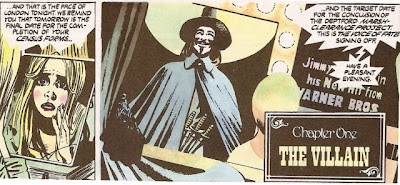
V for Vendetta

I posted a while ago on a panic that gripped Greenwich and Deptford in 1775, with people fleeing in a rainstorm in fear of the area being swallowed up by an earthquake. I was reminded of this when re-reading Alan Moore and David Lloyd's V for Vendetta (1988). The story is set in an alternative present-day London, where war and catastrophe has been followed by a fascist dictatorship. There is a scene where the heroine, Rose, recalls looking out over a flooded London from her home in Shooters Hill.

Deptford also gets a mention as the site of the Deptford Marsh Clearance Project and later of rioting and looting, while 'Brixton and Streatham are quarantine zones'.


Wednesday, October 08, 2008

It's the end of the world as we know it

Never mind credit crunch and financial crisis - on February 1st 1775 some people round here really did think that the end was nigh. According to the Annual Register for that year: 'A most violent storm of wind and rain did incredible damage in and about London, and on the river Thames. The people about Deptford and Greenwich had been alarmed with the reveries of а сrazy prophet, who had predicted that on this day these towns were to be swallowed up by an . earthquake; and on the breaking out of the storm, it is said, some of the inhabitants were weak enough to leave their houses, and to fly to London'.

It is thought that Charles Dickens might be referring to this episode in the opening chapter of A Tale of Two Cities, set in 1775, which mentions 'a prophetic private in the Life Guards... announcing that arrangements were made for the swallowing up of London and Westminster'.

Saturday, May 31, 2008

1968 in South London (4): Lewisham Floods

Photo by David Wright showing the flooding on Bromley Road, Catford, outside the Robertson Jam Factory. The latter closed in 1970 with the loss of 350 jobs.
Probably the biggest event in Lewisham in 1968 was not related to global political movements but to the weather. In September 1968 there was flooding across the South East of England, with the Lewisham area badly hit: ‘Hundreds of families were… trapped in their homes in Lewisham, South London, which was one of the parts worst affected. All the families could do was to shore up their doors with planks, chairs, and carpets as the water swept into their homes. The worst affected part of Lewisham was the High Street. The River Quaggy, normally only 6 inches deep, rose in some places to 15ft. In Carthorn Street the water rose to 4ft. Traffic was halted as it stretched from Catford to New Cross. Extra police were called to filter some of the traffic through side roads’ (Times, 17 September 1968).

Bromley Road facing towards Catford in 1968.
Photo by David Wright on Flickr (he has a couple of other flood photos there)


[last updated with additional pictures 28 December 2013]

Tuesday, December 11, 2007

Lewisham Rail Crash

Fifty years ago, on the 4th December 1957, 90 people were killed in the Lewisam Rail Crash just outside St John's railway station. In thick fog the 4.56pm Cannon Street to Ramsgate express collided with the stationary 5.18pm Charing Cross to Hayes train. The impact brought down the Lewisham to Nunhead railway bridge, which collapsed onto the first three carriages of the Ramsgate train. Last week's Newsshopper includes people's memories of the event, and there was a memorial service at St Johns Church.

Last month was also the 40th anniversary of the Hither Green rail crash on 5 November 1967, in which 40 people died.

Wednesday, March 29, 2006

Marmalade Skies

Marmalade Skies is a wonderfully obsessive archive of flyers, gigs, happenings and everything else connected with British psychedelia, 1966-70. Did you know that The Bee Gees played in Lewisham in 1967 at a charity show in aid of the Hither Green train disaster fund (40 died on 5th November 1967)or that Pink Floyd played Woolwich Poly the following year? Most interesting sounding was an event at The Albany Institute, Deptford in June 1967 featuring 'Films, Strange Sounds plus Psychedelic Poetry!', with artists incuding Michael Chapman, Daevid Allen and Gilli Smyth.

I will also have to check out some of the forgotten psychedelicists like East of Eden, who played in New Cross at the South East London College of Further Education in 1969, and Focal Point, a band signed to The Beatles Apple Records who lived for a while in East Dulwich.