Showing posts with label Borough High Street. Show all posts

Saturday, July 23, 2022

Abdul K. Kpakpa-Quartey: a Pan Africanist in 1920s Borough High Street

Recently I was browsing through the 1922 Post Office Directory in Southwark Archives, just looking at what was on Borough High Street one hundred years ago. One entry that caught my eye was for number 169 Borough High Street, listed as the address for three organisations: the Gold Coast National Aid Society, the Inter-African Moslem Association and the Ethiopian Society for Psychical Research. The secretary of all three organisations was said to be one Abdul K. Kpakpa-Quartey. 

Clearly there was a link with the Gold Coast (now Ghana), but the other organisations suggested a wider pan-African interest of the kind associated at the time with Marcus Garvey for whom 'Ethiopian' sometimes conveyed a sense of Africa as a whole rather than just the country itself. As explored here before Garvey himself stayed for a while on Borough High Street (numbers 71 and 176)  just before the First World War.

As for the psychical research angle, that sounds fascinating - the name presumably inspired by the Society for Psychical Research founded in Britain in 1882 to investigate all things paranormal. Sadly I haven't been able to find anything out about the Ethiopian version, but I have found a bit more about Kpakpa-Quartey.
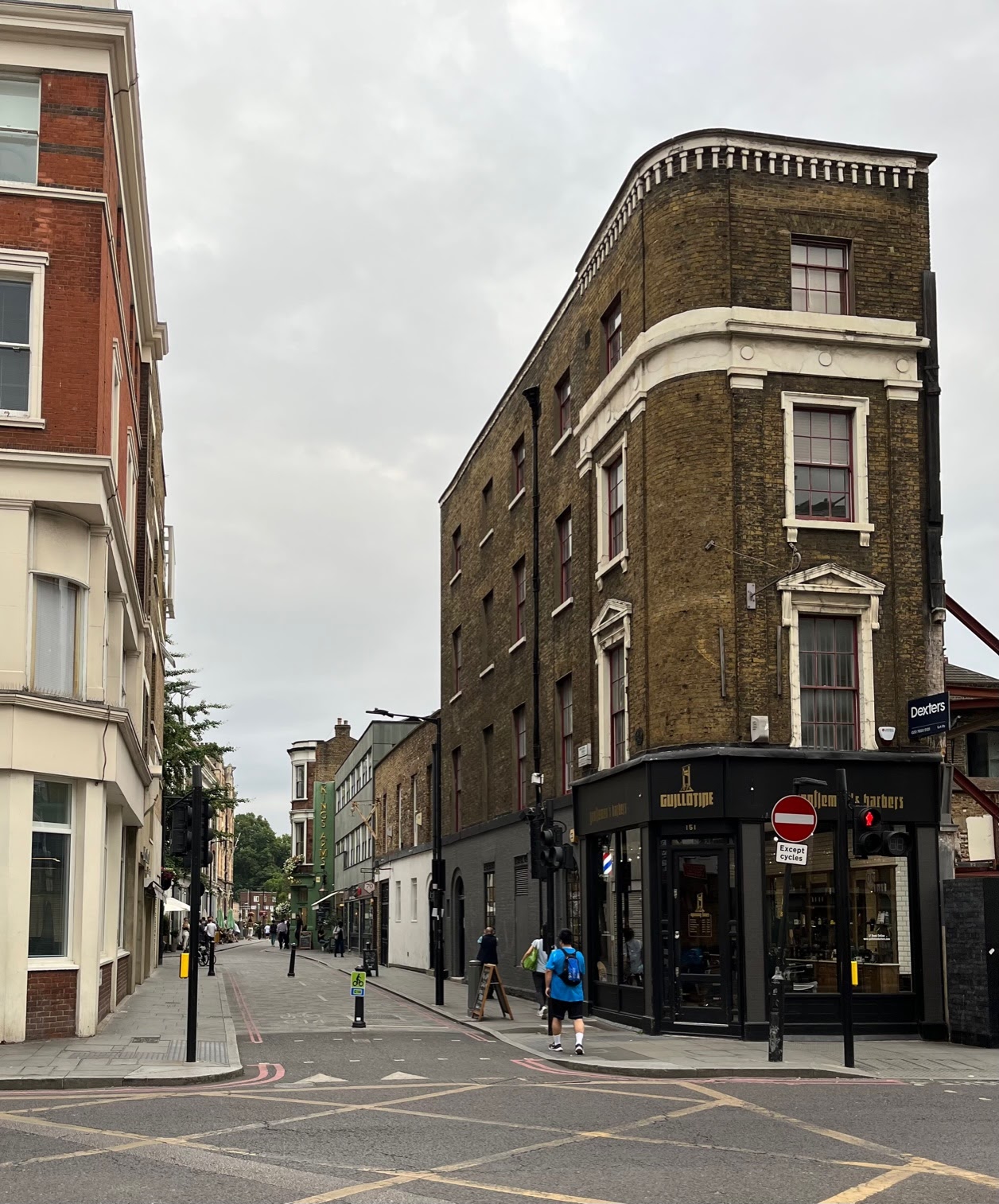
169 Borough High Street today (building on right)

He seems to have been a merchant from the Gold Coast/Ghana who settled in England from the 1920s to at least the 1950s. And he strongly opposed racism internationally, possibly with a link with Garvey's movement. In an an article published in the Islamic Review, May 1921, Professor Abdul Karim Kpakpa-Quartey writes:

'To-day in Christian America the God-created black man, notwithstanding his Christian affiliations, intelligence or social prominence, is a slave and a serf, perhaps worse than in the dramatic days of the world- famed Uncle Tom's Cabin. He or she is still liable to be brutally flogged, kicked, knocked, imprisoned, shot dead or lynched at the will and pleasure of the bloodthirsty and savage American Tin God. Can you imagine the striking contrast between Caucasian Christianity and Islam, the religion of humanity? So utterly preposterous and absurd and scientifically illogical is color prejudice that I will not waste time in controversy'

It seems likely that this was the same person who wrote a letter to Garvey's Negro World paper in 1921 complaining of the treatment of unemployed Somali seamen in England; the letter of 22/10/1921 was signed by 'Prof. Karim Abdul Kpakpa-Quartey' of the African Association [Source].

What Abdul traded in is unclear. At one time he was involved in a business partnership called United States Inter-Allied Commercial Syndicate, described as 'Export and Import Brokers, Merchants and Shipping Agents'. At the time of its dissolution in 1923 his address is given as 91 Altenburg Gardens, Clapham Junction (London Gazette, 12 January 1923)

Marcus Garvey's United Negro Improvement Association was a transnational organisation aiming to link black people across the world, with part of its platform being to assist a return to Africa for the descendants of slaves. Famously he attempted to establish a Black Star Line of ships to make this a reality. So Garvey would not doubt have been interested in linking with African shipping merchants with a similar perspective. 

Intriguingly another merchant from the Gold Coast with a similar name is recorded as speaking at a UNIA meeting in New York's Liberty Hall in 1919. This was Sam. G. Kpakpa-Quartey - was he a relative? His connection with the movement was a concern to the British authorities who wished to counter Black nationalist/Pan-Africanist influence in its colonies, whether in the West Indies or West Africa. Indeed this Kpakpa-Quartey is mentioned in a 1922 letter from Winston Churchill, then colonial secretary, concerning Garvey and the Black Star Line (source). 

As might be expected of an African traveller, the main official records I have found on Abdul K. Kpakpa-Quartey are on passenger lists maintained by immigration authorities.  A 1950 record has him travelling from Liverpool to Freetown, Sierrra Leone, while another from December 1956 records him boarding a Spanish ship in London heading to Las Palmas, Canary Isles.. His date of birth is given as 15/6/1895 and his address as 61 Albert Street, Newark, Notts. The Liverpool connection is interesting as another African organisation, the Native Union of Empire Africans, was founded there in 1935 by  one A.J. Kpakpa-Quartey (source).

A 1950s consular marriage record from Dakar, Senegal indicates that he married Flora Gabbidon who, as Flora Irene Kpakpa-Quartey (dob 10/4/1919), travelled from Liverpool to Takoradi (Ghana) in 1958 with her son Matthew Ibrahim born 1952 (source: Findmypast). 

That's all I know but I am sure there must be some more of his writings out there in yet to be digitised journals as judging by his Borough High Street office he was a very busy man. Today there are many people of Ghanaian heritage living in London so perhaps there might some interest in this Ghanaian activist from a century ago.

Saturday, December 21, 2019

'your discovery was my land, my discovery is your borders'

'Freedom of Movement II' is a poster-based work by Glasgow-based Iranian artist Iman Tajik, recently displayed in the window of the new building on the corner of Borough High Street and Marshalsea Road SE1. Referencing the 1951 UN convention on refugees it proclaims 'your discovery was my land, my discovery is your borders'.  According to the artist the work explores the ‘right to travel as a human rights concept, encompassing the right of individuals to travel from place to place within the territory of a country, and to leave the country and return to it’. The bird featured, an avocet, knows no borders as it migrates between Europe, Africa and Asia.

I wonder whether the artist was aware that this building at 180 Borough High Street - which now houses Fora workspace - occupies what was until recently the site of the Overseas Visitors Records Office where 'foreign nationals' registered with the police, and that in a building on the site before that Marcus Garvey once rented a room.


The work featured in the Better Bankside 'From the other side' of exhibition displayed in local windows during October 2019.

Thursday, October 01, 2015

The Tarot Tour of London

The Wheel of Fortune card from the Rider Waite Tarot Deck -
co-designed by A.E.Waite who has an interesting connection with the Horniman Museum

Coming up next week (Thursday October 8th) at South East London Folklore Society:

'The Tarot Tour of London uses 22 of the major historical sites as the basis of the tour as they correspond with the major Arcana. There are obvious ones like the Wheel of Fortune being represented by the London Eye and the Tower card by the Tower of London. Others are not so easy to presume as it is their history, myth, legend and folklore that makes them complement the meaning of a card.

Geraldine Beskin of The Atlantis Bookshop is a Londoner and occultist and is delighted to combine the two as she presents the capital from a fresh, new angle.

The talk will start at 8pm in the upstairs room of the Old King’s Head, off Borough High Street SE1. Entrance is £3/1.50 concs.

To avoid disappointment in event of a full house you can email nigelofbermondsey@gmail.com to book in advance'


Tuesday, January 13, 2015

Vanished City: London's Lost Neighbourhoods

Coming up at South East London Folklore Society next month, a talk by writer Thomas Bolton - 'Vanished City: London's Lost Neighbourhoods':

'London is in a state of constant transformation, layer upon layer built up over centuries of destruction and reconstruction. There is so much change all around us that we scarcely notice it, but among the areas now vanished and forgotten are some of the city’s most famous, and infamous, neighbourhoods.

These include the most feared neighbourhood in the Western world, London’s first Olympic Park, its first port, the original Grub Street, a high society spa resort, an occult square, a landscape of ancient, mythical kings, a notorious slum, and the streets stalked by the first London serial killer. Through these streets crowd the Earl of Essex, Christopher Marlowe, Charles Dickens, Alexander Pope, Emmanuel Swedenborg, Aleister Crowley, Greta Garbo, Fu Manchu, the Ancients of Norton Folgate and the possessors of 8,000 unidentified corpses'.

Tom Bolton is the author of London's Lost Rivers, A Walker's Guide (2011).

The talk is on Thursday, February 12 at 8:00pm upstairs in the Old King’s Head Pub, The King’s Yard, 45 Borough High Street SE1 1NA.  Entrance is £3/1.50 concs. To avoid disappointment you can email nigelofbermondsey@gmail.com to book in advance.

(facebook details here)

Tuesday, November 25, 2014

Marcus Garvey in Borough High Street

A friend told me recently that the great Pan-Africanist Marcus Garvey (1887-1940) once lived in Borough High Street, which sent me scurrying to the library to find out more


According to Colin Grant's biography, 'Negro with a Hat: the rise and fall of Marcus Garvey' (2008), Garvey first came to London from Jamaica in the Spring of 1912 and rented a room at 176 Borough High Street. He immersed himself in London life, starting his public speaking career at Speakers Corner in Hyde Park, and studying in the British Library.  He got casual work on the docks, and then worked for a while for the African Times and Orient Review 'a monthly devoted to the interests of the coloured races of the world'. Garvey traveled round Europe from December 1913, using his sisters address in Stamford Hill (14 Durley Road) for correspondence, before returning briefly to London.

In May 1914, Garvey was staying at the Argosy Hotel, 71 Borough High Street, from where he wrote a letter to the Colonial Office seeking financial help with the cost of returning to Jamaica (the letter is included in 'The Marcus Garvey and Universal Negro Improvement Association Papers', published by the University of California Press, 1983) . He did not receive funding from them, but did return to Jamaica in June 1914.

Garvey lived in London again in the 1930s. In 1936, when Ethopian monarch Haile Selassie arrived in London following the Italian invasion of Ethiopia, Garvey and others went to meet him at Waterloo Station, though they were ignored - Garvey later denounced Selassie as a 'feudal monarch who looks down upon his slaves and serfs with contempt'. In 1940 he died in his home at 53 Talgarth Road, Hammersmith

I believe 176 Borough High Street was on the site of what later became Brandon House, the Overseas Visitor Records Office - a leftover of the colonial system which Garvey fought against. The Argosy Hotel at 71 Borough High Street seems to have been on the site of the Lloyds Bank building next to the George Inn.

Borough High Street 1908 - the rooms above the Argosy Restaurant at no.71
was presumably where Garvey stayed in May 1914


Tuesday, April 29, 2014

Ruin Lust

A couple of weeks left at Tate Britain of 'Ruin Lust', the exhibition tracing artists' fascination with ruins from the 18th century onwards. London features heavily, with Transpontine content including:

Photographs by Henry Dixon of old inns facing demolition, commissioned  by the Society for Photographing Relics of Old London in the 1880s. This one is of King's Head Inn yard off Borough High Street SE1 in 1881. There is still a pub there of course, but the old 17th century coaching inn structure is no more:


The White Hart Inn in the same street was also photographed by Dixon in 1881, prior to being demolished in 1889:


Keith Coventry's Estate Paintings appear to be abstract designs but are in fact based on the layout of London estates. The exhibition features his 'Heygate Estate', painted in 1995 before the Estate became a famous ruin.


The exhibition also includes Coventry's bronze casts of vandalised saplings in Queens Road SE15 and 'Burgess Park SE5, Planted 1983, Destroyed 1988':


Laura Oldfield Ford's 'Ferrier Estate' (2010) pictures the now demolished estate in Kidbrooke. She sees ruins emerging as part of a class-based reshaping of London, and also wonders about the ruins of the future

'My psychogeographic drifts through different areas of London have become a melancholy project documenting the loss of certain aspects of the city . I return to places that have been important , sites of collective memory and desire that are being demolished. During the Blair years walking through the redeveloped and regenerated London streets was to experience alienation and familiarity simultaneously, fragments of memory would emerge as splinters in the smooth space of developers plans. Places that had been in the commons were being gated off, the consequence of a decade of corporate land grabs and sustained social cleansing. London was becoming an enclave for the wealthy, and the rest of us were being pushed out, scrubbed off the map and out of history... 

Many of the ruins we see emerging at an accelerated rate around London and the South east are the ruins of the future, the new build luxury highrises and inevitable victims of the next collapse in the property market. There are ranks of empty blocks, like Capital Towers in Stratford, bought off plan in auctions in Hong Kong and Malaysia and left as menacing totems of a speculative free for all. What will become of these places? Maybe they will end up as negative equity ghettos like the Pinnacles in Woolwich, sublet to recent arrivals from the former colonies and left in a state of chronic disrepair , or perhaps they will be seized and occupied by bands of rent defaulters, young people unable to afford anywhere to live in the South East whose desperation has led them to take militant direct action' (Laura Oldfield Ford, Zones of Sacrifice: 2010-2014)

'Ferrier Estate' by Laura Oldfield Ford

Tuesday, April 01, 2014

London's Myths & Legends at South East London Folklore Society

Coming up at South East London Folklore Society on Thursday 10th April:

Robert Stephenson: London's Myths & Legends.

In legend London was inaugurated by the fabled Trojan leader Brutus with the construction of a temple dedicated to Diana on the spot now occupied by St Paul's Cathedral. Hear about the city’s legends and founding myths, and their locations.

Robert Stephenson is an expert on London, he is giving a series of fascinating talks at the Guildhall Library on London history and myth. He is a qualified City of London guide and a tour leader at Kensal Green and Brompton cemeteries. He has taught on London for twenty years

Talk starts at 8pm in the upstairs room of The Old King's Head, 45 Borough High Street, SE1 1NA
£2.50/£1.50 concessions

email nigelofbermondsey@gmail to book a place

Incidentally, the interesting Ruin Lust exhibition currently on at Tate Britain includes a photo by Henry Dixon from the 1880s of King's Head Yard, where the current pub now sits off Borough High Street.

King's Head Inn Yard c.1881, photographed by Henry Dixon