Recently I was browsing through the 1922 Post Office Directory in Southwark Archives, just looking at what was on Borough High Street one hundred years ago. One entry that caught my eye was for number 169 Borough High Street, listed as the address for three organisations: the Gold Coast National Aid Society, the Inter-African Moslem Association and the Ethiopian Society for Psychical Research. The secretary of all three organisations was said to be one Abdul K. Kpakpa-Quartey.
Clearly there was a link with the Gold Coast (now Ghana), but the other organisations suggested a wider pan-African interest of the kind associated at the time with Marcus Garvey for whom 'Ethiopian' sometimes conveyed a sense of Africa as a whole rather than just the country itself. As explored here before Garvey himself stayed for a while on Borough High Street (numbers 71 and 176) just before the First World War.
As for the psychical research angle, that sounds fascinating - the name presumably inspired by the Society for Psychical Research founded in Britain in 1882 to investigate all things paranormal. Sadly I haven't been able to find anything out about the Ethiopian version, but I have found a bit more about Kpakpa-Quartey.
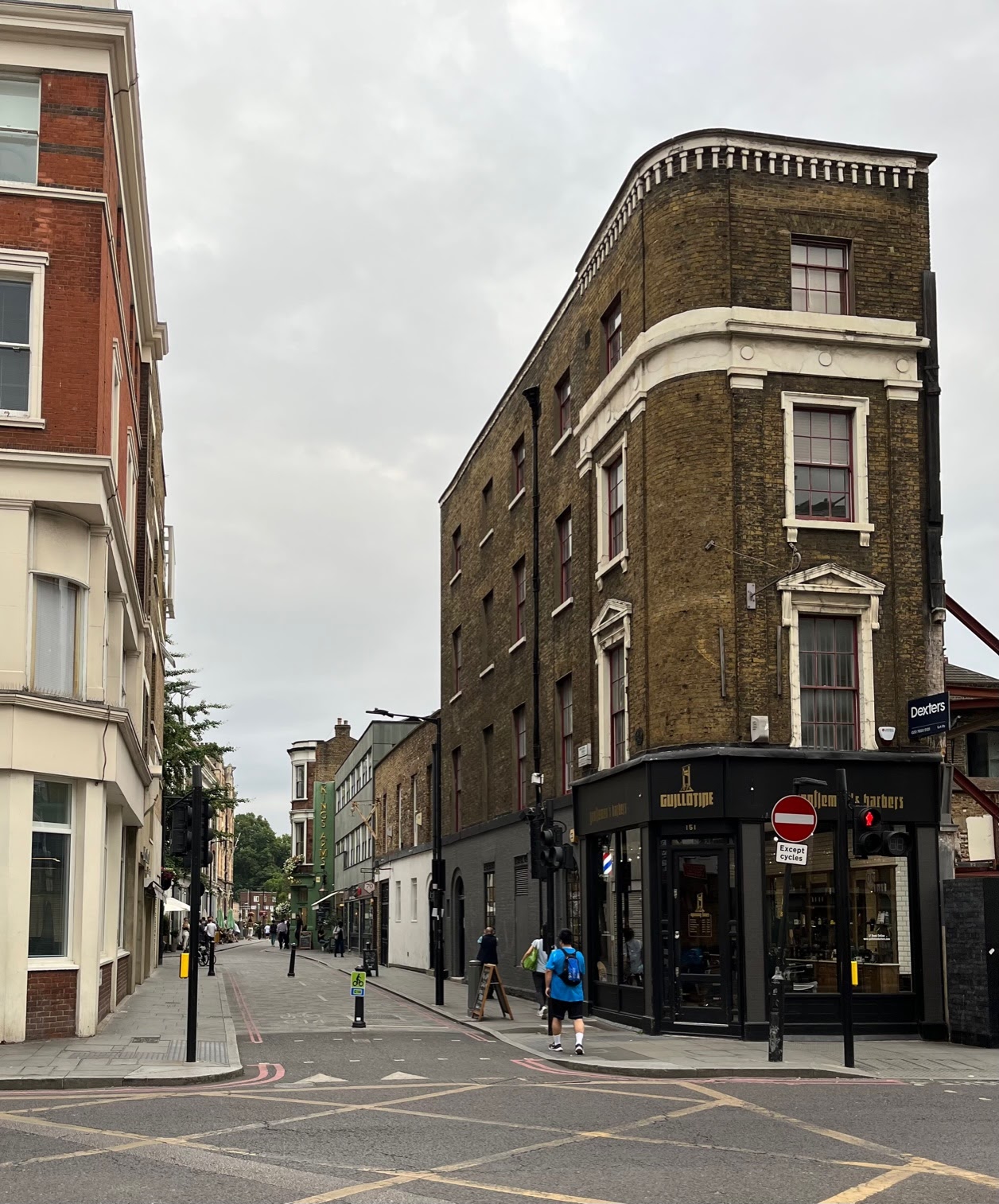 |
| 169 Borough High Street today (building on right) |
He seems to have been a merchant from the Gold Coast/Ghana who settled in England from the 1920s to at least the 1950s. And he strongly opposed racism internationally, possibly with a link with Garvey's movement. In an an article published in the Islamic Review, May 1921, Professor Abdul Karim Kpakpa-Quartey writes:
'To-day in Christian America the God-created black man, notwithstanding his Christian affiliations, intelligence or social prominence, is a slave and a serf, perhaps worse than in the dramatic days of the world- famed Uncle Tom's Cabin. He or she is still liable to be brutally flogged, kicked, knocked, imprisoned, shot dead or lynched at the will and pleasure of the bloodthirsty and savage American Tin God. Can you imagine the striking contrast between Caucasian Christianity and Islam, the religion of humanity? So utterly preposterous and absurd and scientifically illogical is color prejudice that I will not waste time in controversy'
It seems likely that this was the same person who wrote a letter to Garvey's Negro World paper in 1921 complaining of the treatment of unemployed Somali seamen in England; the letter of 22/10/1921 was signed by 'Prof. Karim Abdul Kpakpa-Quartey' of the African Association [Source].
What Abdul traded in is unclear. At one time he was involved in a business partnership called United States Inter-Allied Commercial Syndicate, described as 'Export and Import Brokers, Merchants and Shipping Agents'. At the time of its dissolution in 1923 his address is given as 91 Altenburg Gardens, Clapham Junction (London Gazette, 12 January 1923)
Marcus Garvey's United Negro Improvement Association was a transnational organisation aiming to link black people across the world, with part of its platform being to assist a return to Africa for the descendants of slaves. Famously he attempted to establish a Black Star Line of ships to make this a reality. So Garvey would not doubt have been interested in linking with African shipping merchants with a similar perspective.
Intriguingly another merchant from the Gold Coast with a similar name is recorded as speaking at a UNIA meeting in New York's Liberty Hall in 1919. This was Sam. G. Kpakpa-Quartey - was he a relative? His connection with the movement was a concern to the British authorities who wished to counter Black nationalist/Pan-Africanist influence in its colonies, whether in the West Indies or West Africa. Indeed this Kpakpa-Quartey is mentioned in a 1922 letter from Winston Churchill, then colonial secretary, concerning Garvey and the Black Star Line (source).
As might be expected of an African traveller, the main official records I have found on Abdul K. Kpakpa-Quartey are on passenger lists maintained by immigration authorities. A 1950 record has him travelling from Liverpool to Freetown, Sierrra Leone, while another from December 1956 records him boarding a Spanish ship in London heading to Las Palmas, Canary Isles.. His date of birth is given as 15/6/1895 and his address as 61 Albert Street, Newark, Notts. The Liverpool connection is interesting as another African organisation, the Native Union of Empire Africans, was founded there in 1935 by one A.J. Kpakpa-Quartey (source).
A 1950s consular marriage record from Dakar, Senegal indicates that he married Flora Gabbidon who, as Flora Irene Kpakpa-Quartey (dob 10/4/1919), travelled from Liverpool to Takoradi (Ghana) in 1958 with her son Matthew Ibrahim born 1952 (source: Findmypast).
That's all I know but I am sure there must be some more of his writings out there in yet to be digitised journals as judging by his Borough High Street office he was a very busy man. Today there are many people of Ghanaian heritage living in London so perhaps there might some interest in this Ghanaian activist from a century ago.


