Showing posts with label Brixton. Show all posts

Sunday, March 30, 2025

Bobby Seale of the Black Panthers in Brixton (1992) - as reported by undercover police

Bobby Seale was one of the founders of the Black Panther Party in the USA and like many of its activists bore the brunt of repression from the American state. Infamously in the 1969 trial of the 'Chicago 8' Vietnam war protestors he was ordered by the judge to be bound and gagged to prevent him speaking.

In 1992 Seale came to London and spoke at a huge meeting to a mainly black crowd at Brixton Recreation Centre and I was one of the many who attended. I believe it was organised by Panther UK, a black organisation with links to Militant (later the Socialist Party)

This was a time when 1960s black radicalism was being rediscovered by a new generation. Public Enemy had adopted the Panther aesthetic and indeed recorded a track that name checked Seale (Party for your Right to Fight). They played a number of iconic gigs at Brixton Academy and I saw them there myself in 1993.  The Nation of Islam was also having a revival, I remember guys in suits and bow ties selling their paper The Final Call by Red Records in Brixton.

Not going to lie, this was a period of inspiring anti-racist mobilisation but also intense pressure (racist murders, heavy policing, political egos) which manifested itself in exhausting bad tempered arguments and splits. I recall that 'Panther UK' itself broke up into different factions, and I think Seale himself may have walked off at some point in the meeting due to the politicking. But the Brixton meeting was remarkable and certainly one of the biggest events of this kind I had ever attended. The hall was packed to capacity with many more being turned away.

As reported by Julian Kossoff in  the Independent (5 October 1992):

'The black beret and the leather jacket have given way to a woolly jumper, jeans and sensible shoes. Bobby Seale, the co-founder of the Black Panthers whose clenched-fist salute became a symbol of the late 1960s, is now 56 years old and a teacher, the pistol that once hung from his waist replaced by a paunch. But even so, a 2,000-strong audience crowded into the Brixton Recreational Centre in south London at the weekend to hear his message of black power.

The passion and anger of the Panthers endures. Mr Seale, invited to speak by a newly-formed group of black and Asian people, Panther UK, can still preach the evangelical message of black socialist unity. Stalking the platform, he expounded the movement's 'race-class line', emphasising that different peoples - black, brown and white - had similar experiences of oppression and should unite against their common oppressor, the exploitative capitalist system. 'Don't you get the connection?' he asked repeatedly. The ideology had not changed substantially since the new left hailed the Panthers as the first genuine American revolutionaries since 1776 and Herbert Hoover, the FBI chief, called them 'the number one threat to the internal security of the nation'.

When he remembered the past he preferred to recall when the Panthers had stopped snarling. Armed defence, the controversial concept that all black people have the right to bear weapons to defend themselves from the racist state, was outdated, he argued. 'We don't need guns in the USA, at the moment . . . co-operation, humanism and grass roots organisations is where it's at.'

But Kossoff wasn't the only one present filing a report. From the Undercover Policing Inquiry we can now see a report written by an undercover cop infiltrating radical groups at the time. Spycop HN78 (who went under the name of Anthony 'Bobby' Lewis) reported that 2100 had attended with 500 turned away and that Seale has held:

 'the more or less undivided attention of the audience for fifty minutes. He spoke of the reason for forming the Black Panther Party for Self Defence (BPPSD) back in the mid sixties, of its criminalization by the capitalist media and in particular of its infiltration and destruction by the FBI. He made it clear that the battle he had fought then bore little resemblance to that being fought in the USA today. The current right of activists to demonstrate peacefully had been won for the present generation by the BPP  amongst others, back in the sixties. Law books rather than guns must be their chosen weapon.

SEALE went on to stress that the BPP was a disciplined, community based movement, enthused in the belief that only self defence was permissible if black people were prevented from peacefully marching to obtain their civil rights. However,  should circumstances change and perhaps reflect those pertaining in South Africa at the present time, then he would again advocate the use of weapons. He spoke next of the part progressive whites had to play, reminding the audience of the international nature of the struggle against injustice and that racism from whatever quarter was not to be tolerated. He concluded with the words paraphrased from the title of his book published over twenty years ago 'Seize the time'' .

On a more sinister note the report went on to note the ' impassioned pleas for justice' of  speakers from contemporary campaigns including Clara Buckley of the Orville Blackwood Community Campaign and Nellie Fergus of the Ivan Fergus Campaign as well as 'George Silcott who asked people to sign the petition on behalf of his brother which was to be handed in to the Home Office during the forthcoming picket of that establishment on the 21st October'.

It is now well established that undercover police spied on family justice campaigns who posed no threat other than exposing Metropolitan police wrong doing.  Nellie Fergus was just a Peckham mum campaigning to prove the innocence of her teenage son who had been convicted of attacking somebody with very questionable evidence; Orville Blackwood was a black man who died in Broadmoor Hospital; Winston Silcott was one of the Tottenham 3 convicted of killing a policeman in the 1985 Broadwater Farm uprising, for which his conviction was ultimately quashed.


See also:


Thursday, February 06, 2025

Railton Road Radical Histories Mural

The 'wall of respect for the radical histories of Railton Road' was painted  in 2021 by the RAD Mural Collective on a wall at  the 198 art space at 198 Railton Road. Designed by Jacob V Joyce and Monique Jackson, it packs in a lot of local historical detail, referencing black, queer and other radical spaces and scenes associated with the area. These are  mostly from the 1970s to 1990s, though there is a nod to more recent events with local firefighters shown taking the knee during the Black Lives Matter protests of 2021. 

According to the mural#s designers, 'Railton Road was once known as ‘The Front Line’ due to the sheer amount of anti-racist and counter hegemonic activisms which erupted on this street. A commemorative blue plaque which reads ‘The Front Line’ is painted into the top right corner of the mural. Beneath it local artist and often forgotten hero of black British LGBT history Pearl Alcock leans out of a window. Framing the scene on the left an art work by Rotimi Fani-Kayode, another LGBT icon and member of the Brixton Artist Collective, looms over a sleepy eyed Rasta opening his door in fluffy slippers. References to local organizations include the CLR James Supplementary School, radical squatted book shop 121 Books and a banner which reads ‘Black People Against State Harassment, B.A.S.H, a self defence campaign group also based on Railton Road. The Black Panthers, The Gay Liberation Front, Race Today Collective, and many other anti-racist, queer and feminist groups have been founded or run on this radical South London road'. The Front Line was the centre of the 1981 uprising, also referenced in the mural which was commissioned to mark its 40th anniversary.


I lived in Brixton for best part of ten years in some of these times so was taken aback (in a good way) walking past the mural recently to see all this so boldy and brightly represented, including the 121 Centre where I spent many a happy hour and maybe a few not so happy ones too! You could do another mural, or several, about just the things that happened there, as I summarised elseswhere:

'The 121 Centre in Brixton, variously known as an ‘anarchist centre’, ‘social centre’ and ‘squatted centre’, was a hub of international radical activity and much else throughout the 1980s and 1990s. The house at 121 Railton Road, SE24 was squatted by a group of local anarchists in 1981  (though it had previously been squatted by radical black activists) and was finally evicted in 1999. It is now private flats. Its four storeys included a bookshop, office space, printing equipment, kitchen and meeting area, and a basement for gigs and parties.

Over 18+ years it was the launchpad for numerous radical initiatives, some short-lived, others having a more lasting impact. Many groups used 121 for meetings and events, including Brixton Squatters Aid, Brixton Hunt Saboteurs, Food not Bombs, Community Resistance Against the Poll Tax, Anarchist Black Cross, the Direct Action Movement, London Socialist Film Co-op and the Troops Out Movement. Publications associated with 121 included Shocking Pink, Bad Attitude, Crowbar, Contraflow, Black Flag and Underground.

There was a regular Friday night cafe and many gigs and club nights, including the legendary mid-1990s Dead by Dawn. 121 was a venue for major events including Queeruption, the Anarchy in the UK festival and an International Infoshop Conference. It was, in short, a space where hundreds of people met, argued, danced, found places to live, fell in and out of love, ate and drank'.


Wednesday, October 16, 2024

Edward Said visits C.L.R. James in Brixton

Just been reading Timothy Brennan's 'Places of mind: a life of Edward Said'  in which he mentions the great Palestinian/American intellectual visiting Brixton in 1987, 'Paying his respects to an ailing C.L.R. James in Railton Road... Said had made the pilgrimage, in fact, to honor James's contributions to art and to black liberation. But even though, like Said, James had lived for a long time in the United States and praised autodidacts (and was himself one), his political experiences were starkly different. James had spent much of his life in Trotskyist parties organizing labor or battling with Caribbean nationalist leaders in a bid to create a West Indian federation. His tastes as a critic went much more in the direction of popular culture (especially Hollywood film) than Said's. More than anything, though, by the time of his visit, James's familiarity with Said's stature was limited. Only a few weeks earlier, the great civil rights activist and former Black Panther Stokely Carmichael had visited, and it was not clear James (who was not one to stand on ceremony) knew exactly who he was. Only when Said mentioned that he played piano did the two men settle in. In the hour and a half they spent together, they talked almost exclusively about Beethoven's sonatas and their dislike of Verdi and Puccini. Later, Said sent James a cassette of Gould's performance of The Goldberg Variations, to which James warmly replied 

A copy of James' letter to Said was posted on twitter by uptownberber last year 


As I've mentioned here before, James had many visitors upstairs at 165 Railton Road where he lived out the last years of his life. This visit was in the year I moved to Brixton where I spent much time in Railton Road. Nice thinking about whose paths I may have crossed in the streets

Thursday, October 26, 2023

The Tidal Year


Freya Bromley's 'The Tidal Year: a memoir on grief, swimming and sisterhood' sees the author travelling around Britain's tidal pools in the aftermath of her brother's untimely death. Along the way she visits some of my favourite swimming spots including Walpole Bay in Margate, Clevedon Marine Lake (on the Severn Estuary) and Dancing Ledge in Dorset.

But her home turf swimming spot is Brockwell Park Lido, even through the swimming there does not always come easy: 'Getting in the lido felt like a punishment, which something inside me needed. Getting out felt like a rebirth, which everything inside me needed. I took short, sharp breaths as the water burned my ankles, thighs, stomach, then chest. Crying happens on an inhale, and swimming gives me that same breathless sensation. I swam three laps, then at the deep end screamed underwater. When I emerged, I couldn't stop crying. Witnessing someone having a breakdown in a public pool must be a good way to see British manners'.

Along the way friendships and romance play out against a backdrop of familiar South London landmarks. East Dulwich Picturehouse, the Prince of Wales in Brixton, Myatts Fields, Herne Hill market, the Camberwell Arms and the Silk Road restaurant (also in Camberwell) all feature, not to mention a first date checking out the Lime Kiln in Burgess Park.

Tuesday, June 28, 2022

Brixton Hill Clinic Defence Campaign - defeating anti-abortionists in 1990

The anti-abortion movement in the UK will no doubt be emboldened by recent events in the United States, and while the scope for them to challenge current laws seems to be limited there is a risk that they may step up direct action against health services. In recent years anti-abortionists have picketed St John's Medical Centre in Loampit Vale SE13 (including in 2015 and 2018) and sporadically protest in Brixton and Streatham.

These documents are from an earlier campaign that successfully stopped similar protests, at least for a while. Back in 1990, a Brixton Hill Clinic Defence Campaign was set up in response to anti-abortionists picketing the local clinic.  The Campaign was set up at a meeting at Lambeth Town Hall in July 1990. As the invite issued by the socialist group Workers Power explained:

'As you may know, anti-abortionists have been regularly picketing the Raleigh Clinic in Brixton Hill and the Leigham clinic in Leigham Court Road. Streatham. The pickets have included supporters of Operation Rescue, a US derived organisation noted for its militant and often violent tactics. The pickets take place every Saturday at Brixton Hill between 8am and 12 noon, and as far as is possible to tell, between 10am and 12 noon at Streatham on the last Saturday of the month only.

The anti-abortionists tactics have so far included leafletting and harrasing women going into the clinic.  It is vital that all those who support choice and the right of women to control their own bodies get organised against the anti- abortionists. While there are not very many of them at present, if they are left unchallenged, they will attract support and their tactics will become more and more militant. Informal counter-pickets have been happening every Saturday at Brixton Hill. Such counter-pickets need to be organised properly and built for in the Labour movement.

It has also been argued that there is a need them to be carried out with sensitivity - there is a danger that large unruly counter-picket outside a clinic would have the same deterrent effect on women seeking abortions as the anti-abortionists themselves. 

We have taken the initiative of booking a room in Lambeth Town Hall on Monday 9th July in room 121, in order to hold a meeting to discuss the way forward to defeating the anti-abortionists. We need to discuss what tactics to use and how to mobilise people against Operation Rescue. We would hope that some sort of organising committee could be constituted to organise the counter-pickets, and any other action deemed necessary. We hope everyone who is concerned about the threat that the anti-abortionists represent and wishes to organise against them will either attend or, if an organisation, send a representative'.

Invite to a meeting to 'Organise Against Operation Rescue' at Lambeth Town Hall, July 1990

In the early protests the police did not seem to have been interested and when an anti-abortionist had run towards the clinic and been stopped by a counter-demonstrator it was the latter who was arrested (though later released without charge).  

At the meeting at Lambeth Town Hall the main political difference was on how to respond - representatives attending from the alphabet soup of left/anarchist groups active in Brixton at the time. Broadly speaking the Socialist Workers Party wished to mobilise counter protestors at the clinic. Others present - the majority at the meeting - felt that having a crowd there, even a sympathetic one, would be very uncomfortable for women attending. It was agreed to have enough of a presence at the Clinic to challenge the anti-abortionists and if necessary escort women past them, but not to seek to mobilise large numbers directly outside it. Instead, efforts would be put into preventing Operation Rescue getting to the Clinic in the first place

A leaflet given out at the clinic declared 'A Woman's Right to Choose... Raleigh Nursing Home is one of the few places in Lambeth that performs abortions. We are here today outside it because we believe that every woman should have the right to control over her own body. That means she should have the right to an abortion if she wants one.

Unfortunately there are some people who seek to prevent women from exercising that right- by force, by threats and by terror. You may have seen them here too. As often as not they are the ones on their knees. You may have been given one of their glossy horror pamphlets full of photographs of "dead
babies". If we had the same vast wealth behind us as they do - and the same twisted logic - you could be reading an equally glossy pamphlet full of pictures of dead women; just some of the hundreds of thousands who die every year throughout the world whilst attempting backstreet abortion. Because that is the reality in countries without even Britain's limited legal abortion facilities.

[...] we aren't trying to frighten anybody away. We don't even want to be here ourselves. It can be traumatic enough for women to come for an abortion without a crowd of people on the gate as they go in. We are only here because if we weren't the militant anti-abortionists - who in the United States have resorted to fire bombing clinics - will count it as a victory'


Meanwhile a crew drawn from Workers Power, Red Action, South London Direct Action Movement and other local anarchists, all of whom had a presence in the area, put in place the plan to stop Operation Rescue in their tracks. These people were in effect the backbone of Anti Fascist Action in South London and weren't mucking around. As the anti-abortionists made their way up from Brixton station they were ambushed, and as they used to say 'acquainted with the pavement'. It was a long time before they returned to Brixton Hill.


A report on the campaign from Workers Power, July 1990

 
A letter from the campaign from City Limits magazine, 2 September 1990

The following account, 'Bouncing the Bigots',  comes from Direct Action, October 1990:

'[...] In Brixton a group was formed to oppose Rescue by mounting a counter picket. Over the weeks, our tactics evolved and developed. Members of a variety of groups and organisations  (DAM, Red Action and others) formed the Clinics Defence Campaign.

Our main concern is not to add to the intimidation of women going into the clinic. A vast crowd clustered round the entrance is inherently frightening. We use what we call "them plus two": if they have five people, then we have seven and we surround them with our banners supporting a woman's right to choose. We also have back up in case of any trouble and also relief pickets for when the constant singing and praying gets too much!

Week after the were they have appeared and been met with a hostile reception. Slowly their numbers decreased as weaker souls got too scared to face up to vigorous local opposition. On one appearance due to a certain incident they left en masse (well, there were only 3 of them) in an ambulance. For almost 2 months now, they've been happily absent from Brixton'

[The address given for the Clinic Defence Campaign in this article is 121 Railton Road - the squatted anarchist centre that was used by many local groups in this period]


(updated February 2024 with addition of Direct Action article)

Wednesday, May 25, 2022

The Peanut Factory: squatting in South London in the 1970s

I really enjoyed reading 'The Peanut Factory' by Deborah Price (Guts Publishing, 2022), her memoir of life in South London squats in the 1970s and early 80s - and specifically the scene in the Crystal Palace/Norwood area. Must admit that despite myself being a Brixton squatter later in the 80s I had no idea how much squatting there was around that nearby part of London. But this was in a period when there were plentiful empty private and council homes for people to live in if they could cope with disrepair and no hot water.

She particularly mentions a triangle of streets lower down Gypsy Hill where many of the houses were squatted and a warehouse known as the Peanut Factory became an informal community centre: 'There was big rockabilly scene down at the squats, with King Kurt and other fledgling bands, and a lot of quiffs and hair-gel. Parties happened every weekend. It was amazing how many people could cram into a small Victorian terrace'.


People living round Upper Norwood will appreciate some of the hyperlocal detail, including memories of working in local pubs, the zoo and Crystal Palace Adventure Playground. But there is a lot here for anyone interested in alternative scenes in London and their cultural history. 

Price really evokes this time through her relationships with a shifting cast of friends, lovers and flat mates. There is freedom and affordable living, but also addiction and sexual abuse.

Price moves through the sub cultures of the time, leaving aside her former hippy clothes and records to enthusiastically embrace punk and then moving on to clubbing at places like the Fridge in Brixton, the WAG and Le Beat Route: 'Getting dressed up and partying was a living protest against cuts and poverty. It was fingers up to the Government'. Sometimes cultural/music historians treat these scenes as a succession of completely distinct moments, when the fact is it was sometimes the same people involved just changing their clothes.

The Fridge is probably best remembered now for its long term location at the bottom of Brixton Hill, now home of Electric Brixton. But for a couple of years in the early 1980s it was above the Iceland store on Brixton Road. Price remembers it at that time as being 'glittering white, decorated with lots of fake ice stalagmites and stalactites... lit up with silver and blue lights to get a cold icy backdrop' (I went there once to see Rubella Ballet). She also recalls regularly getting her cut at one of the famous gay squats on Railton Road. 

The author is giving a talk at the Bookseller Crown bookshop in Crystal Palace on 26th May 2022, details here. 

Monday, November 15, 2021

Joy Crookes - South London Songs

Joy Crookes at Queens Road, Peckham

Singer Joy Crookes has a new album out, Skin,  and very good it is too. She's been compared to Amy Winehouse, but she has a great voice of her own and her songs are rooted firmly in 2020s London. Joy grew up at Elephant and Castle and her songs reference various South London locations, notably the Elephant itself on the track '19th floor' which bemoans the changes there: 'Lost the tower where my heart is,  Cinema skylines that I don't recognise, Strip the life out of these streets,  It's a daylight robbery'. The song mentions 'Bopping down Walworth Road'

'When you were mine', a single from the album, has a Brixton setting - 'Hand in hand, Coldharbour Lane... Smile with a Brixton shine'.  The Ritzy cinema and Electric Avenue are namechecked and the video is filmed around Brixton market particularly the area near Brixton Rec.


Joy explored these streets on some of her earlier songs. London Mine (2019) is a kind of hymn to multicultural London with a video shot on Walworth Road featuring local faces including tailor George Dyer.  Lyrics include 'Lovers walk Old Kent Road' and Kennington Road is also mentioned.


There are kids playing football at Peckham Town's ground...

...and dancing in the now vanished Elephant and Castle shopping centre.


Another 2019 track, 'Two Nights' sings of 'runnin' through East Street with emotional baggage', and much of the video is shot in East Street market as well as at the Michael Faraday steel box memorial at the Elephant (erroneously believed by some to have once belonged to Richard James/Aphex Twin!)


Tuesday, May 25, 2021

Black Lives Matter in South London, one year on

'ACAB' 'Floyd' - Albert Embankment SE1, April 2021

A year ago today the killing of George Floyd by a police officer in Minneapolis sparked off the latest round of the global Black Lives Matter movement. The UK movement really started off with a march in Peckham on the 30th May and today Black Lives Matter activist Sasha Johnson is in our thoughts, seriously ill in Kings Hospital after being shot in Peckham last weekend. We have covered some of the many protests and posters in South London here before, but a year on here's a few more examples of the visual impact of the movement locally.


'FTP/BLM', Cold Blow Lane SE14


'Black Lives Matter', Hilly Fields


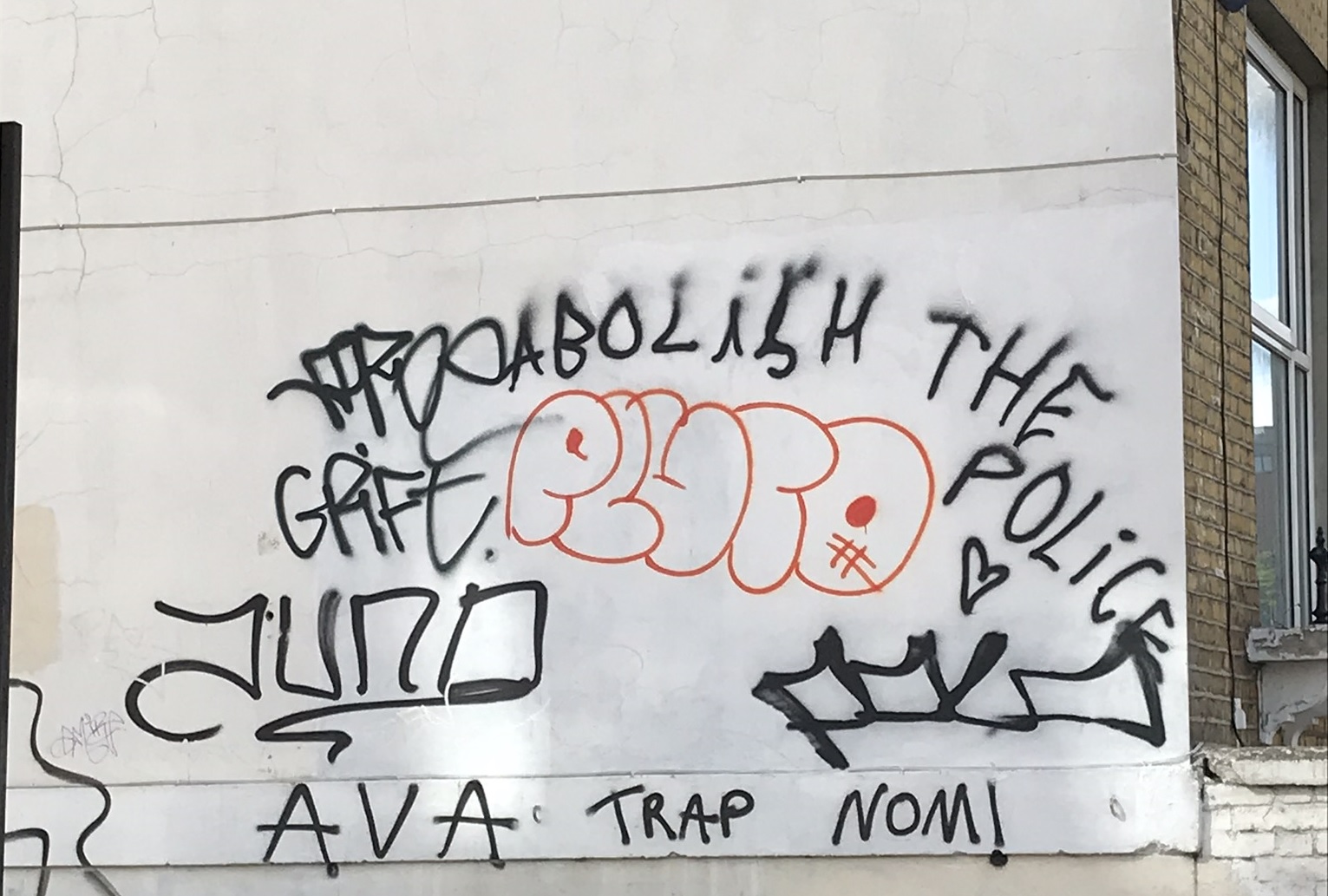
'Abolish the police' - Queens Road, Peckham


Lewisham Way, outside Goldsmiths


'George Floyd' with fist, Barry's Food Store, Barry Road, East Dulwich


'Black Lives Matter - we understand that we will never understand. However, we stand'
(London Theatre, 443 New Cross Road)

'More blacks, more dogs, more Irish' - sticker on Lewisham Way

Black Lives Matter topiary, Brixton end of Dulwich Road


A number of professionally designed posters appeared, including on paid for advertising billboards. The messages and images were sometimes strong, but I did feel uneasy at a kind of marketing style 'aestheticisation of rage.'  

'I can't breathe' - Brockley Cross


'Black British History is British History', Amersham Road SE14

'Bun the Police' - Queens Road station
   
Arguments about appropriate (or even appropriating) imagery came to a head in relation to the use of the instantly iconic photograph of Patrick Hutchinson carrying an injured white man following clashes in London on June 13th. On that day a large number of right wing eejits demonstrated in central London, supposedly to defend statues from Black Lives Matter protestors. They had a punch up with the police and as some warriors of the master race were heading home via Waterloo station they were humiliatingly decked by anti-racists. Dylan Martinez got a great photo of Hutchinson, and this was reproduced all over the place - including on this 'bank note' billboard by Queens Road station, Peckham. 


Soon though people began to question why this image had become so acceptable in mainstream media. It seemed to being used to suggest some cosy reconciliation between racists and their opponents, mediated by the figure of a 'respectable black man'. This was certainly not Hutchinson's intention. In interviews since he has been very clear that racists can't complain if they face the consequences of their words and actions, and his motivation on the day was partly to prevent young black people ending up on serious criminal charges if the guy had ended up  badly injured or worse. 

Local mural artist Lionel Stanhope painted a mural based on Martinez' picture on hoardings in Lewisham in September 2020. Lionel is a good guy and meant well but the critical discussion about the overuse of this image was reaching its zenith. Somebody painted over it 'We don't rescue racists in Lewisham, we run them out'. Soon it was painted out altogether (see discussion at Huffington Post).


Builder Balfour Beatty had allowed the original mural to be painted, along with other street art, on the boards around its property development near Lewisham station. The limits of its tolerance were exposed shortly after when Balfour Beatty painted over a mural opposite the police station in memory of Kevin Clarke who died while being restrained by police in Catford in 2018. A reminder that we have our own George Floyds closer to home who also must not be forgotten.


Wednesday, August 29, 2018

Gill Roth and Andrew Clarke - Make Believe (and 30 years of making things happen in London)

Opening this week at Lewisham Arthouse, Gill Roth and Andrew Clarke present their joint exhibition 'Make Believe'  Gill and Andrew 'make work that blurs the edge between abstraction and representation, where the observable world meets the environment of the imagination. While drawing forms the core of Gill’s practice, Andrew’s figures emerge through a process of collaging and assemblage. Both work on paper in a way that embraces intuition, accident and play with recurring motifs hinting at inner bodily functions or states of mind' (see website for further details).


I had a chat with Gill and Andrew last week. Apart from the intrinsic interest of the exhibition itself, I want to highlight their role as long term 'cultural activists' in London (for want of a better word), helping to make interesting things happen for more than 30 years.

Gill and Andrew met at Maidstone College of Art in the 1980s, where their contemporaries included Tracey Emin, moving up to South London - where Gill had grown up in West Dulwich - shortly afterwards. Andrew did a printmaking course at Morley College, where Gill worked for a spell too.


Gill and Andrew at Maidstone College of Art


Andrew (left) at Maidstone graduation - Melvin Bragg warns art students of the 'hostile world' of market forces
This was a time when cultural work was enabled by a (fast disappearing) economy of benefits, free/low cost adult education, cheap housing (they lived for a while in the Gypsy Hill Housing Co-op) and cash in hand jobs. Like many other art students before and since, Andrew subsidised his own work by life modelling including for the artist Maggi Hambling.

Andrew got involved with legendary Brixton club the Mambo Inn, which ran at the Loughborough Hotel from the late 1980s to 1996. The club was best known for its African and Latin American music but also had a jazz thread running through it which Andrew helped contribute as DJ ‘Danny Polo’. He also designed some of the banners which defined the club’s strong visual image (I had some great nights out there myself in my Brixton clubbing days). Andrew was also able to combine his musical and artistic interests in this period by doing illustrations for Paul Bradshaw’s influential Straight No Chaser magazine. His involvement in music has continued ever since, including singing in 1990s bands Matilda and Charm.
Andrew at Mambo Inn at Loughborough Hotel
Answering an advert in Time Out which asked ‘Why Work’in 1985 led to Gill and Andrew joining ‘Build Hollywood and Film It’, a film/theatre collective operating out of an empty school in Chelsea. Build Hollywood worked for a couple of years making a movie that was never released, but they did make short films including a promotional video for Brixton Cycle Co-op. They also put on events including a comedy night at the Hackney Empire featuring Jonathan Ross and his Last Resort sidekick Dr Scrote. Later the pair were involved with putting on the Umbrella Club at the Diorama Arts Centre near Euston (where Andrew DJ'd along with Charlie Gillett and others), and organising a fundraiser variety night featuring Vic Reeves and Jack Dee performing early in their careers.
Umbrella Club banners and 1991 flyer - 'funk/soul/house/African/jazz/reggae/Latin/raggamuffin/rare groove'
Andrew's own acting involvement led him to perform at that most prestigious of South London venues - the old Den, home of Millwall before its demolition in 1993.  As part of the Bargain Bucket theatre company, Andrew provided pre-match children's theatre. They also put on a children's circus on Ladywell Fields. Alongside his creative work, Andrew trained to teach English as a Foreign Language and has been working with refugees in this field for many years.

Having worked for spells at Morley College, Camberwell Arts College and as an Edinburgh Festival volunteer, Gill meanwhile pursued a career in freelance journalism and arts PR, working initially with Julia Hobsbawm (thanks to an introduction while showing Quentin Tarantino around town on his first visit to London - it's a long story). Over the years she worked for many clients in the arts and museum world including Artangel, the Victoria and Albert Museum and the Imperial War Museum

In 2005 they launched Cinetopia, a film night with a quiz, initially at the Crown and Greyhound pub in Dulwich. Later they moved it to the Hill Station Cafe on Kitto Road. This led on to them starting the popular New Cross and Deptford Free Film Festival, bringing their expertise in film, promotion and events.

Gill and Andrew had continued to practice their drawing and printing at various times through the 1990s, including exhibiting in an open show at the famous Cool Tan squat on Effra Road in Brixton (I went to some great parties there too but that's another story). Their relocaton to Telegraph Hill in the early 2000s with its thriving Open Studios scene inspired them to make more work and show it publicly.

Andrew Clarke mural at the Hill Station SE14  - Procession of the Manimals (2014)
Gill Roth paints scenery for Telegraph Hill Pantomime 'Babes in the Wood' (2012)

Andrew and Gill appreciate Lewisham Arthouse as one of the vanishing places offering cheap studio and exhibition space with a minimum of bureaucracy. While they don't have studios there, Gill has attended life drawing classes there for some time as well as more recently attending events organised by the London Drawing Group (who among other things run Drink and Draw sessions at Buster Mantis in Deptford). Gill says I have 'drawn people since I was a kid' but highlights the work of artists such as the London Drawing Group and Nicola Tyson who are doing interesting contemporary work in this medium and showing that 'you can draw in 2018 and still make sense)

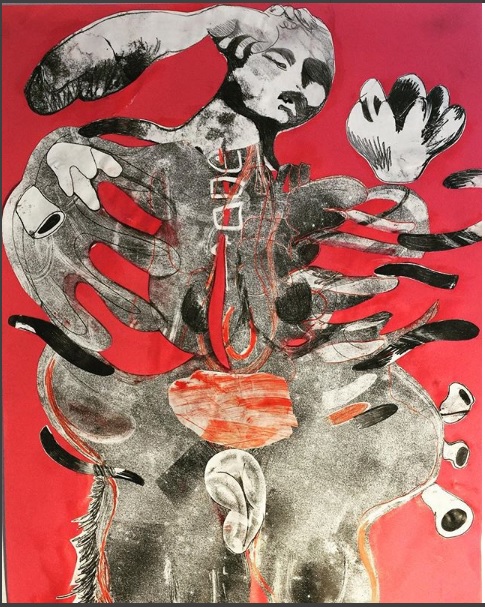
Gill Roth, 'Anatomical Venus'

Make Believe runs from Saturday 1st September to Sunday 9th September 2018 (Opening Times: Weds – Sun, 12 – 6pm), with the Private view on  Friday 31st August. 6 – 9pm. Lewisham Arthouse is on Lewisham Way, SE14 6PD. Full details here: http://www.lewishamarthouse.org.uk/project-space/make-believe/

instagram: @rothgill @clarkesville.art

Sunday, March 12, 2017

Stan Firm inna Inglan at Tate Britain


 Tate Britain gallery is currently displaying 'Stan Firm inna Inglan: Black Diaspora in London, 1960s-1970s', featuring images by 'eight photographers who documented Black communities in London: Raphael Albert, Bandele 'Tex' Ajetunmobi, James Barnor, Colin Jones, Neil Kenlock, Dennis Morris, Syd Shelton and Al Vanedenberg'.


There are a number of outstanding South London images to be seen, including Syd Shelton's photographs from the New Cross/Lewisham anti-National Front protests of 1977...


A smoke bomb in New Cross Road, August 1977 © Syd Shelton


..and Neil Kenlock's early 1970s photographs of the British Black Panther movement, particularly in the Brixton area, including this one of girls with Black Panther bags.


© Neil Kenlock

Sunday, November 06, 2016

Van Gogh in South London

As a young man, the artist Vincent Van Gogh (1853-1890) spent a couple of years living in London. Thanks to his practice of sending regular letters to his brother Theo and others, we know quite a lot about his time here including his movements across South London. The complete letters are available online courtesy of the Van Gogh Museum.

Van Gogh drawing of 87 Hackford Road - rediscovered in 1973
(source: wikipedia)
It was in the summer of 1873, while working for an art dealer,  that he moved to lodgings at 87 Hackford Road, Stockwell.  He wrote of it: 'I now have a room, as I’ve long been wishing, without sloping beams and without blue wallpaper with a green border. It’s a very diverting household where I am now, in which they run a school for little boys'. The 'diverting household' was the house of Ursula Loyer and her daughter Eugenie. A year later, Van Gogh declared his love for the latter, and when rebuffed the heartbroken artist moved  with his sister Anna to new lodgings  at the Ivy Cottage 395 Kennington Road - the house of John Parker, a publican. While he was staying there, the landlord's daughter Elizabeth Parker died of pneumonia, as mentioned in an April 1875 letter to Theo:

'I’m sending you herewith a small drawing. I made it last Sunday, the morning a daughter (13 years old) of my landlady died. It’s a view of Streatham Common, a large, grass-covered area with oak trees and broom. It had rained in the night, and the ground was soggy here and there and the young spring grass fresh and green'.


We know that he visited Dulwich Picture Gallery, writing on  4 August 1873) 'I had a nice day last Monday. The first Monday in Aug. is a holiday here. I went with one of the Germans to Dulwich, an hour and a half outside L., to see the museum there, and afterwards we walked to a village about an hour further on. The countryside here is so beautiful; many people who have their business in L. live in some village or other outside L. and come to the city every day by train' (L. is of course London). Exactly a year later he returned to the Gallery with his sister Anna (see note)

After a period in Paris in 1875, Van Gogh also spent much of 1876 living in England, in Ramsgate and then Isleworth. It was during this period that he visited the Gladwell family in Lewisham, who lived at 114 Lee High Rd.  It was a sad occasion, as he wrote from Isleworth (18 Aug. 1876) 'Yesterday I went to see Gladwell... Something very sad happened to his family: his sister, a girl full of life, with dark eyes and hair, 17 years old, fell from her horse while riding on Blackheath. She was unconscious when they picked her up, and died 5 hours later without regaining consciousness. I went there as soon as I heard what had happened and that Gladwell was at home. I left here yesterday morning at 11 o’clock, and had a long walk to Lewisham, the road went from one end of London to the other. At 5 o’clock I was at Gladwell’s.  I’d gone to their gallery first, but it was closed'.

Harry Gladwell was a friend of Vincent's who he had met  while working in Paris. It was his sister Susannah Gladwell who had. Gladwell's father, Henry Gladwell, ran a gallery in Gracechruch Street in the City of London. The six hour walk from Isleworth to the City and then to Lewisham is around 30 km. His route from the City would have presumably been across London Bridge and then down the Old Kent Road, through New Cross and up what is now Lewisham Way. 

Van Gogh wrote home in October 1876:  'One of these days, perhaps, I’ll go to London or Lewisham again', and soon he did. In Isleworth Van Gogh worked in a school and was sometimes sent by its headmaster, Thomas Slade-Jones, on errands such as collecting school fees. He wrote to his parents in November 1876: 'It is already late, and early tomorrow morning I must go to London and Lewisham, for Mr. Jones...I must be in the two remotest parts of London: in Whitechapel - that very poor part which you have read about in Dickens; and then across the Thames in a little steamer and from there to Lewisham'. He added the next day 'I started this morning at four o'clock, now it is two. I have just passed through the old cabbage fields - now for Lewisham. One sometimes asks, how shall I ever reach my destination?'. Wonder where the cabbage fields were? I guess the 'little steamer' crossing could have been at Woolwich.

Later that month he was back in Lewisham again, this time visiting the Gladwells at the end of another long journey: 'I left here at 4 in the morning, arrived at Hyde Park at half past six, the mist was lying on the grass and leaves were falling from the trees, in the distance one saw the shimmering lights of street-lamps that hadn’t yet been put out, and the towers of Westminster Abbey and the Houses of Parliament, and the sun rose red in the morning mist – from there on to Whitechapel, that poor district of London, then to Chancery Lane and Westminster, then to Clapham to visit Mrs Loyer again, her birthday was the day before... I also went to Mr Obach’s to see his wife and children again [314 Brixton Road]. Then from there to Lewisham, where I arrived at the Gladwells at half past three. It was exactly 3 months ago that I was there that Saturday their daughter was buried, I stayed with them around 3 hours and thoughts of many kinds occurred to all of us, too many to express'. 

Van Gogh mentioned his friend Harry in a letter in December 1877:  'I hope he’ll be able to go to Lewisham at Christmas. You know that painting by Cuyp in the museum here, an old Dutch family, when he saw that he stood looking at it for a long time and then spoke of ‘the house built on the rock’ and of his home in Lewisham. I, too, have memories of his father’s house and will not easily forget it. Much and strong and great love  lives there under that roof, and its fire is in him still, it is not dead, but sleepeth'.

Friday, April 08, 2016

The No Frills Band & 20 years of South London folk sessions

The No Frills Band are playing at the Birds Nest (Church Street SE8) in Deptford on Saturday afternoon  - April 9th 2016 - so expect some fine traditional folk music. Check facebook for details, but they should be up and running by 4 pm

Last time I saw them play was only last Saturday on the steps outside Carnegie Library on Herne Hill Road, occupied in protest at its planned closure by Lambeth Council.


The band can always be relied upon to turn up at community events in the South London area, but more than that the members of the band have been at the centre of an ongoing series of folk sessions in the area stretching back for over twenty years...

Last night's fun

In 'Last night's fun: a book about music, fun and time' (1996), Ciaran Carson muses on simultaneous Irish music sessions in different parts of the world as 'starry fragments of a great galactic internet which shimmers over all the shebeens of the earth... Across the many time zones the same tune might be bi-located at the same time, in the same time'.

But while the pub session scene might have started out with Irish music, Carson suggests that the origins of the Irish session are in London rather than Ireland. Traditional Irish musicians back home used to mainly play at weddings and other community functions, rather than in the public bar. The large number of Irish migrants who moved to London for work after the Second World War were separated from this circuit so musicians began gathering in pubs to play. This practice of fairly informal drop in folk music pub sessions eventually spread back to Ireland itself.
 
There's an interesting discussion about this history at The Session website, including a list of London pubs that hosted Irish sessions in the 1950s and 1960s. South of the river this included The Admiral Duncan in Deptford (New Cross Road), Duke of Gloucester in Walworth (Gurney St SE17), The World's End in Newington Causeway SE1 and The Black Prince (Kennington Road SE11) - of which only the latter survives.


Mandolins and me
 
My initiation into this scene came when I took up the mandolin in the early 1990s. I had been listening to a lot of Irish and Scottish music, and the instrument had gradually entered my consciousness,  creeping up on me until one day at a now-vanished shop in Camden Lock I just went for it and bought one. I'd never even picked one up before. My first mandolin was made by Ozark in Romania. For some strange reason it featured the design of a palm tree on the front, something I assume is rarely seen in its country of origin.

It was back up to Camden again to learn how to play it. At that time the Working Men's College was a major source for the diffusion of Irish music. Pete Cooper ran a fiddle evening class, whilst Mick O'Connor ran a combined tenor banjo and mandolin class.  His technique was simple - no fiddling around with scales or theory, just learn the tunes. He would stand at the front with his banjo and very patiently play slowed down versions of jigs and reels, with  the rest of us attempting to follow using the hand written tabs Mick supplied. Many of us also brought in cassette recorders (remember them?) to help us remember the tunes for practising at home.
 
Mick O'Connor
 
As we grew in confidence, a group of us started meeting up to play together. We began in a room above a pub in Southwark, the now demolished St George's Tavern, opposite The Imperial War Museum and next  to the Roman Catholic St George's Cathedral on Lambeth Road SE1. Before long we had migrated to the bar downstairs for what became a regular Sunday lunchtime session. There were a couple of experienced musicians, but most of us had never played in public before. Someone came up with the name McGonagall's Revenge, since our shambolic offerings were on a par with the rudimentary poems of the Scottish amateur, appreciated after his death for being so bad they were almost good. The  line-up usually included mandolin, fiddle, guitar, banjo and bodhran, sometimes with more than one of each depending on who turned up. On one occasion we even stretched to uilleann pipes. There was a regular core of people, but anyone was welcome to drop by. Sometimes you would get some random tourists over from the Imperial War Museum joining in - I remember some Swedish guys coming by and singing a song.
 
We had a regular repertoire of songs as well as tunes: 'Back home in Derry', 'the Fields of Athenry', 'The Rocky Road to Dublin', 'Flower of Scotland', 'The Lark in the morning' etc. But in that period singing Irish songs in public was a tricky business even if you avoided the most obvious republican rebel songs. The cathedral next door had hosted the funeral of Terence MacSwiney, the mayor of Cork who had died on hunger strike in Brixton prison in 1920. Every year there was a memorial mass in the Cathedral, with an overspill of veteran republicans into the pub afterwards. In 1993 this coincided with the weekend of the terrible bombing of a chip shop in Belfast Shankhill Road, in which nine people died (an attack which may have involved a British state double agent within the IRA). I recall the nervous landlord in the pub asking us to stick to tunes and to leave the songs alone. During that period too one of our group, a young Irish guy,  was arrested under the Prevention of Terrorism of Act - though I don't think it was his music that drew the attention of the police (he was released without charge).
 
There were many other Irish sessions across London. There were some great playing, but the atmosphere was sometimes a bit intimidating - if you had to ask what the tune was, you probably shouldn't have been there. I recall a particularly high speed session at The Telegraph pub on Brixton Hill. I didn't dare get my mandolin out there!
 
Brixton Sessions
 
But the core of what was later to become the No Frills Band had started a different kind of session in Brixton pubs like the Windmill and the Duke of Edinburgh (Ferndale Road SW9). Many of the people had their roots in the local squat/punk scene, and there was less preciousness about the repertoire than in some traditional sessions: a core of Irish tunes to be sure, but also music from around the world.  Well national authenticity in folk music is often bogus anyway - 'Irish music' has always drawn on Scottish reels, Bohemian polkas, Polish mazurkas and English hornpipes, with tunes travelling across borders as readily as itinerant musicians.
 
Last session at the Grosvenor in August 2014
(photo by Mike Urban at BrixtonBuzz)
This session later moved on to The Grosvenor in Stockwell until it closed in 2014, and continues to this day as the No Frills session on the second Sunday of the month back at The Windmill off Brixton Hill, starting at around 7 pm: 'All musicians and all styles welcome. Irish, Welsh, English and Scottish, American old time, bluegrass and western swing, French, Yiddish, East European, Scandinavian, Greek, Turkish, Balkan and more. All abilities tolerated. Come and swap tunes and songs, meet people and learn stuff. Or, do what most people do and just grab a beer and enjoy the music. See you in the Windmill!'. Next one is actually this forthcoming Sunday.

I played a few times in those mid-1990s sessions at the Duke of Edinburgh, but then headed off through a period of house and techno obsession followed by parenthood in which my never more than basic mandolin playing got very rusty. I did have a go at one of the Grosvenor sessions a couple of years ago, and at another session upstairs in the Old Nun's Head. Maybe I'll get back into it again properly some time, when you start playing the fingers remember the tune even when the mind doesn't... 
 
Scores of  musicians must have taken part in those sessions over the past 20 years, passing through and picking up tunes, the definition of a living music tradition.

Magdalena Marmot (Maggie), a regular at those Brixton sessions who sadly died
in Calderdale Royal Infirmary in 2012

[update March 2026 - I saw some footage just now of a session this week at the Sir Colin Campbell pub in Kilburn, with Mick O'Connor still going strong on banjo]