Showing posts with label First World War. Show all posts

Thursday, April 07, 2016

Socialist Opposition to World War I - exhibition and talk in Blackheath

Interesting event coming up next week:

'St George's Church in Westcombe Park is pleased to host a showing of a free educational exhibit entitled "Socialist Opposition to World War I". The exhibit runs all day on Friday 15 and Saturday 16 April in the nave of the church, located on Glenluce Road in Blackheath, SE3 7RZ.

On Friday 15 April at 7:30 pm there will be a lecture by Prof Mary Davis, Visiting Professor of Labour History at Royal Holloway University of London, and creator of the exhibit. She has written, broadcast and lectured widely on women’s history, labour history, imperialism and racism. She was awarded the TUC women’s Gold Badge in 2010 for services to trade unionism. Refreshments will be available throughout the exhibit.

As we consider the causes and legacy of that terrible conflict, we commemorate those who served, those who never returned, and also those who opposed the war due to conscience.The exhibit was created through the auspices of the Marx Memorial Library and is funded by the Heritage Lottery Fund'.

(facebook event details here)


Friday, June 05, 2015

1915 London Tram Strike in New Cross

A hundred years ago this week, tram workers in London were sacked for going on strike and sent off to war. The London tram strike was prompted by the rising cost of living - the 7,000 strikers demanded a 'war bonus'.  The response of the employer, London County Council (LCC), was to sack all men of military age, telling them to volunteer for the armed forces.

The strike of drivers and conductors started out on Friday 14 May as an unofficial walkout at the New Cross depot - now the bus garage on New Cross Road - and soon spread across London (Sunday Mirror, 16 May 1915). The strike united workers from two rival unions - the London and Provincial Union of Licensed Vehilce Workers (known as the "red button men" ) and the "blue button" Amalgamated Union of Tramway Vehilce Workers'  (Daily Mirror - Monday 17 May 1915).

Pickets at New Cross depot (Daily Mirror, 17 May 1915)

The trams were the main source of transport for many workers to the Woolwich Arsenal, and it was reported that  'The New Cross men have made an offer to the L.C.C., which has been refused, to work cars each day to Woolwich for war munition workers without pay. The one condition was imposed — that the Council should allow the men to travel free'  (Liverpool Echo - Tuesday 18 May 1915)

Some trams did run to Woolwich:  'Extraordinary scenes were witnessed in South London yesterday morning as a  result of the tram strike. Heavy rain had been falling since an early hour, and thousands of people waited at different points in the hope of getting omnibuses, but the majority were doomed to disappointment. At New Cross, where cars labelled ' War munitions workers only" were running to and from Woolwich, great resentment was occasioned when only those producing Arsenal passes were allowed to board the cars'  (Newcastle Journal, 19 May 1915).  Strikers picketed the New Cross depot throughout the strike.

New Cross Road in the strike, by the depot (Sunday Pictorial, 16 May 1915)
On the last day of the strike, 'At New Cross about 1,200 strikers attended the Hatcham Liberal Club, when a resolution was adopted expressing confidence in the joint committee of the unions and determination 'to fight to a finish'.  One speaker complained that what was started a a 'strike' had now been made a 'lock-out' by the Highways Committee of the L.C.C. The men were advised to go back in the belief that their grievances would be dealt at once, but the L.C.C. were really taking the place of the Government by insisting on conscription' (Birmingham Daily Post, 1 June 1915).  The Daily Herald also reported 'a meeting in the Five Bells, at New Cross, the storm centre of the tram-men's strike'  (Daily Herald - Saturday 22 May 1915)

The strike took place at a time of increasing social tensions. In the same week there were anti-German riots in different parts of the country, in which shops run by Germans (or those with German-sounding names) were attacked, including in New Cross and Deptford:  'One result of the riots is a severe bread shortage. Near New Cross Gate so many bakers’ shops have been smashed that the police had be called yesterday to regulate the crowd which surged round the only shop in the neighbourhood where bread could be obtained' (Birmingham Daily Post - Monday 17 May 1915).

Monday, May 18, 2015

Peace meetings in First World War Lewisham

Opposing the First World War was a difficult business, with harassment from the authorities and from pro-war mobs. In 1916, Nellie Best of the Women's Anti-Conscription League was jailed for 6 months for deterring recruiting, and the Lewisham Borough Peace and Anti-Conscription Council passed a resolution demanding her release (Daily Herald,15 April 1916).

Sylvia Pankhurst, the radical socialist and suffragist, was active in the anti-war movement, as a key figure in the Women's Suffrage Federation/Workers Suffrage Federation (after 1917 name change)/Workers Socialist Federation (from 1918). The WSF was particularly active in the  East End of London, but sometimes south of the river, as this report of a 'GREAT PUSH" FOR PEACE' (Daily Herald, 6 October 1917) demonstrates: 'The Workers' Suffrage Federation's " Great Push" for Adult Suffrage, Socialism, and, above all, for Peace by Negotiation, held on Saturday, September 29, in Greenwich and Lewisham, where all the speakers met with good reception. Men in khaki and wounded soldiers from the local military hospital took Peace leaflets and bought the Workers' Dreadnought. A good collection was taken...  Volunteers for these parades should write to Miss Sylvia Pankhurst, 400, Old Ford Road, Bow, E3'.

Sylvia Pankhurst
A planned meeting the following month by the pro-peace Fellowship of Reconciliation received a more hostile response. Those opposing the war were likely to be labelled as pro-German as the headline to the following article from the Nottingham Evening Post (9 November 1917) makes clear:

'THE KAISER’S FRIENDS. PACIFISTS REBUFFED AT LEWISHAM.

A meeting under the auspices of the Fellowship of Reconciliation at Lime Hall, Lime-grove, Lewisham, to be addressed by Mrs. Swanwick, was cancelled at the last moment yesterday owing to the presence of a large and hostile crowd. Cheers were given for the "Boys in Khaki" and the Lads in Navy Blue,” and several of the promoters of the meeting were rather roughly handled. An impromptu patriotic meeting was held outside the hall, at which a resolution was passed in favour of refusing to allow any more peace meetings to be held'.

'Mrs Swanwick' mentioned here was presumably Helena Swanwick, the first Chair of the Women's International League, an organisation set up by pro-peace suffragists (she was also, incidentally, the sister of the artist Walter Sickert)

Helena Swanwick - stopped from speaking in Lewisham, 1917

Ken Weller's book 'Don't be a soldier!' The radical anti-war movement in north London 1914-1918 is an excellent account of this period. As the name suggests it is primarily about north London, though he mentions the WSF making  'occasional forays into the transpontine wastes of South London'!. Wish I had the time to research a South London version.

Monday, August 25, 2014

World War One: the first local deaths

Thousands of people from the Lewisham area were killed in the First World War. If you want to get an idea of the sheer scale of the devastation have a look at the Commonwealth Graves Commission site. It includes a fairly comprehensive list of casualties from both world wars and on their 'Find War Dead' page you can search under name or put in the name of a place or street under 'additional information'. If you live in a road that's more than a 100 years old you are fairly guaranteed to find out that someone who once lived nearby to your home died (many of the CWGC records include details of next of kin, with address listed).

Although Britain officially entered the war on 4 August 1914, the first encounter between British and German forces did not take place until the Battle of Mons in Belgium on 23rd August 1914.  And on that first day of fighting one hundred years ago at least four people with local family connections were killed:

- Richard King (aged 35), Royal Scots Fusiliers - the brother of Mrs. A. Gallon, 10 Hales St, Deptford.

- J A Sharpe (aged 36), East Surrey Regiment - husband of Elizabeth Ward (Formerly Sharpe), of 1 Royal Naval Place, Amersham Vale, New Cross

-  Albert  Edward Burstow (20),  Queen's Own (Royal West Kent Regiment), son of Mr. And Mrs. E. R. Burstow, of 3, Hanlon St., Grove St., Deptford.

Deptford-born Burstow was a ‘Rivet Carrier’ by trade and enlisted
into the Army on the 28th January 1913 at New Cross.
He was killed in the village of Tertr (source).

- A. Rogers (26), Queen's Own (Royal West Kent Regiment), son of George And Sarah Ann Rogers, of Lewisham; Husband Of Margaret Rogers, of 89, Hazlebury Rd., Fulham.

Thursday, May 15, 2014

Lewisham First World War Resisters

Today is apparently International Conscientious Objectors Day, marked around the world each year on 15 May to commemorate those who have refused to fight in wars.

Lewisham have launched an interesting and rapidly developing 'London Borough of Lewisham in the First World War' wiki, which includes information about local war resisters at that time. They have identified 'twenty-three men from Deptford and ninety-nine men from Lewisham who were conscientious objectors', with details of some of them (more to be added).

I will just mention one of them for now - Albert Edward Allen of 1 North Terrace, Fairlawn Park, Sydenham, 'a carpenter and trade unionist' and 'member of the Amalgamated Society of Carpenters and Joiners'. He told the Military Service Tribunal in 1916 that 'he had conscientious objections to all war, especially this war because of the scientific slaughter that was going on and to taking human life either directly or indirectly. He disputed the right of any government to say whether he should take part in warfare and said that he was not a member of any religious body and objected on moral grounds'.

He was conscritped into the army but refused order and was court martialled. As an 'absolutist' who refused not only military service but any civilian work supporting the war effort, Allen spent the remainder of the war in  'a cycle of disobeying orders, being sentenced to a period of hard labour in civilian prison and on discharge being handed back to the army for the cycle to recommence. From 1916 to 1919, he would serve three sentences of hard labour in Wormwood Scrubs, Wandsworth, Brixton and Portsmouth prisons. He was one of 120 absolutists who were sent to Wakefield prison'.

Check out No Glory and the Real WWI for more on commemorating the hidden histories of the war to end all wars.

Saturday, March 16, 2013

Oh What a Lovely War: the First World War and a New Cross Church

This weekend a cast  and crew of around two hundred are taking part in the Telegraph Hill Festival Community Production of Oh What a Lovely War. The musical about the First World War was developed by Joan Littlewood and her Theatre Workshop and first premiered almost exactly fifty years ago on 19 March  1963.


This might be an all ages amateur community show put together in a short period, but it remains very poignant and moving. There was actually a 99 year old woman in the audience of the show today who lived through the war, but essentially this is a war that is now passing out of living memory as we near the centenary of its outbreak. Something of the spirit of the times is conveyed though in the songs from that period that are the backbone of this musical - songs of love, homesickness, and defiant humour amidst terror and tragedy.

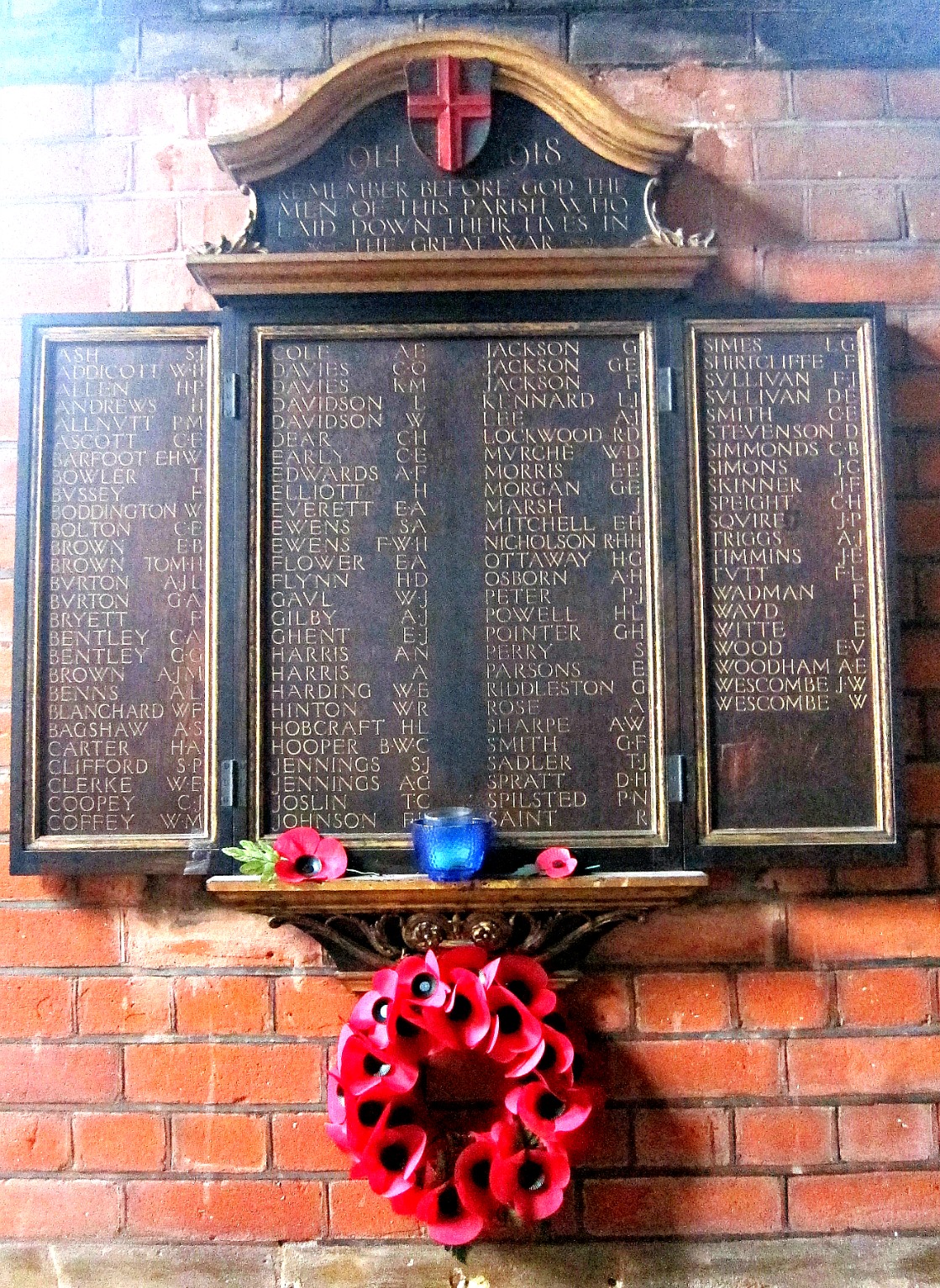
The show is taking place in St Catherine's Church (Kitto Road SE14), a building that bears witness to the terrible loss of human life in the 'Great War'.  A memorial in the chapel lists the names of 'the men of this parish who laid down their lives in the Great War'. Some surnames repeat two or three times (e.g. Bentley, Brown, Davidson, Davies, Jackson, Jennings, Sullivan, Wescombe), suggesting that some families suffered double or treble bereavements. 


Another plaque commemorates the presentation of a candlestick 'by members and friends of St Catherine's Girls Guild in Pious Memory of the Officers and Men of this Church and Congregation who gave their lives'. Underneath it says 'These died at war that we at peace might live' - a forlorn hope.


A lectern in the Church bears a plaque 'in loving and sacred memory of Ralph Dudley Lockwood who was killed in action at Leuze Wood September 1916, age 19 years'. Leuze Wood  (known to soliders as 'Lousy Wood') was captured by the British during the Battle of the Somme in early September 1916 at the cost of many lives.


Finally there is a reminder that after a short period of peace, much of the world was plunged into war once again. A plaque records 'the re-building of this church after heavy damage by enemy action on 7th September 1940'. 


There are two more shows of Oh What a  Lovely War on Sunday - there are a few tickets still available from the box office.