Showing posts with label Old Kent Road. Show all posts

Friday, December 05, 2025

Critical Mass mark killing of cyclist on Old Kent Road.

 Hundreds of cyclists rode down Old Kent Road and New Cross Road last week (Friday 28 November 2025) as part of the monthly Critical Mass ride. 

Critical Mass is a monthly bike ride on the last Friday in over 300 cities, started in 1992 and in London in 1994, to highlight bike-unfriendly cities. With no formal leadership, cyclists meet at a set time and place to ride together. In London, people meet on the last Friday of the month 19:00 on the South Bank under Waterloo Bridge.

Critical Mass outside the New Cross Inn

The ride paused on the Old Kent Road near the Dunton Road junction where a 'ghost bike' memorial had been placed to mark the death of a cyclist a week before. 34 year old Gery (full name not released) was killed there on 21 November 2025';  a driver has been arrested 'on suspicion of causing death by dangerous driving' 

Flare and flowers on Critical Mass ride

The cyclist has not been publicly named at this stage, but there are some very touching messages from friends on site - 'you were one of the most genuine people we ever met, kind, generous and hilarious' - a reminder that behind each road death statistic is a terrible personal tragedy.


Update January 2026:

Sad to report that another cyclist has been killed on this road so soon after Gery. Irene Leardini, aged 39, died on 20 January 2026 after being hit by a lorry on New Cross Road close to New Cross Gate station. Irene, originally from Italy, was herself a bike mechanic (picture below from Insta),


I cycled through there earlier that day and thought to myself how dangerous that section is. Travelling south east on New Cross Road by the Sainsburys junction there is a bit where two lanes of traffic merge into one and where some of the left lane turns left into Sainsburys and some go straight ahead, so as a cyclist if you stay left you risk being hit by left turning traffic but if you go in the middle you risk being hit by vehicles in the left lane going straight ahead.

On that same route towards/from London Bridge, this time on Borough High Street, 35 year old David Clark was killed by the police when hit by a car on 6 January. His wife commented: 'My husband David was not a headline, a statistic, or a passing news story. He was a loving husband, a devoted father to our baby daughter, a son, a brother and a deeply cherished friend. His death has left a profound and lasting void in our lives'.

Rest in power beautiful people, make it stop those of us still here.


Saturday, September 27, 2025

Miners strike benefits 1984: Deptford, Woolwich, Old Kent Road with Test Dept, The Mekons and more

There were many fundraising gigs in support of the miners during their 1984/85 strike, including across SE London. One of the most musically significant took place at the Albany in Deptford in September 1984 where Test Dept played with the South Wales Striking Miners Choir - starting a strong relationship between the two that led to the album 'Shoulder to Shoulder'. I've written about that here before, but there's some additional detail in an interview with Test Dept's Graham Cunnington at Electronic Sound. According to Gra:

“Pat Brown, who was in the Deptford Labour Party at the time, was putting on this benefit at the Albany arts centre, but all the bands he’d earmarked to play had pulled out. Jack Balchin, who was our sound guy and who worked in Deptford and Lewisham teaching music to young kids, said we should do it. He went up to Pat and said, ‘I’ve got the band for you’. Pat had never heard of us, but he said OK, and because we were used to putting on our own shows, we said we’d organise the whole thing. We also said we should have some direct involvement with the mining community, not just do a benefit and send the money out'.  I didn't realise that the Choir was originally pulled together for this gig, rehearsing their songs on the bus on the way to London.


Poster for the Albany gig by Brett Turnbull
(sourced from Test Dept facebook group where there are some pics from the gig)

The Ambulance Station squat on the Old Kent Road also hosted gigs. This 'Solidarity with the Miners' punk benefit in August 1984 featured Your Heterosexual Violence, The Unknown Colours, Violet Circuit and State Hate (I saw the latter play there on another occasion). The Ambulance Station building (which seems to have actually been a former fire station) still stands opposite the Tesco supermarket on Old Kent Road.


In November 1984 The Mekons played a miners benefit at Thames Poly cellar bar in Woolwich with 5 Go Down to the Sea, the Eels,  A Popular History of Signs and the Violet Circuit (again)


See previous posts:


A mix of music from the miners strike I did a while ago:


Sunday, May 11, 2025

Hitler hanged and burned: VE Day in South London 1945

The end of war in Europe was celebrated with several days of relieved VE (Victory in Europe) celebrations across Britain in May 1945. In South London as in many other areas this includes bonfires, parties and singing in the streets. On the Old Kent Road there were 'groups of people singing round pianos on the pavements'; on Rye Lane, Peckham sailors rode on the top of double decker buses; hundreds gathered at One Tree Hill.

During the events 'scores of effigies of Hitler were burned' while it was reported that in Artichoke Place, Camberwell 'another Hitler dummy is swinging from a gas lamp with a noose around his neck' (South London Observer, 11 May 1945)


Tuesday, October 25, 2022

South London Gas Protests 1936

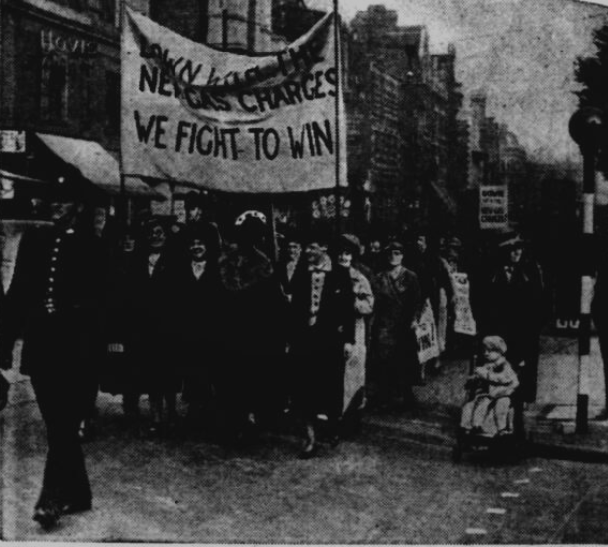
Unaffordable gas prices... boycotts... mass protests. Yes all this was happening not just now but back in 1936. The South Metropolitan Gas Company in the Old Kent Road supplied gas across South London and in that year brought in a new scale of charges which critics argued meant that the 'poor are to pay more and the better to do will reap the benefit... A boycott has been discussed and it already it is apparent that large numbers of consumers are putting this threat into effect'. From the starts, women were at the forefront of the movement - the New Cross Women's Co-operative Guild put forward a demand that  'the question of the price of gas be reconsidered and adjusted on the basis of a flat rate per therm whatever the consumption' (Daily Herland 18/9/36)

Demonstrators marched to the HQ of the Gas Company in a series of protests. The Daily Mirror reported that on 30 September 1936 10,000 took part in a demonstration - ''the street was blocked and the crowds sang to pass the time. Hundreds signed a petition of protest. Police had to divert traffic'


Daily Mirror, 1 October 1936


A week later 'Several thousand demonstrators from Deptford and Camberwell marchds to the head offices of the South Metropolitan Gas Company in the Old Kent Road to protest against the new charges. One speaker, amid applause, urged housewives to refuse to burn gas for at least s day' (Daily News, 8/10/36). A banner read 'Down with the new gas charges, we fight to win'. 


'Gas protest by women marchers', Daily News, 8 October 1936

Then after another week, the Gas Company announced it was scrapping its new charging structure. As well as street protests they had faced opposition from South London MPs and Councils, including Deptford. On the day the decision was announced 'To the swirling music of bagpipes played by kilted men, 250 South London housewives, many carrying banners' marched again on the offices (Daily Herald 15/10/36).


Saturday, April 10, 2021

Fenton Ogbogbo- murdered by racists in the Old Kent Road, 1981

Fenton Ogbogbo was a 25 year old man who was murdered in a racist attack on the  Old Kent Road in June 1981.

 Three white youths aged 15 to 17 from the Peckham area were jailed at 'Her Majesty’s pleasure' in  a trial at the Old Bailey in the following year.  The court heard that on 21 June 1981 after an incident in a pub on the Old Kent Road, 'Other white youths were recruited and they went after him. But Mr  Ogbogbo of Nunhead Grove, Peckham,  was rescued by young whites he had been playing pool with' in the pub. A few minutes later the three murderers 'who had described the rescuers as “n* lovers”, caught Mr Ogbogbo alone in a fish shop' and stabbed him  repeatedly (Times 23 February 1982). Fenton has been watching a  boxing match on TV in the Senol Fish Bar in Old Kent Road. He died at Guys Hospital.

Fenton had come to London from Nigeria in 1969 and gone to schools in Peckham before working assembling computers, but he had lost his job and was unemployed.

Bizarrely the police suggested that he may have considered suicide earlier that day having supposedly 'pulled back from jumping from the balcony of a block of flats'. This was denied by his family, and in any event was irrelevant to his brutal racist murder later in the day (Times, 23 June 1981)

His father Isiah Ogbogbo, an electrical engineer, said: 'I have lost a child because of the racial trouble in this country. Why should somebody kill a quiet innocent boy like him? [...] It is these skinheads with their hated of black people. That is why my child died. We have a lot of English people living in Nigeria but we do not kill them'.

The report below mentions that another black man had been stabbed in a racist attack in Peckham in the previous week, and that in the same period there were clashes between the police and black youth in the area:

'The Saturday night of Fenton‘s murder hundreds of black youth, joined by some white youth, had fought for two hours with the police in Peckham Rye. “It looked like they were seeking confrontation with us“ said Superintendent Staplin in charge of the police on the scene. He couldn’t have been more right. Wooden stakes were torn up from fences and used as spears to throw at the police, police vehicles were attacked, and such money grabbers as Currys, Boots and British Home Stores were broken into. The BP petrol station narrowly escaped destruction.…

A few miles from Peckham in Lewisham shopping centre, in just two forays by the police, 20 black youths were picked up on 4 and 5 June. These youths, the youngest of which was 13, were held for hours in Ladywell police station. A pregnant teenager among them was attacked and given a black eye. All were subjected to a constant barrage of racist abuse. When one young girl asked how she was supposed to get home when she was released late at night with no money she was told “you can swing on trees“. She was left as an easy target for the kind of racists who killed Fenton Ogbogbo that the police allowed to roam the streets' (Fight Racism! Fight Imperialism!, July/August 1918 - sourced from the Splits and Fusions archive)


Monday, January 25, 2016

Music Monday: Anarcho punk 1984 in New Cross & Old Kent Road

'Not Just Bits of Paper', edited by Tony Bull and Mickey Penguin is 'A series of recollections, memories, imagined dreams perhaps from the collective memories of those who lived through the punk and anarcho-punk years' of the 1980s (available from Situation Books). It includes lots of flyers and other 'ephemera' and I noticed these two from the Transpontine area.

The first is from November 1984 and is for a gig at the Ambulance Station on the Old Kent Road. This famous squatted venue was in what is now the home of Blue Mantle Antiques across the road from Old Kent Road Tescos - confusingly it is generally known as the old fire station; maybe it housed both emergency services in its history (see more on the squat by the Ruinist). 


The line up for this gig looks good - Antisect were an incredibly powerful, almost heavy metal, hardcore band from Northamptonshire. 

No Defences, my favourite band from that scene, were very different - kind of mutant punk funk with mesmerising deadpan vocals. They recorded an album for Crass's label but it never got released - apparently there was too much bass for Crass to handle! Former members of the band are working on putting out some of that material now, so maybe it will finally get the appreciation it deserves 30 years later.

'No Defences' banner at the Ambulance Station-
'The worst thing imaginable is happening now'
(from Graham Burnett's anarcho-punk archive)

Karma Sutra were my friends from Luton, where I was living at the time. I travelled down with them in their van to the Ambulance Station a few times, and I know I saw them play there as well as Conflict, Chumbawamba, No Defences and State Hate, but I have no memory of seeing Antisect there,  so not sure if I was at this particular gig. Exit-Stance were from Milton Keynes and Sedition from Northampton.

The fire station in its hey day (opened 1903)

Hagar the Womb

The second flyer is for a gig at the Goldsmiths Tavern (now the New Cross House) on 12 May 1984. Headliners Hagar the Womb were originally an all-woman band which was very rare in the punk scene at that time, though later they also had male members including drummer Chris Knowles - who went on to become London acid tekno DJ/producer Chris Liberator. Hagar, once described by Billy Bragg as the new Shangri- Las, reformed a few years ago. Support act State Hate  were in the Conflict hardcore punk mode.


The picture below of Hagar the Womb was from an NME interview (11 August 1984), and was apparently taken in New Cross's Fordham Park in the rain. At least one member of the band then lived in the SE14 Nettleton  Road 1980s punk nexus (lots more about this band, and indeed the whole scene at the excellent Kill Your Pet Puppy site)


Tuesday, April 15, 2014

Bob's Abandoned Bike Shop on the Old Kent Road


These empty shop fronts on the Old Kent Road (opposite Asylum Road, near to Toys R Us) have been decorated with signs saying 'Untitled Ltd' and 'Bob's Abandoned Bike Shop'. The typography makes me suspect that the artist Bob & Roberta Smith may have been involved, but I may be wrong - anyone know anymore?

Tuesday, February 18, 2014

London's Linguistic Wealth - a new world taking shape?


Multi-lingual wood carving in Fordham Park, New Cross
'One of the most complex, unique and fascinating aspects of London is its linguistic landscape. Its streets are rich with evidence that London is inhabited by people who speak and read many languages. Multi-lingual cacophony fills the air in all public places. Newsagents throughout London display an impressive range of of publications in a variety of scripts used by European and world languages. Business signs, service information, and adverts presented bilingually are a regular feature of the London scene'

There are many different forms of English itself in the city - Whistle and Flute dry cleaners (144 New Cross Road) derives its name of course from cockney rhyming slang for suit. Elsewhere there are signs reflecting African and Caribbean dialects of English.
Smokey Jerkey, New Cross Road

'The linguistic potential of London is a significant resource. Conditions need to be provided for future generations to develop attitudes that will enable them to make this potential beneficial to the city as a whole. Today nobody is truly monolingual. We are all exposed to different languages in education; on holidays; through film, media, music; we  use computer languages; we are exposed to signs and print in different languages on an everyday basis... The way London has embraced its cultural diversity inspires the thought that it cannot be too long before London also wakes up to the potential of its linguistic wealth'
( Dina Mehmedbegovic, '"Miss, who needs the languages of immigrants?" London's multilingual schools' in 'Education in a Global City: Essays from London', edited by Tim Brighouse and Leisha Fullick, London: Institute of Education, 2007)

Hong Kong City Chinese Restaurant, New Cross Road

Can Tho Vietnamese cafe, Old Kent Road

Kagyu Samye Dzong Tibetan Buddhist Centre, Spa Road SE16

For me 'linguistic wealth' isn't about turning this potential into economic value, but a social wealth that is freely available to everyone. Once you start to to pay attention to the range of scripts and languages in the city streets, let alone the different languages you hear being spoken, you are constantly struck by it. Children growing up in London are made aware from an early age of the range of symbols humans use to communicate, they may not be able to read all these scripts but they recognsise them as forms of language and in doing so they gain an understanding of how languages work, including their own main language. 


Polish biscuits and Jewish memorial candles (with Hebrew characters on box) in New Cross Sainsburys

In a world city like London, all parts of the world are represented in the city, and all its tongues are spoken. In Lewisham schools alone, pupils speak more than 170 languages (2012 figures). Is it utopian to see this multi-lingual metropolis as prefiguring a different kind of world human community, where all these languages and their speakers can coexist and intermingle in relative peace? Where these cultures and languages are not hermetically sealed entities but also through their proximity give birth to new forms of culture and language like 'Multicultural London English'? 

Maybe the future of the world is taking shape right now in New Cross Road, Rye Lane and Deptford High Street, and in the playgrounds of local schools.

Gracias - a Spanish name for 'English & Afro Caribbean Groceries' in New Cross Road
(formerly the Washline launderette)
Distribution of Chinese speakers in Lewisham schools 2012 - including Cantonese, Mandarin, Hokkien and other forms. 'Chinese-speaking children in Lewisham are heavily concentrated in North Lewisham, especially the East of Evelyn and New Cross, and in Lewisham Central wards'. Similar maps for other languages at Lewisham Joint Strategic Needs Assessment..

Thursday, February 13, 2014

Knocked 'Em in the Old Kent Road

Former Hollywood child star Shirley Temple (1928-2014) died this week. Once upon a long time ago she sang a South London song in 'The Little Princess' (1939), loosely based on the novel by Frances Hodgson Burnett. Fallen on hard times as a servant girl, she searches the Veterans Hospital for her missing father, entertaining the inmates along the way with a few verses of 'Knocked 'Em in the Old Kent Road'.


Others who have sung the same song have included Marlene Dietrich in the 1950s. In 1954, 'Dietrich swept on to the "Night of a Hundred Stars" at the London Palladium with Noel Coward. The glamorous pals faked a cakewalk to "Knocked 'Em in the Old Kent Road", a number neither of them really knew, but nobody minded, for they raised £10,000 for the Actors' Orphanage' (Marlene Dietrich: Life and Legend by Steven Bach, 2011):


...Julie Andrews (in 1973)- this is awful -


... and best of all Fozzie Bear as a Pearly King in the Muppet Show (1978):


If all this is a terrible mockney/cockernee caricature, you could say the same about the original song. It was written in the 1890s by music hall star Albert Chevalier (1861-1923), with music by his brother Charles Ingle. Chevalier was born in Notting Hill to a French father and Welsh mother, hence his rather wonderful full name of Albert Onesime Britannicus Gwathveoyd Louis Chevalier.


Previously a professional actor, Chevalier specialised in writing 'coster songs' (costermongers were street sellers, especially of fruit and veg), using the costers' cockney slang. The full lyrics, with its tale of a Camberwell donkey being left in a will, are as follows:

Last week down our alley came a toff,
Nice old geezer with a nasty cough;
Sees my Missus, takes 'is topper off
In a very gentlemanly way;
"Ma'am," says he, "I have some news to tell,
Your rich uncle, Tom of Camberwell,
Popped off recent, which ain't a sell,
Leaving you 'is little donkey Shay."

Chorus.
"Wot cher!" all the neighbors cried,
"Who're yer goin' to meet, Bill?
have yer bought the street, Bill?"
Laugh? I thought I should 'ave died.
Knocked 'em in the Old Kent Road!

Some says nasty things about the moke,
One cove thinks 'is leg is really broke;
That's 'is envy, 'cos' we're carriage folk,
Like the toffs as rides in Rotten Row;
Straight, it woke the alley up a bit,
Thought our lodger would 'ave 'ad a fit
When my missus, whose real wit,
Says, 'ates a 'bus because its low."

When we starts, the blessed donkey stops,
He won't move, so out I quickly 'ops,
Pals start whackin' him when down he drops,
Some one says he wasn't made to go.
Lor ", it might 'ave been a four-in- and,
My old Dutch Knows 'ow to the grand,
First she bows, and then she waves 'er 'and,
Calling out we're goin' for a blow!

Ev'ry evenin' on the stroke of five,
Me and missus takes a little drive;
You'd say, "Wonderful, they're still alive"
If you saw that little donkey go.
I soon showed him that 'e'd have to do
Just whatever he was wanted to,
Still I shan't forget that rowdy crew,
'Ollerin' Woa! steady! Neddy woa! -

Another Chevalier song, The Cockney Tragedian mentions The Cut at Waterloo, opening with the line 'I used to wheel a barrow for my father down the Cut, until I saw a drama at the Brit what turned my nut'.

Wednesday, January 29, 2014

Supermarket Self-Checkout - is scanning kind of scabbing?


Always been a Marc Almond fan musically, and I think we can claim a bit of him for South London as he lived around the Bermondsey Street area for quite a while (not sure he still does). In fact he's just about to release an exciting-sounding London-themed album 'The Tyburn Tree' with John Harle, which I'm looking forward to hearing. The publicity shots were done in Nunhead Cemetery.

Recently I started following him on twitter, and last week he posted on a subject dear to my heart - the proliferation of 'self-checkouts' in supermarkets. As Marc expressed it 'I will NOT use self-checkouts and I will not be forced to. They take jobs'. Of course he is right, the more people can be persuaded/pressured to use self-checkouts, the less people will be needed to work on the tills. It's not actually 'scabbing', they're not on strike after all, and shoppers don't always have much of a choice if there are huge queues for the few staffed tills.  But when you do it yourself you are doing the work that somebody used to be paid to do. 

The far famed checkouts at Asda  on the Old Kent Road-
on the site of the studio where Gang of Four and Ian Dury recorded classic albums

But it's not only that. Self-checkouts also mean worse working conditions for those doing the jobs remaining. Instead of sitting at the till, more supermarket staff now spend the day on their feet frantically directing customers to self-checkouts as they become available. So the remaining jobs will become less accessible to older and physically disabled workers.

Finally there is the loss of the everyday human contact, all those short conversations and acknowledgements at the checkout. It feels as if supermarkets want to eradicate all 'surplus' encounters other than the naked business of paying.

With big supermarkets seemingly superseding churches as the places where the greatest cross section of the community come together every weekend, any loss of genuine human interaction is to be regretted and resisted, as is the loss of opportunities for local people to make some kind of a living from the huge amounts of money passing through these stores.

So if you see Marc Almond having a strop in a supermarket near you, give him your full support!

A Marc Almond selfie from Nunhead Cemetery

Tuesday, December 17, 2013

Old Kent Road 1983: A Smash Hits Advert

Like Punk Never Happened- Brian McCloskey's Smash Hits Archive is a great site featuring fortnightly scans of issues of the pop magazine from 30 years ago. This Premium Bonds advert from June 23 1983 features a young woman standing by an Old Kent Road street sign and dreaming of an advance to Mayfair (i.e. from the cheapest to the most expensive property on the Monopoly board). 


Monday, November 25, 2013

Music Monday: James Maker and Morrissey in Bermondsey

In his recently published 'Autobiography' (Penguin, 2013), Morrissey mentions spending time in Bermondsey before forming The Smiths. The teenage Moz was an obsessive New York Dolls fan, and a letter of his published in a 1977 music paper led to another young Dolls fan from South London getting in touch with him. James Maker lived with his parents on the now demolished Bonamy Estate SE1 - in fact Morrissey gives the precise location as 91 Redlaw Way, 'a maisonette of ramps and grey slabs on the corner of St James' Road and Caitlin Street'.

The young Stephen Patrick Morrissey
Maker and Morrissey became close friends travelling between Manchester and London to see each other. Morrissey recalls making 'this journey many times' - 'The bus rattled down the Old Kent Road - away from the overdeveloped pink blob of the Elephant and Castle shopping centre. Each inch of the road has spent itself in other eras... I jump off the bus at the Civic Centre, where Tommy Trinder fell from the rafters every Friday night and told it his own way to those unlucky people'.

James Maker photographed by Morrissey on the Bonamy Estate with his
New York Dolls stencilled denim jacket.
Morrissey doesn't tell us too much about what he and Maker got up to other than listening to the New York Dolls and going 'swimming at a typically pitiful public pool in Peckham'. But it is clear that the two had a great influence on each other. While by his own account Morrissey struggled with sexual intimacy with men or women for many years to come, Chaser seems to have been clearer that he was gay (though this is not a word that Morrissey uses).

Other sources say more about this time. A letter Morrissey wrote at the time, quoted in Tony Fletcher's 'A Light that Never Goes Out: the Enduring Sage of the The Smiths' recounts that he and Maker spent time on the balcony of the latter's flat watching what they believed to be UFOs: 'At one point I stood on the balcony and stared directly into one hovering ship, and it STOPPED in mid-air above me'.

A teenage James Maker - think those are the tower blocks of
the Tustin Estate on Old Kent Road behind him
Maker almost became The Smiths 'Bez' - at their first gig in 1982, he danced along with the band on stage complete with maracas and high heels. Maker went on to make music himself as the lead singer of Raymonde, who released the 1987 album Babelogue, and then RPLA - who caused consternation at rock magazine Kerrang when they realized they'd put a 'gay metal band' on their cover.

James Maker in RPLA period - 1993

He also put out under his own name the fine 'Born that Way' in 2004.


I'm aware that Maker has published his own memoir, Autofellatio (2011), but haven't read that yet.

Tuesday, November 19, 2013

Undercover with the Bushwackers

Yesterday's Telegraph had an interview with James Bannon, who infiltrated Millwall firm the Bushwackers as an undercover cop in the late 1980s:

'At 7pm on Friday April 3 1987, two novice undercover police officers left Brockley police station for a drive down the Old Kent Road in south London. These were grim miles of looming tower blocks, shuttered shops and graffitied trains clattering above looming arches. It was also the territory of Millwall Football Club and their hooligan firm the Bushwhackers. It was just gone 8pm when the two men entered one of the Bushwhackers’ favourite pubs, The Old Castle...

...total infiltration wasn’t as simple as a handshake. Over the coming months, the two men had to prove their worth. Bannon won the trust of several key individuals by joining them in planned violence in pubs and backstreets. Chris accused his partner of enjoying his role too much.

“Was I a football hooligan?” Bannon asks of himself. “Yes. But I never lost sight of the fact that it was a job. There were parts of it where I laughed more than I’ve ever laughed before. I met people I’d quite happily have had as lifetime friends. But it was a job. You create a role and you live that role – to a point.” But where, exactly, is that point? If he’s drinking with thugs, singing their songs and fighting in the streets with them, how is he not one of them? “If I pick a bat up and run at a load of West Ham fans, there’s no justification in that,” he says. “But if I’m with a group of Millwall fans and a West Ham fan is running at me with a bat, I’m totally within my rights to hit him. That’s the difference.”' (The Undercover Football Hooligan, Telegraph,18 November 2013).

Bannon has written a book about the operation, 'Running with the Firm'. On his account there were four full time undercover cops infiltrating Millwall fans in this period. Alongside recent revelations about infiltration of political activist circles, this is further evidence of the widespread use of this tactic. Similar questions arise - were they just keeping watch, or were they joining in, maybe even initiating trouble as 'agent provocateurs'? And what about the emotional abuse of people they developed relationships with? Bannon says he didn't have a sexual relationship despite falling in love on duty, but it appears from his book that he strung along a woman he identifies as 'Steph'.

This made me laugh in the Telegraph interview: 'Bannon, 48, asks to meet at a café around the corner from the now-empty Brockley police station, above which his small team was based in its earliest weeks. With its artisan flapjacks, this middle-class establishment is not the sort of place that existed when he patrolled the streets in the mid-Eighties. Bannon, it’s easy to tell, is of the old pre-gentrification order...'. Assume they went for a coffee at The Broca, or maybe Browns.

See previously:

May Day 2001: A police spy at the Elephant and Castle
Undercover in East Dulwich

1926 and all that...

Naturally Bannon's book includes accounts of conflict between Millwall and West Ham. And how does he explain this rivalry? Yes this old chestnut: 'hostility developed between two shipyards on either side of the Thames. To the north you had the workforce of the Royal Docks (the claret and blue of West Ham) and to the south, the Millwall, London and Surrey docks (the blue and white of Millwall). When the Millwall shipyard broke the 1926 dockers strike, the anger across the river raised the tensions to boiling point' (p.126).

No, no, no! As shown at Transpontine before, there is no evidence of Millwall or South London dockers breaking the 1926 General Strike. And what's more Millwall dock was on the north bank of the Thames - the club moved from the Isle of Dogs  to South London in 1910 but the docks didn't!

Monday, May 13, 2013

Music Monday: Maria Minerva

The video for Maria Minerva's new track Soulsearchin was filmed by Laid Eyes around various SE London locations in Catford (the cat feaures), Lewisham , Peckham (Rye Lane) and Brockley. The last part was seemingly shot in Aladdins Cave salvage yard on Loampit Vale SE13. At one point Maria clambers over the old Russian tank in Mandela Way off the Old Kent Road.


Maria is from Estonia, but has been making music in London since studying at Goldsmiths in New Cross.


Monday, September 17, 2012

Trading Tatiana

'Trading Tatiana' by Debi Alper (2005) is very much a South London novel. The main character is Jo, an ex-heroin user living in 'Boddington Heights', a tower block on the Old Kent Road. She gets involved with helping Tatiana, a Ukrainian sex worker running in fear for her life.

If that sounds a bit grim, the book is actually quite lightly written with comic touches and a plot that keeps the pages turning. Among other SE London elements the novel includes:

- a circus on Peckham Rye;
- a friendly housing co-op in the Kirkwood Road/Gordon Road area of Nunhead/Peckham (not named but described as 'running from a low-rise estate at one end down to Nunhead Green at the other');
- a stall on Greenwich market;
- an agorophobic candle maker in New Cross;
- a dramatic encounter in the National Maritime Museum.

Alper has written a number of books and seems to have led an interesting life, including a spell in the actual Shangri La Housing Co-op in Peckham in the early 1990s (the Co-op in the novel is called Nirvana instead). An earlier novel, Nirvana Bites (which I haven't yet read), is also set around the fictional Peckham co-op.


Monday, September 03, 2012

Party gone out of bounds


A surreal sight in the window of Party One Stop (novelties/party supplies shop) at 374 Old Kent Road.

Wednesday, August 22, 2012

Circuses without Bread


This piece is on the Old Kent Road, across the road from the fire station (photo taken this morning)

Tuesday, May 01, 2012

May Day Horse Parades

May Day greetings everyone, looks a bit wet right now to go and wash your face in the morning dew but hopefully it will have cleared up a bit by the time the Deptford Jack in the Green procession gets going later - not in Deptford or Greenwich this year, but around north Southwark and the City. They will be starting off around noon at The Wheatsheaf (24 Southwark Street SE1) and end up around 4 pm at The Charles Dickens, 160 Union Street, London, SE1 (full route here). On the political end of May Day, there will be the usual march in Central London and a day of action against workfare targeting companies involved.

From my pamphlet 'May Days in South London' (2011), here 's some information about a largely forgotten May Day custom - horse parades.

Horse Parades

A final group of workers associated with May Day was those working with horses. May Day 1860, saw  'the decorations of horses belonging to the several railway companies and other large establishments' in South London. The annual procession from the South-Eastern Railway Company from the Bricklayers Arms on the Old Kent Road 'created some sensation in the locality' with the streets crowded and the horses 'preceded by a band of music'. In the evening 'a supper was provided for the drivers, presided over by the principal officials, at which about one hundred sat down'. However another custom had already faded away by this date: ‘The procession of mail-coaches which formerly drew such crowds to witness at the General Post-Office on May-day, no longer exists’ (South London Chronicle 5.5.1860).

An annual May Day parade of horses was held in this period at Wellington Wharf, Lambeth by Eastwood and Co. Ltd. The event had outgrown the Wharf by 1899 when it was moved to Battersea Park and featured nearly a hundred 'gaily bedecked' horse drawn vehicles. In the same year St Olaves Board of Works in Bermondsey agreed to give 5 shillings to each carman and dustman in its employ for the 'parade of horses on May 1' (South London Press, 6 May 1899).

Local Council workers also held a parade. In 1892 ‘the Bermondsey dustmen and other servants of the Vestry turned out with twenty-two teams’, and prizes were awarded to the most effective of them' (The Graphic, 7 May 1892).

Bermondsey Horse Parade 1892
(The Graphic, 7 May 1892)

This event was still taking place at the turn of the 20th century: 'On Tuesday the annual May Day parade of the horses belonging to the vestry of Bermondsey was held. Twenty four horses, with their carmen, paraded in Spa Road... at the conclusion of the judging, the parade was continued through the streets of Bermondsey until 1:30 pm, the carmen being given the remainder of the day as holiday'. Prizes were awarded for the best cared for animal (SLP, 5 May 1900). In 1920, May Day horse parades were put on in Lee by employees of Mr. A. Manchester, horse and steam contractors (based at Dacre-Park) and at the Whitbreads bottling store in Lewisham, the latter a revival of 'a popular feature before the war' (KM, 7.5.1920).


Monday, December 19, 2011

Ed Gray - London Souls

I went along to London Souls last week, an exhibition of prints by Ed Gray in The Crypt Gallery under St Pancras Church opposite Euston Station.  Gray, who was recently interviewed on the Robert Elms show on BBC London, mainly paints London street scenes.

I had a quick chat with Gray - in fact he made me a cup of tea - and it transpires that he lives in Rotherhithe, worked for several years as an art teacher at St Thomas Apostle secondary school (Nunhead/Peckham) and is represented by GX Gallery in Camberwell. So unsurprisingly there are plenty of South London settings - Camberwell Green (pictured below), a nightbus in Old Kent Road, a Paddy Power bookies on Walworth Road, Brockwell Park Lido, London Bridge, Electric Avenue, Salsa dancing at The Loughborough Hotel (Brixton) etc.

Really though it's London people rather than buildings that are at the centre of the paintings, walking about, working, snogging, commuting, eating, drinking... all kind of Hogarthian but without a sense of any moral judgement.

  
London Souls is open until 22 December 2011, 10am-6pm, admission free (great space by the way, proper old crypt with piled up gravestones etc.)

Friday, September 30, 2011

South East London 1786

John Cary's 'Actual Survey of the Country Fifteen Miles Around London' from 1786 (at Old London Maps) is fascinating. A few things to note -

- it's 'Rotherhithe or Redriffe' (hence there is now a Redrif Primary School in the area);
- 'Watering Bridge' on the left of the picture is where the junction of Albany Road and Old Kent Road is now, by the Thomas a Becket pub (the place referred to in the Canterbury Tales at St Thomas a Watering);
- today's Queens Road is 'Peckham Lane';
- also on what is now the Old Kent Road there is a 'Halfway House' and a 'Black Boy Lane' (near where Ilderton Road is now?);
- the section of the road coming into New Cross is called '5 Bell Lane' - the Five Bells pub was clearly already there;
- what was the 'Rainbow House' in Peckham?


In the following section, note:

- 'Plow Garlick Hill' - now Telegraph Hill;
- 'None Head' (Nunhead);
- 'Brockley Gn' (Brockley Green) - this was the area around what is now Brockley station;
- 'Loom Pitt Hole' (now Loampit Vale) - this was a quarry.
- 'Fryum Farm Hill' in Dulwich, 'Pigg Hill' (sometimes Pig Hill) in Sydenham and 'Mount Misery' on the way from Lewisham to Bromley. Do any of these hills still have names? The building up of London means we are aware of slopes when we're walking or cycling but we don't really get a sense of the distinct shape of the hills.