New book out now - click on image for more details, including where to get it
Showing posts with label 1900s. Show all posts

Monday, February 21, 2022

Russian Revolutionaries in New Cross/Deptford, 1907

In 1907 the 5th Congress of the Russian Social Democratic Labour Party was held at the Brotherhood Church in Hackney. The 338 delegates represented the various factions of the party, chiefly its Bolshevik and Menshevik wings, and included Lenin, Stalin, Trotsky, Rosa Luxemburg and, Maxim Gorki. The Radical History of Hackney blog has written about this and why not, that was where it all happened.

But did some of the delegates stay in SE London? A later account given by one George Adam, a Reuters journalist at the time, suggests so. The article 'When Lenin came to Islington' (Graphic, 4 February 1928) states that:

'shortly before the Harwich boat-train came in with its cargo of Russians,six unmistakable Yard men, wearing the Yard bowler hat and the Yard boots [...] marched on to the platform and took up strategic positions behind the pillars supporting Liverpool Street Station. The delegates were marched off into groups with Scotland Yard in step with them to the East London Underground

In the train I became friendly with one of the C.I.D. (Special Branch), and he confessed that they did not know where the Russians were going, adding that they were all Nihilists, bomb-throwers, and villains of the deepest dye. They went no farther than New Cross, where these desperadoes- they certainly looked the part- prosaically marched up to a big London County Council lodging - house, paid a tanner apiece for their bedrooms, and went to sleep comfortably, while the Special Branch found what rest it could on the hard wooden benches of the hall'.
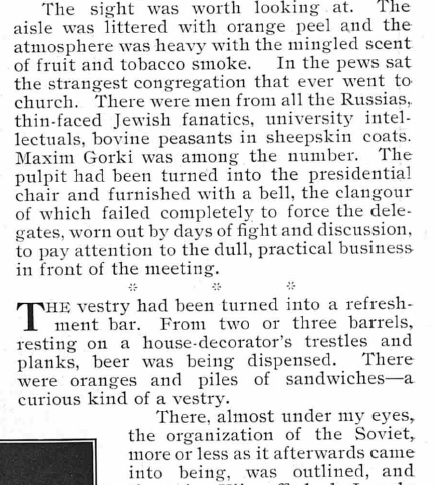
Adam managed to get inside the Church during the Congress - this is his description - 'There were men from all the Russias, thin-faced Jewish fanatics, university intellectuals, bovine peasants... The vestry had been turned into a refreshment bar. From two or three barrels, resting on a house-decorator's trestles and planks, beer was being dispensed... There almost under my eyes, the organization of the Soviet, more or less as it afterwards came into being, was outlined'


The tale is certainly feasible. At this time trains could indeed be taken on the East London line from Liverpool Street to New Cross, and if so the accommodation mentioned is likely to have been the LCC's Carrington House in Brookmill Road, Deptford, opened in 1903 as a hostel for working men.

Which of the delegates stayed there is not known - others stayed elsewhere for sure, including Stalin who is said to have stayed at another hostel in Fieldgate Street in Whitechapel.  
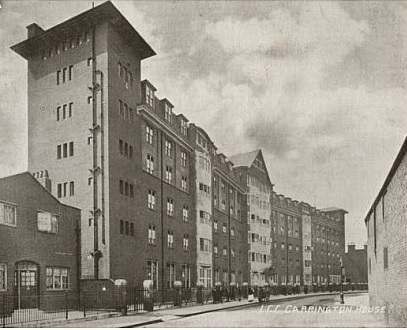
Carrington House - the building still stands

Friday, January 08, 2021

P W Luton- a New Cross Photographer

Percy William Luton was a photographer in the early 20th century whose Carlton Studio was at 34 New Cross Road SE14.  Electoral Registers and Post Office Directories show that he was there from at least 1909 to 1930, with his wife Florence. 

Portraits taken by him show up on ebay and other sites, often with no information about the subject. Nevertheless they provide a window into the past and its fashions.


An exception to this anonymity is this photograph, from the US  Library of Congress  which includes the name J.Lemm as well as name and address of the photographer. Seemingly this is John Lemm, a wrestler and a weight lifter variously known as the “Swiss Mountaineer”, the  “Swiss Mountain Climber" and the "Swiss Hercules" (I think we can surmise he was from Switzerland). 


Lemm competed in Europe and the USA in the years leading up to the First World War, including for instance a contest in New York in 1911 and the Oxford Music Hall in London in 1909:


How Lemm came to be photographed in a New Cross studio is anybody's guess, but I wonder if there is any connection with this 1909 photo of the Swiss Gymnastic Society also taken by PW Luton. The London branch of this had its HQ off Shaftesbury Avenue in central London.


The  house at 34 New Cross Road still stands - the left hand building below. Along with its white painted neighbour at no.32,  it is a Grade II listed building as a good example of an early 19th century house of this type.


See previous posts:


Wednesday, December 30, 2020

Lewisham Unemployed invade Council Meeting, 1908

Times were hard in the Winter of 1908, with widespread unemployment. There were protests in many places demanding work and relief including a weekly unemployed demonstration from Tower Hill to the wealthier areas of Mayfair and Belgravia.

In Lewisham, the Council 'found its public gallery invaded... by a crowd. One councillor, the Rev. J.C. Morris, vicar of St Mark's, Lewisham, was told that he had a pebble where his heart ought to be; and when Councillor Trenchard looked up to the gallery cries of "Scamps" and "Rotters" were frequent. Others shouted: "Our wives and children are starving; you have got plenty: beware! look out! If you don't listen to us  you will know it. We don't want your half-sovereigns: we want work' (The Woman Worker, December 23 1908).

(Woman Worker, paper of the National Federation of Women Workers, December 23 1908).

The socialist paper Justice (26 December 1908) reported that there were similar scenes in other Council meetings including at St Pancras and Portsmouth, but in Lewisham 'the council went into the cowardly silence of committee and had the gallery cleared'.

(The Metropolitan Borough of Lewisham was created in 1900, and covered the Lewisham, Blackheath, Lee, Hither Green, Catford, Brockley, Forest Hill and part of Sydenham - but not Deptford and New Cross which were under the separate Deptford Council until 1965. Not sure of the political make up of the Council in 1908, but it would have been either Liberal or Conservative in this period)

Thursday, October 25, 2018

More New Cross Faces from 1860s to 1900s

As mentioned before, I periodically look on Ebay and similar sites for interesting local photos (the ones here are all currently on sale, click links for futher details). I am particularly fascinated by the products of photographers' studios, of which there were a number on the New Cross Road in the Victorian/Edwardian era.

The first photo here is of a finely whiskered gentleman photographed by C.Goulder, Artist and Photographer, 341 New Cross Road (ebay link). Seemingly Charles Goulder was operating there in 1867, and at other premies in Deptford in the same period.


Elsewhere online I found this card from the photographer:


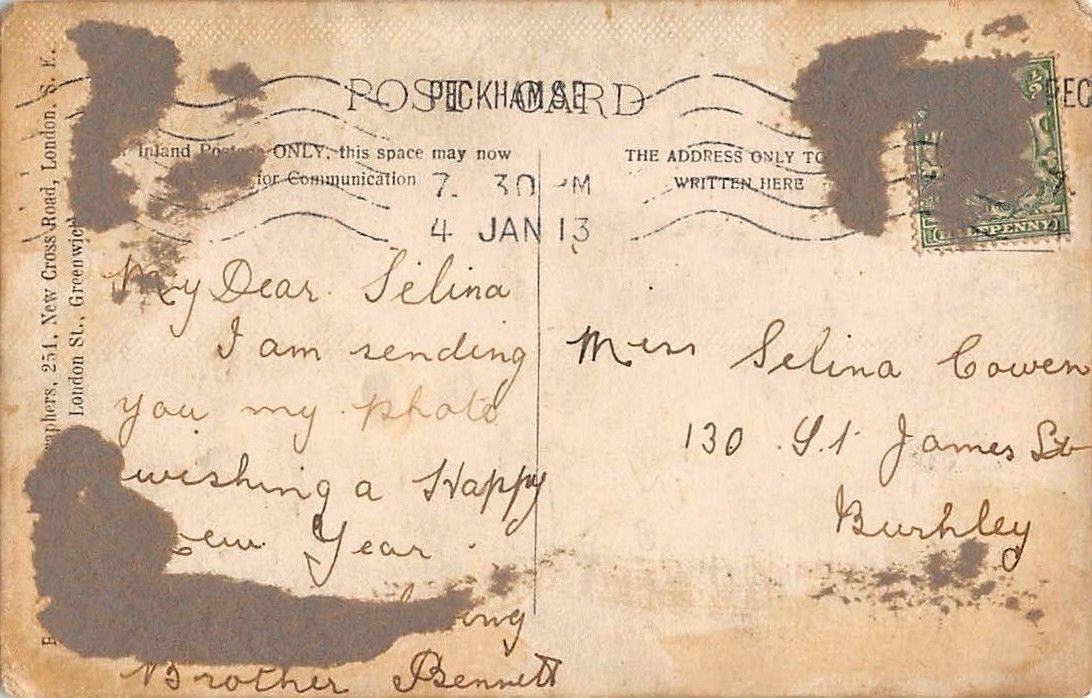
Often with these images we don't know who the subject is. What makes this next one quite intriguing is that there is some information, as the photo was sent as a postcard by the young man pictured. The photographer's address can be made on the back as 251 New Cross Road - I believe the photographer to be R & J Foster who had studios here and at 21 London Road, Greenwich

The postcard was sent from Peckham, on 4 January 1913 to a Miss Selina Cowen, 130 St James Street, Burnley (ebay details). The message reads 'My dear Selina, I am sending you my photo wishing a Happy New Year [loving?] brother Bennett'

The 1911 census has Selina Cowen, then aged 10, living at this address as the adopted daughter of Aaron (a tailor shopkeeper) and Annie Cowen. Intriguingly all three are stated to have been born in Russia, the parents having become 'naturalized British subjects' in 1895.  I would speculate that they could have been Russian Jewish emigres, Cowen was sometimes adopted as an anglicised version of Cohen.

I couldn't find any trace of a Bennett Cowen from this time, though maybe if his sister was adopted they could have had different names. As a long shot, there was a Bennett Cohen of around the right age (born c.1898) living with his father Abraham Cohen, another Russian born tailor, in Leeds in 1901 and 1911 Census.


The final photograph was taken by P. Luton of 24 New Cross Road in 1909. It shows the Swiss Gymnastic Society, London (ebay) - one of a number of societies at the time for Swiss people based in the capital.


See previous posts:


Sunday, December 18, 2016

Death of an Italian Deptford Anarchist (1907)

'ANARCHIST DISCIPLE’S DEATH

'The body man of a man found shot through the head, at Lambeth Meadow, Plumstead on Wednesday morning, was on Thursday identified as that of Leone Povinelli, Italian ice-cream vendor, residing at 25, Brookmill Road, Deptford. Emilio Nella, a companion of the deceased, who lives at the same address, saw the body during the afternoon, and at once identified it. Deceased is said to have been frequenter of a club resorted to by Anarchists in the neighbourhood of Hampstead Road, but he was in no way a well-known Anarchist, nor was he “wanted' the police on any charges' 
(Evening Star - Friday 4 January 1907)

'A SUICIDE MYSTERY. ITALIAN'S UNKNOWN TROUBLE. 

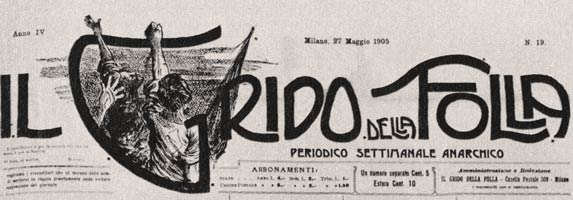
The death of the young Italian, Leon Povinelli, who was found shot on Plumstead marshes, and was supposed to be an Anarchist, was inquired into by the Coroner at Woolwich yesterday. Povinelli was a knife grinder, and resided with a compatriot, Mr. Emelionella, who has a knife-grinding business in Brookmill-road, Deptford. The latter said that Povinelli had been drinking a good deal lately, and had declared that he did not like to live in this world any longer The witness was shown a copy of a weekly Anarchist journal, the “Grido della Folla” ['cry of the crowd'] published in Milan, which was found on the deceased, but be knew nothing of it. A detective stated that some writing on a corner of the paper might be translated "To avoid disgrace.” The revolver discovered near the body was not of English make. The Coroner remarked that the writing on the Anarchist newspaper showed that the man must have had something on his mind, although it was not known what. A bankbook had been found belonging to the man, showing that he had placed £25 to his credit in September and October last. He had put no money in since, and had probably been drinking it away. A verdict of “Suicide during temporary insanity, caused by drink and trouble,” was returned'


(Leeds Mercury, 8 January 1907)

'ITALIAN’S SUICIDE. Inquest on Supposed Anarchist Who Shot Himself. TRAGEDY OF DRINK

At Woolwich today as inquest was held on the body of the man who was found shot on Plumstead Marshes on Wednesday last. The name of the deceased was Leone Povinelli. When discovered on the Marshes he was dead, shot through the head by a revolver, which was lying by his side. In his pocket was found an Italian newspaper.

Mr. Emelionella (whose evidence had to be translated from Italian to English), carrying on the occupation of knife grinder at Deptford, said he was acquainted with the deceased, who was 26 years of age, and was a knife-grinder. He lived with the witness.

The Coroner: What country was he a subject of? —He lived in the Tyrol. Used this man to drink much?— Yes; for some time past he was always drinking too much, and for the past two or three weeks he had been worse. Witness went on to say that deceased had been in this country about six years, but it was a habit of  his to go to and from his native country. Witness last saw him alive on New Year's Eve, when he was dressing himself in his best clothes. He said he was going to St. Mary Cray to see a friend. 

The Coroner : Has he ever threatened  to commit suicide?—I have heard him say he did not like to live in this world any more. A letter was produced which arrived this morning from the deceased’s father, who had written to his son urging him to write more often and also longer letters, promising him that he would do his best to have him back in Austria if he was unwell and did not like the place in London. Evidence was given as to the finding of the body. Medical evidence was to the effect that death was due to the bullet wound, and the jury returned a verdict of suicide whilst temporarily insane, brought about by drink and trouble' 

(Sheffield Evening Telegraph - 7 January 1907)

Update March 2024:

As people have mentioned in the comments, after this sad episode Emilio Nella (misspelt as Emelionella in some news reports) carried on with his knife grinding business in Deptford and remarkably five generations later it continues as Nella Cutlery Services.  In fact it is  'the UK’s leading knife sharpening company' according to its website, which also tells the story of its origins: 'The Nella story began back in Italy in 1901 in the small village of Carisolo in the northern region of Trentino. Emilio Nella the great grand father of the current owners decided to move away from his native land to seek a better life elsewhere in Europe. He acquired a portable grind stone, and began to make his way across the continent doing his knife sharpening service. After a year travelling on foot Emilio arrived in Deptford London where he quickly established a reputation as a master grinder and sharpener'. Today its main office is in Orpington. And they still have Emilio's original grinding stone (picture from Newsshopper article on history of firm)


Wednesday, December 30, 2015

Death by Dancing: New Cross (1940) and Bermondsey (1903)

A couple of tragic tales of death by dancing, hopefully those going out on New Year's Eve can avoid such dangers.  The first relates to the New Cross Palais de Danse - still going today as the Venue in New Cross Road - the second occured at a Christmas party in Bermondsey.

'Witness 'jitterbugs' at inquest on girl who fell' - Manchester Evening News, Friday 24 May 1940:

Giving evidence at an inquest at Lewisham to-day, a young man stepped from the witness-box to give an exhibition of the “jitterbug dance” to the coroner, Dr. W. H. Whitehouse. A verdict of accidental death was recorded on Virginia Guidotti (19), Wickham Road, Brockley, London, who died in hospital. She had fallen while dancing the “jitterbug,” at New Cross Palais de Danse. Henry George Cox, of Park Hill Road. Deptford, said they danced the “jitterbug,” in which he explained they did “ all kinds of fantastic and funny things.” He then stepped on to the coroner’s bench and, locking his hands, went through various movements of the dance. At one stage, he said, the girl fell backwards on the floor and he fell on her.

The Coroner: It is peculiar. It sounds to me very vulgar.

Cox said that after the fall he suggested that the girl should have a glass of water and she said that she would be all right. Evidence was given that the management of the Palais de Danse had made efforts to stop the dance being performed.

'The Fatal Thirteen - Death from excessive dancing'-  South London Press, 3 January 1903:

Dr Waldo held an inquest at the Southwark Coroner's Court on Wednesday on the body of Mary Ann Cocklin, aged 35 years, the wife of a Bermondsey labourer. John Cocklin, the husband, stated that he and the deceased went to a Christmas party at the house of a relative on Christmas Day, and kept on dancing until after midnight. Deceased then lay down to rest, but awoke in a fright, screaming that three men were after her.

Dr Waldo: Had she been drinking any spirits?

Witness: No, sir, only port wine. We had nothing but port wine, any of us.

Dr Waldo: What happened when she came to herself again?

Witness: She went down stairs and resumed dancing to the music of an automated piano organ we had in the house. I next heard she was very ill, and that she had again gone to rest, but had turned giddy and fallen down the stairs.

Dr Waldo: How many?

Witness: The fatal 13.

Susan Poore, a neighbour, stated that she heard the deceased fall. She was taken to Guys Hospital, where she died the same day. The medical evidence showed that death was due to fracture of the thigh caused by the fall, which was the result of giddiness produced by dancing. A verdict was returned accordingly'.

Tuesday, August 04, 2015

Hilly Fields 1907: 'Socialists in hot water: eight arrests follow a riot'

Once upon a time Hilly Fields in Ladywell was the scene of intense political dispute, with thousands arguing and sometimes fighting at public meetings in the park:

'An enormous crowd charged a Socialist procession as it was leaving Hilly Fields, Brockley, yesterday afternoon, and, in the free fight that ensued the S.D.F. [Social Democratic Federation] red flag was hauled down and its bearers severely handled. The police made eight arrests. For some weeks public meetings have been taking place on the Hilly Fields on Sunday afternoons. Yesterday nearly 6,000 people assembled, and distributed themselves into four groups, addressed by members of the S.D.F., a detachment of suffragists, an Anarchist, and an Agnostic respectively. There was a strong attendance of police and London County Council park-keepers to maintain order. The speakers were vigorously heckled during the afternoon, but the meetings were brought to a close without serious interruption. The Socialists marched off, protected by a police escort. In their wake came a hostile crowd, several thousands strong, waving sticks and umbrellas, and hooting and jeering in a threatening manner. The procession passed into Eastern-road, and a strong force of police came up at the run, and attempted, unsuccessfully, to head off the crowd. A sudden rush brought down the red flag, and the next minute the roadway was blocked by a mass of struggling humanity. As the opposing parties came to grips, hats and sticks flew in all directions, and arms and legs were briskly used in the affray. The police acted with restraint throughout, but matters rapidly became worse, and, in order to quieten the crowd, eight of the ringleaders were arrested and marched to the police-station at Ladywell' (Nottingham Evening Post - Monday 25 November 1907)

Tuesday, January 06, 2015

A school trip to Lewisham Arcadia (1905)

Just over a hundred years ago, children from the 'dingy streets' of Southwark went on country outings to 'the Londoner's idea of Arcadia' - Lewisham!. This report from Gloucester Citizen - (Saturday 8 July 1905) describes a trip from Lant Street County Council School, Borough (now Charles Dickens Primary School) to meet their counterparts at Plassy-Road School, Catford, for 'cricket and other sports' at Ladywell Recreation Ground.


Friday, November 14, 2014

'Partisanship' & 'Unsportsmanlike action' - Dulwich Hamlet supporters, 1903


With their stickers, radical fan contingent and even Transpontine banner, Dulwich Hamlet's supporters have been getting quite a reputation - featured recently in the Independent as the Rabble vanguard of the rise in non-league football support: 'Far, far away from the £2,000 season tickets, the officious stewarding, and the airline-stadium sponsorship of the Premier League, a football revolution is underway.In this otherworld, supporters can buy a craft ale and drink it standing behind the goal. Here is a place where crowd segregation is unnecessary and where fans, quite of their own volition, take up banners calling for an end to racism and homophobia in football and display them from the stadium walls'

More than a hundred years ago, the team's supporters already had a fearsome reputation, judging by this article in the South London Press, 7 February 1903:

'Perhaps without unduly prolonging an unsavoury subject, I may be permiited to quote from one letter sent me this week from a Hamlet supporter, judging by the gist of his remarks. He writes:  "... I have only watched them (Dulwich Hamlet) a few times this season, my chief reason for absenting myself being their strong weakness for fouling and the unsportsmanlike action of their supporters. The latter show far too much partisanship, and rarely give the opponents the slightest credit for good work. This kind of thing does the club concerned a lot of harm. Once get a strong and determined referee who will not put up with the insulting remarks made to him so often on this ground, but report the matter, and the ground will be closed... The Dulwich Hamlet are undoubtedly a fine team, but their reputation is likely to be tarnished unless the players mend their ways and the spectators behave like English sportsmen".

I believe the behaviour of certain sections of the Champion Hill crowd has already engaged the serious attention of the club committee... A few summary ejectments by the police and severe measures by the referees would quickly kill this pest that often brings humiliation and disgrace to a club morally, but not legally, to blame in this matter'.


Thursday, April 24, 2014

Frederick Wiedhofft - New Cross Photographer

I recently stumbled across a fine photograph Graeme Brooker posted on twitter with the caption '1920. New Cross. George & Nelly Rumble. My great-great aunt & uncle'. The photo was in a frame bearing the name 'F.Wiedhofft, 338 New Cross Road', and a quick search across family history and photography sites will locate many pictures attributed to this photographer.


His own life has been documented at a Wiedhofft family history site, so we know that Frederick Wiedhofft, the grandchild of German migrants, was born in Clerkenwell in 1854. He started off as an  'oil and colourman' in the 1870s, moving his business over the next 20 years from Grays Inn Road to Notting Hill and then Balls Pond Road in Dalston. An oil and colourman would have sold paints, lamp oil, etc.from their shop.  It wasn't until 1897 that he moved into photography, opening up a studio at 338 New Cross Road - where he was listed as living when he got married in 1899. Near to New Cross station, this has most recently been an Indian restaurant (Monsoon).

On the 29th July 1910 Frederick died of pneumonia at his then home at 358 Romford Rd. Forest Gate, but the business seems to have continued a while longer. In the 1914 Post Office directory the New Cross Road shop has been joined by two other branches in Holland Park and Junction Road in Islington. Photo London states that he was succeeded at the New Cross studio by Percy John Blackbeard. 

The picture above of George and Nelly Rumble has 'July 1920' written on the back so studio may have been going as long at that - though that date could have been written in error at a later date:

'F. Wiedhofft, Art Photographer'

"John James Pay, on his retirement from the Metropolitan Police June 12th 1910 after 25 years service"


A reference to the 'late J.J. Avery' -
Wiedhofft seems to have taken over his business in Holland Park