Showing posts with label protest. Show all posts

Saturday, January 06, 2024

Goldsmiths Occupations: a chronology

Found at the awesome 56a Info Shop archive a copy of SHIP Network News (Southwark Homeless Information Project) reports an occupation at Goldsmiths College in Summer 1991, specifically of the  Outreach Unit at 32 Lewisham Way which had just been closed down. 'the occupiers have opened it up to anyone and everyone' and proclaimed a 'free university' with a planned democratic education summer school. Not sure how far this got, as they seemed to have quickly been served a court summons. I don't know if this was the same 1991 occupation at which there was talk of Spiral Tribe putting on a party in the Great Hall only to be blocked by nervous student union officials.

There have been quite a few occupations at Goldsmiths over the years, some of which we have covered here previously. But here's an attempt at a chronology - no doubt missing many so let us know if you have any others - or have memories/documentation of the one below.

1968: Perhaps surprizingly Goldsmiths does not seem to have been directly affected by the wave of student occupations of art schools in 1968, notably at Croydon and at Hornsey Colleges of Art. It is though recorded that ‘Sixty students from Goldsmiths’ College of Art, New Cross, SE, invaded Hornsey College of Art on the first day of its new term… They crowded into the corridors of Hornsey and chanted ‘We support you. We support you’. Hornsey college authorities called police, who dispersed the students and ejected them’ (Times, 5 November 1968).

1976: Students at Goldsmiths voted to occupy as a part of a wave of protests sweeping teacher training colleges prompted by the fact that at a time of education cuts many newly qualified teachers were leaving college and ending up unemployed.(Socialist Worker, 29 May 1976)

1984:  the Administration building (later the Whitehead building) was occupied for 8 days to protest against staff cuts in the Media and Communications team (more here)

1991: 'free university' occupation at 32 Lewisham Way (see above)

1999: as detailed by Past Tense, 'Part of Goldsmiths College, New Cross, was occupied 26th February – March 5th 1999. 300 students took over college admin building, after eight students were expelled because they couldn’t pay £1000 a year tuition fees that had been imposed on them. A court granted the college an eviction order, but the occupying students refused to leave till the eight reinstated. A few weeks previously, students had held a demonstration, blocking New Cross Road outside, over same issue'. Mark Brown told me on Twitter that during this occupation they received a message of support from Kevin Rowland (Dexys Midnight Runners) and that Rob Newman, Silver Sun and Mark Keds (Senseless Things) all played.


2009: a two day occupation of the Deptford Town Hall building  by 50 or so students as part of a national wave of protest against Israel's bombing of Gaza (plus ca change). The occupation did achieve one of its demands -  scholarships for students from Palestine's al-Quds university. The blog from the occupation is still online 


2009


2010 saw a huge movement linking together university students, school students and others in the front line of austerity in the aftermath of the financial crash.  In November 2010 around 40 students occupied the old Deptford Town Hall for two days in protest at education cuts and the proposed increase in students fees. Effigies of prime minister David Cameron and his deputy Nick Clegg were strung up on New Cross Road next to a banner saying 'Education for the Masses, not the Ruling Classes'. More here.

November 2010 occupation


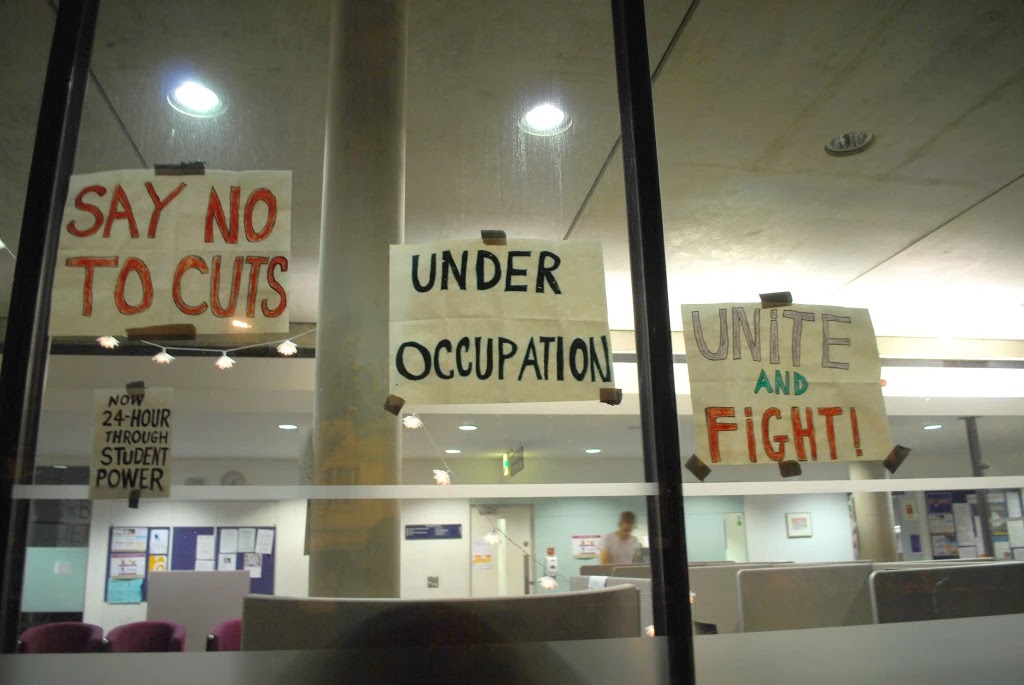
Then in December 2010 there was a larger scale occupation of the library, with several hundred taking part at the beginning. This lasted for almost a week from 5 to 11 December (More here and here). I believe Kae Tempest (then known as Excentral Tempest) performed at the occupation. The radical anthropologist David Graeber, then working at the College, was heavily involved, going on the next year to play a significant role in the Occupy protest in New York.  I gave a talk in the library on the radical history of New Cross.

December 2010

In March 2011 there was a short occupation of the Town Hall in support of striking lecturers. More here

March 2011


A short occupation of the Whitehead building in November 2011 declared itself 'in solidarity with the UK-wide strike on November 30th and the global occupy movement. We are here because we reject the privatisation of the university, symptomatic of the neo-liberal agenda that permeates all aspects of life. For this reason we have strategically occupied the building housing Goldsmiths’ finance offices, responsible for executing the cuts and the privatisation agenda'. More here.

November 2011

In December 2013 around 100 people occupied the Town Hall building in support of striking staff. More here.

2013

March 2015 saw another occupation of the Town Hall with a wide range of demands and a focus on the marketisation of education. More here

2015

The Goldsmiths Anti- Racist Action occupation of 2019 took over part of the Town Hall and lasted for a mammoth 137 days between March and July. Arising as part of the global Black Lives Matter movement its demands focused on institutional racism at Goldsmiths. 

2019


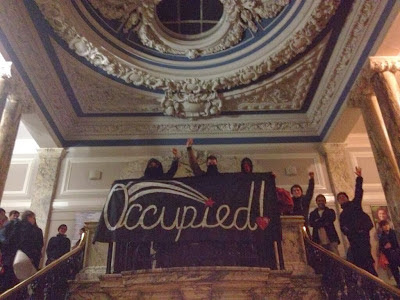
Goldsmiths students occupied the Stuart Hall building on 20th February 2024 in solidarity with Palestine. The occupation finished after five weeks, with the University agreeing to create an additional Palestinian scholarship:


(2024 images from Gold4Palestine)

On 29 May 2024 there was a further Palestinian solidarity occupation of the College's gallery, the Centre for Contemporary Arts, prompted by allegations of it receiving sponsorship from Zac Gertler, a property magnate described last year as 'Netanyahu’s new favorite multimillionaire, the owner of the Carlton Hotel in Tel Aviv, where Bibi spent a tense election night last November'. The occupation continued until the end of term nearly a month later.

With Goldsmiths management threatening to make more than 130 lecturers redundant as part of a brutal programme of cuts, students occupied the Council Chamber in the old Deptford Town Hall on 4 June 2024 and remained there for over a week.

photo by @phellermann

Update April 2026:

In April 2026,  students occupied the library against the latest round of  funding and staff cuts. The occupiers reckoned that this was the 15th Goldsmiths occupation, and have built on what I wrote above to find out some more about this history: 

'Goldsmiths has an extraordinary history of student organising and activism, earning itself a reputation as the first to take action against injustice. Students at Goldsmiths have occupied at least 14 times since 1968, in 1976, 1984, 1999,  2009, twice in 2010, 2013, 2015, 2019, four times in 2024. And now in 2026 we have this returned to the potency of the occupation in our defence of knowledge and creativity. 

In honour of our predecessors and to sustain the collective memory of Goldsmiths as a place for action, we have filled our occupation with archival banners, placards and zines from pa'st student organisers, campaigns and occupations.  Please visit us so together we can investigate what can be learned from past organisers and occupations, and if you have any additional material from previous occupations, please drop them off, we’ll take good care of them! (Free Goldsmiths, April 2026)


Friday, October 13, 2023

Peckham Taser Death Protest

A demonstration took place on Saturday 30th September to protest against the death of Zodoq Obatolah, a 52 year old man who died after being tasered by police in Peckham earlier this year. People marched from the Rye Hill Estate, where the man died in April apparently after falling from a balcony following being tasered. The protest ended in a rally at Peckham police station where people sat in the road to hear speeches from the United Friends and Families Campaign, which brings together people affected by the deaths at the hands of the police.  Speakers included Marcia Rigg, whose brother Sean Rigg died in Brixton police station in 2008, and Germaine Phillips whose son Adrian McDonald died after being tasered by police in Staffordshire in 2014.


Monday, March 20, 2023

Opposing the Iraq War in South London

The Iraq War started on 20 March 2003 with a massive American-led 'shock and awe' bombing campaign, followed by a land invasion of US, British and other troops. Over the next eight years more than 100,000 civilians were killed.

Early protests

There was a long build up to the war, with sanctions against Iraq dating back to the previous Iraq war in 1990/91 causing long term hardship to people living there. As a new war became increasingly likely, protests began to start. On December 14 2002 for instance, Lewisham and Greenwich CND and Lewisham Stop the War Coalition held a march and candlelit vigil in the centre of Lewisham, with about 100 people braving the cold wet weather.

The February 15th 'Don't Attack Iraq' demonstration

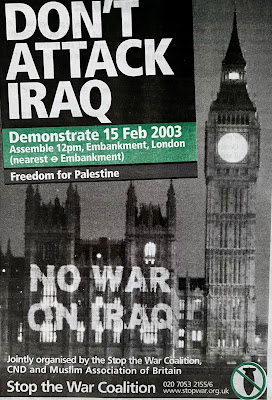
As the start of the war became imminent there was massive opposition across the world including the largest ever demonstration in London when on Saturday 15 February 2003 more than a million people took to the streets in a march from Embankment to  Hyde Park. I was there... who wasn't?


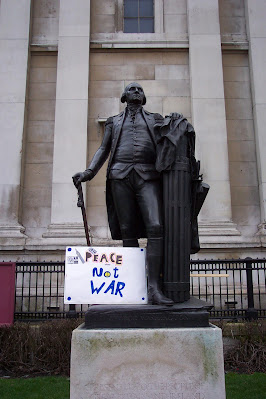
My son's 'peace not war' placard adorns a statue in Trafalgar Square. At his school - Edmund Waller Primary School - a group of around 20 older pupils staged an anti-war demonstration in the playground on 22 January 2003.

School students walk out

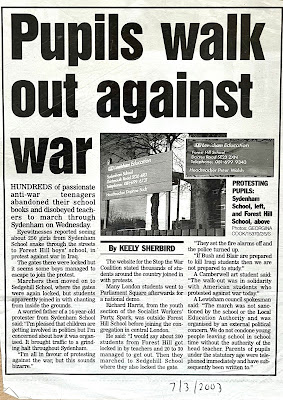
Between that day and the war actually starting there were many other protests, some of the most inspiring being led by students walking out of schools. I believe the first big schools walk out was on March 5th. The South London Press (7/3/2003) reported 'Pupils Walk Out Against War:  Hundreds of passionate anti-war teenagers abandoned their school books and disobeyed teachers to march through Sydenham on Wednesday. Eyewitnesses reported seeing about 250 girls from Sydenham School snake through the streets to Forest Hill Boys School in protest against war in Iraq. The gates there were locked but it seems some boys managed to escape to join the protest. Marchers then moved on to Sedgehill School where the gates were again locked but students apparently joined in with chanting from inside'.
Two weeks later on 19th March with war looming there was another schools strike with marchers converging on Whitehall to stage a demonstration. Some of them were interviewed in The Times (20 March 2003):

'A clutch of 14-year-old girls from Haberdashers’ Aske’s in New Cross, South London, said that teachers had refused to let them stage a protest outside the school, even though they had parental permission. “They threatened us with suspensions and detentions. Someone set off a fire alarm and the fire brigade arrived. We distracted the teachers, legged it and got the train here,” Naomi Benjamin said. “It’s important that we show Tony Blair we are against war. Our opinion matters as much as anyone’s... Sam Kinloch, 14, was one of of about 70 pupils who ran out of lessons at Langley Park School for Boys in Bromley, South London, and caught the train into town. He said: “It’s my first time on a protest, but I’ll be back when war is declared. It’s a brilliant atmosphere and there’s so many people from school here so we shouldn’t get into trouble.”'

A few of the Haberdashers students from the tie have shared memories of this with me. Alex, then aged 16, recalled: 'I remember we flyered the school to get people to walk out. I don't think people needed much encouragement. The head of sixth form implored us  to stop the younger kids from leaving, we refused and a bunch of them walked out too. It seemed like hundreds went down to catch the train at New Cross Gate into town. I think there were two walk outs around the time and on one of them we blocked the road outside parliament for a bit before being dragged off'. According to Fran and Debbie, who were in the Sixth Form:  'I remember wearing our old uniform, even though we were in sixth form, to stress the point we were students… and because of the uniforms (and being in the paper) then getting dragged into Dr Sidwell’s office' (head of school).
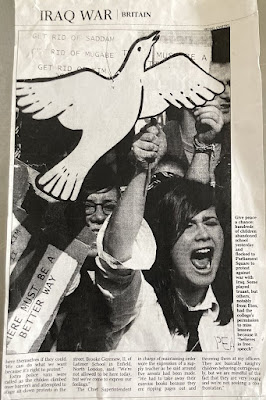
Haberdashers students pictured in The Times

I remember that on that night before the war started there was a protest on the (now gone) traffic island in New Cross Road by the White Hart. Between 50 and 100 of us gathered there with placards and candles.

The 185 Bus incident

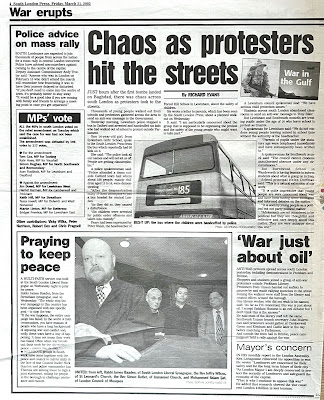
The next day when the war started school students were again in the front line of the protests. But some didn't make it as far as central London as they were stopped by police in Catford.  The South London Press (21/3/2003) reported:

'Just hours after the first bombs landed on Baghdad, there was chaos across south London as protesters took to the streets. Thousands of young people walked out from schools and protesters gathered across the area to send an anti-war message to the government. 

Yesterday morning Lewisham police stopped a bus in Catford and arrested and handcuffed six kids who had walked out of school to protest outside Parliament. One 14-year-old girl from Sydenham Girls School spoke to the South London Press from the bus which reportedly had 50 kids on it. She said 'the police took all our names and will not let us off. People are getting claustrophobic'. A police spokeswoman said 'police attended a demo outside Catford Town Hall where about one hundred people, mainly children aged 15 to 16 were demonstrating. After the demonstration many of them attempted to join a bus headed for central London. As they did so they caused a disturbance. Six children were arrested for public order offences and taken into custody"

One of those arrested was charged with assaulting a police officer, though he was acquitted at trial eight months later. He recalled:  'We boarded the 185 bus but before the driver could set off the police had ordered him to wait. They proceeded to take the names and telephone numbers of all school students present. When I questioned them about it they insisted on taking my name and asked me how they where supposed to know if I wasn’t a convicted criminal or paedophile...  All around students were arguing the case against the war, while the police kept accusing them of skiving off school and being truants... the order came to physically remove them. In the course of this the police used force against myself and others and arrested us... The Magistrate dismissed the case because he was not satisfied with the police evidence. The prosecution had failed to produce any proof, apart from the statements of the police themselves, that I had kicked PC Ashdown in the "groin area". No independent witnesses, no statement from the bus drivers, no records from the hospital. The police testimony was grossly overstated and in some cases entirely made up'. 

Day X

Elsewhere on that day, the South London Press (21/3/2003) reported 'Anti-war protests spread across south London yesterday including demonstrations in Peckham and Brixton... Shoppers and students joined a group of anti-war protesters outside Peckham library. Protesters from Unison handed out leaflets to passers-by and made rallying speeches in the street. Joining the walk out were staff in the library and council offices around the borough. One library worker who did not wish to be named said "as far as I'm concerned this war is just about oil. I accept Saddam Hussein is an evil dictator but I don't think this is the answer". He said most of the library staff felt the same. Southwark Unison branch secretary John Mulrenan said protesters would gather at Camberwell Green and Elephant and Castle later in the day before marching to Parliament. And outside the town hall in Brixton peace campaigners held a rally against the war.' A multifaith service for peace was held at South London Liberal Synagogue in Streatham with Jewish, Christian and Muslim representatives.
People had been planning in advance to take action on 'Day X' - whenever the war started. Like many others I headed up to Whitehall, where it was pretty chaotic, people pulling crowd control barriers across the street etc. The Guardian (21/3/2003) reported:

'Tens of thousands of anti-war protesters filled streets and squares, blocked roads, walked out of school and universities and temporarily stopped work yesterday. Trade unionists, students, hospital staff, civil servants and students joined hundreds of noisy, spontaneous demonstrations across the country.

More than 5000 gathered in Parliament Square London festooning statues with posters and stringing up a 'stop the war' banner in Whitehall. Police cordoned off the area immediately in front of Westminster but demonstrators blocked streets around Parliament. Whistles, drums, megaphones and chants penetrated the soundproofing of MPs offices. Police drew their batons to turn back a crowd of demonstrators who tried to force their way into Whitehall. Officers were pelted with bottles and sticks from banners. 20 people arrested for public order offences'.

The following Saturday there was another big demonstration in central London, with up to 500,000 marching to Hyde Park again (along with millions protesting across the world). I remember I bribed my young daughter to come with me by taking her to Hamleys toy shop on the way. 

On Saturday 29 March 2003 there were more local protests. Around 300 people marched from Lewisham shopping centre to Greenwich, and around 700 on various local feeder marchers met up for a rally in Brixton, including a contingent of Graveney School students who marched there from Clapham South (hundreds of pupils had protested at that Tooting school when the war started). After the Brixton rally some set off to try and protest at Foreign Secretary Jack Straw's house (ironically near the Imperial War Museum).

A large part of the population took part in those protests, including a lot of children who grew up through 20 years of more or less permanent war involving British forces in Afghanistan and Iraq. If the peace movement failed to stop the wars, the wars certainly failed to bring peace.

Any memories of these events? Please leave a comment.


Sunday, October 23, 2022

Chinese protest posters in New Cross

A series of protest posters have appeared around New Cross with the hashtags #FreeChina #EndDxicatorship (referring to  Chinese leader Xi Jinping who has just had his position extended to a third term)

'No obedience, no patriarchy, no police violence'


Support for Peng Lifa, who was arrested after staging a one person banner protest in Beijing last week

'No more fear, we can do this'

These photos were taken on the streets of SE14, CNN has featured similar posters put up at Goldsmiths College

Update 8 December 2022 (all from Goldsmiths):


#thepostermovement

'we stand with Uyghurs; we stand with Iranian women'

'Stand with uyghurs, stand with tibet, stand with hong kong, stand with taiwan, stand with iranians, stand with ukraine, stand with all peoples resisting dictatorship oppression and violence'


'we want freedom, we want food on our tables, we want to breathe, we want art, we want democracy, we want to love, stand with chinese people'


Wednesday, December 30, 2020

Lewisham Unemployed invade Council Meeting, 1908

Times were hard in the Winter of 1908, with widespread unemployment. There were protests in many places demanding work and relief including a weekly unemployed demonstration from Tower Hill to the wealthier areas of Mayfair and Belgravia.

In Lewisham, the Council 'found its public gallery invaded... by a crowd. One councillor, the Rev. J.C. Morris, vicar of St Mark's, Lewisham, was told that he had a pebble where his heart ought to be; and when Councillor Trenchard looked up to the gallery cries of "Scamps" and "Rotters" were frequent. Others shouted: "Our wives and children are starving; you have got plenty: beware! look out! If you don't listen to us  you will know it. We don't want your half-sovereigns: we want work' (The Woman Worker, December 23 1908).

(Woman Worker, paper of the National Federation of Women Workers, December 23 1908).

The socialist paper Justice (26 December 1908) reported that there were similar scenes in other Council meetings including at St Pancras and Portsmouth, but in Lewisham 'the council went into the cowardly silence of committee and had the gallery cleared'.

(The Metropolitan Borough of Lewisham was created in 1900, and covered the Lewisham, Blackheath, Lee, Hither Green, Catford, Brockley, Forest Hill and part of Sydenham - but not Deptford and New Cross which were under the separate Deptford Council until 1965. Not sure of the political make up of the Council in 1908, but it would have been either Liberal or Conservative in this period)

Monday, September 24, 2018

Goldsmiths Centre for Contemporary Art opens as Justice for Cleaners wins victory

The Goldsmiths Centre for Contemporary Art is a new public gallery on the Goldsmiths campus in  New Cross (entrance via St James SE14). It is located in part of  the former Laurie Grove Bathhouse, including the water tower for the swimming pool which closed in 1991 (see history here

The opening exhibition features the work of Argentine-born artist Mika Rottenberg, much of it film-based. If the idea of contemporary video art sounds daunting, I recommend going to see this colourful and very accessible show. Some of it would be great for kids - one film shows long nosed men sneezing out rabbits - but it also poses deeper questions, particularly about women's work in the global economy. Several of the film pieces feature women engaged in obscure labours. There are cute rabbits assembled from pearly beads....


A woman is seen crushing coloured light bulbs, in the process creating a brittle collage.


 It is not always clear what the seemingly meaningless work is for, but somewhere we imagine a market is being fed. 

Of course there often seems to be a contradiction between the radical/critical rhetoric of some of the contemporary art world and its actual economy of wealthy collectors, corporate sponsors and poorly paid gallery staff. This contradiction played out at the opening of the new gallery on 7th September  when the Goldsmiths Justice for Cleaners campaign protested against Goldsmiths continuing to outsource its cleaning to the private company ISS. The general demand that cleaners should enjoy similar employment terms to directly employed staff was given additional impetus over the summer with a restructure of shifts threatening a further deterioration in conditions for cleaners at Goldsmiths.


A banner asked 'Who Keeps the Cube White?'


 Following the protests,  Goldsmiths last week announced its intention to end the outsourcing of cleaning - a great victory though the campaign has warned that some cleaners face hardship and job losses between now and the end of the contract. They have set up a hardship fund, saying : 'Goldsmiths management have recently announced that they will be bringing cleaning staff in-house after a six month transition period. However under the current management of outsourcing company ISS, at least 20 workers have been unable to return to work for a month following a shift pattern restructure. This has left many with crippling financial losses. A number of these workers are now facing or have already faced dismissal'.


Monday, February 12, 2018

Funeral Farewell to New Cross Post Office


Protestors gathered in the rain on Saturday 10th February for a funereal farewell to the New Cross Post Office, due to close this week and be replaced by a counter within a local convenience store.


From the Press Release:


'From 15 February, New Cross Gate post office services will be run as part of a One Stop shop nearby. New Cross Gate Crown post office is the third London Crown post office to be axed under plans unveiled last year to sell off a total of twelve Crown post offices. Earlier this week campaigners and councillors went to Downing Street to hand in a petition against the closure signed by 3,000 people.


Kirsten Downer, local campaigner said: “We’re concerned about this downgrading of services. There will be fewer counters in the new shop, and vulnerable people will have to queue past lottery tickets and alcohol. There are no guarantees of a long term service under a private provider – up the road in Deptford post office services are in the back of a shop which has since closed, and it looks like a junk shop. How can it be right that the Post Office, a government company with a duty to act in the public interest, can pay its CEO £600,000 while lecturing local communities about the need to cut costs?”'


Among other things, there will be a loss of the free cashpoint at the post office, compounding the previous loss of cashpoint at the adjacent ex-Barclays Bank.


Saturday, January 28, 2017

'You can't stamp us out' - Save New Cross post office protest

A good turn out this morning for the protest to launch the Save New Cross Post Office campaign. As mentioned here before, the busy community facility is threatened with closure.

EastLondonLines reports, 37 Post Offices around the country are under threat, with the Communication Workers Union estimating the loss of around 300 staff on top of 2,000 post office workers who lost their jobs in 2016.


Saturday, June 04, 2016

NHS 'Bursary or Bust' Protest

Student nurses, midwives and associated health professionals marched in London today against Government plans to scrap bursaries for NHS students and replace them with loans. Protestors sat down and blocked Waterloo Bridge during the demonstration

Outside St Thomas Hospital
(photo from @LondonNurse2015)

Sit down on Waterloo Bridge (photo @NHAparty)

Waterloo Bridge (@LondonNurse2015)


Bexley, Bromley and Greenwich National Health Action Party banner
(photo from @cambsmeridian)
Speakers include Vivienne Westwood:

photo from :@TheUniPaper


Unison says that 'the net result will be

- Student nurses, midwives and other vital NHS staff graduating with nearly £50,000 worth of debt.
- Fewer potential health workers entering training due to the burden of debt (especially when the starting salary for many of them is relatively low).
- That in turn will lead to universities being worse off (as fewer students take their nursing courses) and potentially even the end of some nursing courses altogether.
- And rather than this cut saving money (as the government claims), few health workers will repay the entirety of their student debt over the course of their working lives – and the burden of additional agency staff (and overseas recruitment costs), thanks to a continued and worsening nursing shortage, means this ham-fisted attempt to save money will end up costing the taxpayer more money'.