Showing posts with label Forest Hill. Show all posts

Saturday, October 04, 2025

The Gig Guide - 1995 South London music listings


I found this June 1995 issue of  The Gig Guide for London in Revolution Records in Penge. I don't remember it from the time and it certainly doesn't cover the breadth of music from that period. Its focus is very much on the pub music scene but it provides an interesting snapshot of South London venues, some no longer here. 

There are some recognisable names. Placebo are listed at playing at McMillans in Deptford which must have been an early gig for them. Brain of Morbius are at the Prince of Orange SE16, Pavement and Motorhead at Brixton Academy and Shane MacGowan and the Popes at the Clapham Grand - followed a week later by Whigfield.  

Most of the other artists aren't familiar - to me anyway - but The Station and The Roebuck in Lewisham, the Rutland in Catford, the White Swan SE10,  the Pie & Kilderkin in Forest Hill (now the Signal), the Paradise Bar in New Cross and the World Turned Upside Down on Old Kent Road are all busy with various rock, jazz and indie nights.  Clubbing was probably bigger than gigging in 1995, it certainly was for me, but that doesn't get too much of a look in here apart from The Fridge in Brixton with its gay nights Love Muscle and Gridlock. Drummonds in Beckenham High Street promises 'the best funk and soul bands' every Thursday.


Monday, March 20, 2023

Opposing the Iraq War in South London

The Iraq War started on 20 March 2003 with a massive American-led 'shock and awe' bombing campaign, followed by a land invasion of US, British and other troops. Over the next eight years more than 100,000 civilians were killed.

Early protests

There was a long build up to the war, with sanctions against Iraq dating back to the previous Iraq war in 1990/91 causing long term hardship to people living there. As a new war became increasingly likely, protests began to start. On December 14 2002 for instance, Lewisham and Greenwich CND and Lewisham Stop the War Coalition held a march and candlelit vigil in the centre of Lewisham, with about 100 people braving the cold wet weather.

The February 15th 'Don't Attack Iraq' demonstration

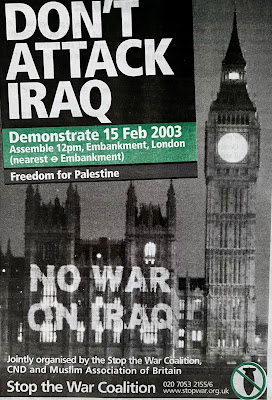
As the start of the war became imminent there was massive opposition across the world including the largest ever demonstration in London when on Saturday 15 February 2003 more than a million people took to the streets in a march from Embankment to  Hyde Park. I was there... who wasn't?


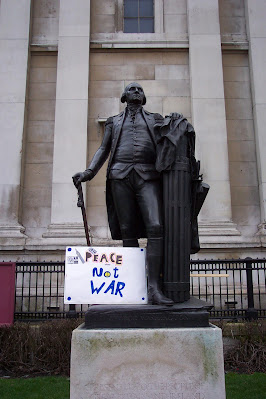
My son's 'peace not war' placard adorns a statue in Trafalgar Square. At his school - Edmund Waller Primary School - a group of around 20 older pupils staged an anti-war demonstration in the playground on 22 January 2003.

School students walk out

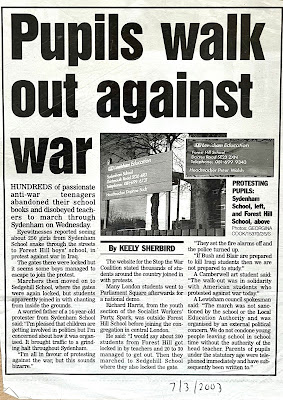
Between that day and the war actually starting there were many other protests, some of the most inspiring being led by students walking out of schools. I believe the first big schools walk out was on March 5th. The South London Press (7/3/2003) reported 'Pupils Walk Out Against War:  Hundreds of passionate anti-war teenagers abandoned their school books and disobeyed teachers to march through Sydenham on Wednesday. Eyewitnesses reported seeing about 250 girls from Sydenham School snake through the streets to Forest Hill Boys School in protest against war in Iraq. The gates there were locked but it seems some boys managed to escape to join the protest. Marchers then moved on to Sedgehill School where the gates were again locked but students apparently joined in with chanting from inside'.
Two weeks later on 19th March with war looming there was another schools strike with marchers converging on Whitehall to stage a demonstration. Some of them were interviewed in The Times (20 March 2003):

'A clutch of 14-year-old girls from Haberdashers’ Aske’s in New Cross, South London, said that teachers had refused to let them stage a protest outside the school, even though they had parental permission. “They threatened us with suspensions and detentions. Someone set off a fire alarm and the fire brigade arrived. We distracted the teachers, legged it and got the train here,” Naomi Benjamin said. “It’s important that we show Tony Blair we are against war. Our opinion matters as much as anyone’s... Sam Kinloch, 14, was one of of about 70 pupils who ran out of lessons at Langley Park School for Boys in Bromley, South London, and caught the train into town. He said: “It’s my first time on a protest, but I’ll be back when war is declared. It’s a brilliant atmosphere and there’s so many people from school here so we shouldn’t get into trouble.”'

A few of the Haberdashers students from the tie have shared memories of this with me. Alex, then aged 16, recalled: 'I remember we flyered the school to get people to walk out. I don't think people needed much encouragement. The head of sixth form implored us  to stop the younger kids from leaving, we refused and a bunch of them walked out too. It seemed like hundreds went down to catch the train at New Cross Gate into town. I think there were two walk outs around the time and on one of them we blocked the road outside parliament for a bit before being dragged off'. According to Fran and Debbie, who were in the Sixth Form:  'I remember wearing our old uniform, even though we were in sixth form, to stress the point we were students… and because of the uniforms (and being in the paper) then getting dragged into Dr Sidwell’s office' (head of school).
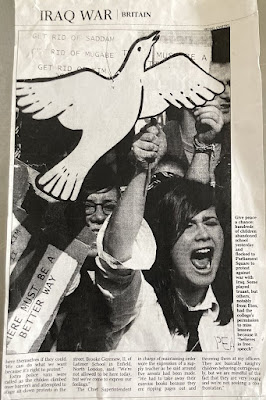
Haberdashers students pictured in The Times

I remember that on that night before the war started there was a protest on the (now gone) traffic island in New Cross Road by the White Hart. Between 50 and 100 of us gathered there with placards and candles.

The 185 Bus incident

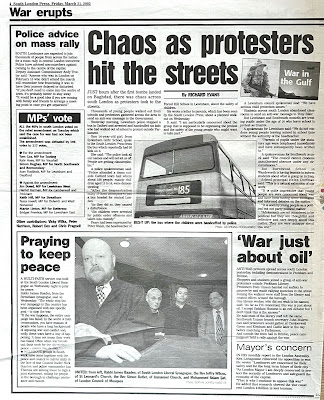
The next day when the war started school students were again in the front line of the protests. But some didn't make it as far as central London as they were stopped by police in Catford.  The South London Press (21/3/2003) reported:

'Just hours after the first bombs landed on Baghdad, there was chaos across south London as protesters took to the streets. Thousands of young people walked out from schools and protesters gathered across the area to send an anti-war message to the government. 

Yesterday morning Lewisham police stopped a bus in Catford and arrested and handcuffed six kids who had walked out of school to protest outside Parliament. One 14-year-old girl from Sydenham Girls School spoke to the South London Press from the bus which reportedly had 50 kids on it. She said 'the police took all our names and will not let us off. People are getting claustrophobic'. A police spokeswoman said 'police attended a demo outside Catford Town Hall where about one hundred people, mainly children aged 15 to 16 were demonstrating. After the demonstration many of them attempted to join a bus headed for central London. As they did so they caused a disturbance. Six children were arrested for public order offences and taken into custody"

One of those arrested was charged with assaulting a police officer, though he was acquitted at trial eight months later. He recalled:  'We boarded the 185 bus but before the driver could set off the police had ordered him to wait. They proceeded to take the names and telephone numbers of all school students present. When I questioned them about it they insisted on taking my name and asked me how they where supposed to know if I wasn’t a convicted criminal or paedophile...  All around students were arguing the case against the war, while the police kept accusing them of skiving off school and being truants... the order came to physically remove them. In the course of this the police used force against myself and others and arrested us... The Magistrate dismissed the case because he was not satisfied with the police evidence. The prosecution had failed to produce any proof, apart from the statements of the police themselves, that I had kicked PC Ashdown in the "groin area". No independent witnesses, no statement from the bus drivers, no records from the hospital. The police testimony was grossly overstated and in some cases entirely made up'. 

Day X

Elsewhere on that day, the South London Press (21/3/2003) reported 'Anti-war protests spread across south London yesterday including demonstrations in Peckham and Brixton... Shoppers and students joined a group of anti-war protesters outside Peckham library. Protesters from Unison handed out leaflets to passers-by and made rallying speeches in the street. Joining the walk out were staff in the library and council offices around the borough. One library worker who did not wish to be named said "as far as I'm concerned this war is just about oil. I accept Saddam Hussein is an evil dictator but I don't think this is the answer". He said most of the library staff felt the same. Southwark Unison branch secretary John Mulrenan said protesters would gather at Camberwell Green and Elephant and Castle later in the day before marching to Parliament. And outside the town hall in Brixton peace campaigners held a rally against the war.' A multifaith service for peace was held at South London Liberal Synagogue in Streatham with Jewish, Christian and Muslim representatives.
People had been planning in advance to take action on 'Day X' - whenever the war started. Like many others I headed up to Whitehall, where it was pretty chaotic, people pulling crowd control barriers across the street etc. The Guardian (21/3/2003) reported:

'Tens of thousands of anti-war protesters filled streets and squares, blocked roads, walked out of school and universities and temporarily stopped work yesterday. Trade unionists, students, hospital staff, civil servants and students joined hundreds of noisy, spontaneous demonstrations across the country.

More than 5000 gathered in Parliament Square London festooning statues with posters and stringing up a 'stop the war' banner in Whitehall. Police cordoned off the area immediately in front of Westminster but demonstrators blocked streets around Parliament. Whistles, drums, megaphones and chants penetrated the soundproofing of MPs offices. Police drew their batons to turn back a crowd of demonstrators who tried to force their way into Whitehall. Officers were pelted with bottles and sticks from banners. 20 people arrested for public order offences'.

The following Saturday there was another big demonstration in central London, with up to 500,000 marching to Hyde Park again (along with millions protesting across the world). I remember I bribed my young daughter to come with me by taking her to Hamleys toy shop on the way. 

On Saturday 29 March 2003 there were more local protests. Around 300 people marched from Lewisham shopping centre to Greenwich, and around 700 on various local feeder marchers met up for a rally in Brixton, including a contingent of Graveney School students who marched there from Clapham South (hundreds of pupils had protested at that Tooting school when the war started). After the Brixton rally some set off to try and protest at Foreign Secretary Jack Straw's house (ironically near the Imperial War Museum).

A large part of the population took part in those protests, including a lot of children who grew up through 20 years of more or less permanent war involving British forces in Afghanistan and Iraq. If the peace movement failed to stop the wars, the wars certainly failed to bring peace.

Any memories of these events? Please leave a comment.


Sunday, February 26, 2023

Fascists seen off at Honor Oak pub

A large crowd gathered outside the Honor Oak pub in Brockley Rise yesterday to defend it from far right threats against a drag queen storytelling session.  An impressive community turn out of more than 500 people occupied the street in front of the pub and the handful of far right goons who turned up never got anywhere near it.

The protest was called by Turning Point UK (nothing to do with the long established drug charity who must be seething) who are trying to wage a US-inspired right wing culture war focusing on universities. Their attempt to mount a street mobilisation failed, but it did show how different strands of  the far right come together - Turning Point occupy the extreme right of Conservative politics and they were joined yesterday by GB News presenter Calvin Robinson who is linked to reactionary 'traditionalist' Christian circles. He didn't like people chanting 'you're not a real vicar'. Also present were some familiar fascist faces, included former members of violent neo-nazi group Combat 18. A couple of people gave fascist salutes.

Brockley Rise occupied by anti-fascist crowd


The far right contingent barely made double figures


'Be fabulous not a fascist!'

'Fascists out of Lewisham' - a poster

Earlier in the week the pub issued a statement correcting some of the lies being spread about it:

'Everyone here at The Honor Oak is proud to serve the wonderful community of Forest Hill. We are here to make sure your local pub is a safe, warm and a fun place for everyone to enjoy. Next Saturday morning we will be hosting our Magical Storytelling session, hosted by That Girl.
 
It has come to our attention that there may be some misunderstanding about the event, so we wanted to reassure you all that our popular Magical Storytelling event will be age appropriate and it isn’t anything different to what families will see and experience together in a theatre. This event is an opportunity for families and friends to come together and listen to a reading of a storybook and have fun.
The most important thing for us is that everyone is safe and happy when they are here'.

Wait til the fascists hear what goes on in Pantomime...


Monday, August 08, 2022

Music Monday: Saint Jude 'No Angels'


Forest Hill based Saint Jude (Jude Woodhead) has been putting out music for a few years now and gradually getting more attention in terms of critical interest, radio plays on BBC6 Music etc. A couple of his tracks have over  a million plays on Spotify. I am sure it's only a matter of time before he goes to the next level and I wonder whether the breakbeat driven 'No Angels'  is going to be the song to do it. It certainly should be, and comes with a great video featuring scenes around SE23, Corsica Studios and elsewhere.

The music and video are partly inspired by Covid 19 urban wanderings, as explained at Slow Dance:

 '“The message in ‘No Angels’ is about more than lockdown specifically,” Jude says of the track. ‘Community and solidarity is the most important thing, and will always be in conflict with the forces of capital and money.’ With knowing nods to sonic movements that are so deeply associated with the capital’s working class neighbourhoods, the track’s chorus hook says it all in its simplicity: “you say the money doesn’t matter too much / you say the love for your people is enough.” Savage Messiah, Laura Grace Ford’s graphic novel about London outcasts and psychogeography within the city, provided inspiration during the single’s incubation period'.

Saturday, July 25, 2020

Black Lives Matter in South London- 2 months on

Two months after the police killing of George Floyd in  Minneapolis on May 25th, the global wave of  Black Lives Matters protests continues to make an impact around the world. This is a quick overview of the last eight weeks in South London, where the current phase of the Black Lives Matter movement in the UK started in Peckham on 30 May 2020 with hundreds of people marching across the Common and down Rye Lane.

Peckham Rye, 30 May 2020 (photo by @katyG_LSL)
Probably the largest demonstration so far took place a week later on Sunday 7 June, with a huge crowd gathering by the American Embassy in Battersea before crossing over Vauxhall Bridge and marching on to Whitehall. It was one of the biggest demonstrations seen in London in recent years, perhaps in the region of 50,000 or more.  On the way there I saw streams of people walking towards it from different parts of London due to the limited Covid 19 public transport. 

Vauxhall Bridge, 7 June 2020
A feature of the protests has been the wearing of face masks and the predominance of home made cardboard placards, well everybody seems to have a cardboard box to hand in these days of endless deliveries due to shop closures. But there were some banners to be seen, and I was pleased to see a proud Millwall anti-fascists banner at Vauxhall.

Millwall anti-fascists, Vauxhall Bridge

It seems that most local parks and public spaces have had some kind of Black Lives Matter gathering, usually 100-200 people taking the knee - a sign of the reach of the movement beyond the usual places where protest happens. I mean it's not every day (or decade for the that matter) that there is a protest in Hilly Fields or Telegraph Hill Park.

Lewisham Police Station, 3 June 2020 (photo by Mark Thompson)

Hilly Fields, 13 June 2020
(photo by Melissa Jacques full report at EastLondonLines)

Burgess Park, 14 June 2020

Ladywell Fields, 27 June (photo from SUTR)

Telegraph Hill Park, 4 July 2020 (photo from @avocadamn)

Protests have also taken place in Mountsfield Park (Catford) and outside the Deptford Lounge, among other places.

Firefighters take the knee at Lewisham Fire Station (photo from @itslukecharles, 3 June 2020)
Black Lives Matters signs can be seen in many local houses, following the recent trend for NHS rainbow window signs. Here's a few examples from around SE14.


There's also some BLM/anti-racist street art and graffiti. 

'Black Lives Matter', Waldram Park Road, Forest Hill

'Fight racism, build unity' - Thames path, Greenwich peninsula

'Racists still not welcome' - Thames path, Greenwich peninsula
What will happen next remains to be seen, in terms of  public protests all movements have ebbs and flows in their momentum. But away from the streets, this phase has kicked of a widespread questioning in workplaces, homes, sports clubs etc. There is a sense that something has to change and that is not going away. 

See also:


More local Black History:


Sunday, January 26, 2020

New Forest Hill Street Art

New street art in Forest Hill on the South Circular put up last week on hoardings around former Co-op site on Waldram Park Road (apparently a hotel is being built there). Artists include @lionel_stanhope who did the banana (best known locally for doing all those area name signs under railway bridges- Brockley, Nunhead etc);  @thereevesone, @whoamirony, @jellyjartist, @ueya.streets and others.


Sunday, June 30, 2019

Police Raid Forest Hill Gay Club (1987)

From London LGBT paper 'Capital Gay' (2 October 1987), a report of police raiding a gay club in Forest Hill in 1987, prompting the headline: "Clear out of Forest Hill! Police Want Gays Confined to the West End." 

The target was Frolic at 240 Stanstead Road, SE23 which on Saturday September 19th was raided by '30 officers, some wearing rubber gloves' who 'ordered customers off the premises'. The club was closed down and owner Phillippe Sinclair was summonsed to appear in court charged with licensing offences including serving non-members after pub hours (not sure if it later re-opened, anybody know?)

Local police Chief Superintendant John Taylor was reported to have said 'Gays belong in the West End, not out here'. 


The club promoted itself as 'South London's most exclusive gay nite club' with events that summer including a benefit for HIV organisation Terrence Higgins Trust.

Advert in Capital Gay, 14 August 1987


Monday, October 22, 2018

The Press Art School, Forest Hill (1905-1960)

An interesting find on a second hand stall in Lyme Regis over the summer was this brochure for The Press Arts School, a correspondence course in drawing run from Forest Hill. The brochure is undated but internal evidence suggests it was published during or shortly after the First World War.


The Press Art School was established by Percy Venner Bradshaw (1877-1965), who had studied art himself at a Goldsmith College evening class. In the 1901 census he is shown as living with his parents at 128 Drakefell Road SE14 but moved to 37 Dacres Road in Forest Hill SE23 after his 1910 marriage at St Catherine's Hatcham church. 


The correspondence course was prompted by the success of a series of articles on drawing Bradshaw wrote for the Boys Own Paper. Founded in 1905, The Press Art School moved in 1911 to the Tudor Hall in South Road, Forest Hill SE23. This former mansion had been built in 1854/5 as The Red Hall, before becoming a private girls' school known as Tudor House school from 1865 to 1908.

The building housed the Press Art School until it closed in 1960. Much of it was demolished in 1961, though part of it remains as flats (the section shown on the right below).

At its peak the Press Art School was a major operation, training would be commercial artists and amateur enthusiasts who would send in their work for evaluation and criticism. By 1916, it had 3,000 students signed up and 20 staff. Many of the illustrators for UK newspapers and magazines started out with one of Bradshaw’s courses, including Norman Pett who created popular Second World War cartoon strip ‘Jane’ for the Daily Mirror. Sculptor Henry Moore took lessons while serving with the army in World War One. One of Bradshaw’s later students in the 1950s was Ralph Steadman who recalled in a 1989 interview with The Comics Journal:


‘I saw an advert which said, “The Percy V. Bradshaw’s Press Art School Course. You too can learn to draw and earn pounds.” So my mother and father who were by this time a little distraught because I didn’t have a proper job, and I didn’t know what I was going to do, said, “If you’d like to take the course, since you’re drawing now, we’ll pay for it.” It was 18 lessons: 12 lessons spread over 12 months on how to draw, and the other six months learning how to be a cartoonist. The whole course cost 18 pounds — a pound a lesson, something like that — very cheap. My mother and father paid for it and then I went into the forces and whilst I was in the forces I did the course. I wish I kept the letters from Percy V. Bradshaw to me because of my complaints about the old-fashioned style of the course, and he’s saying, “Ah, my boy, the principles of drawing never change.” He’d get me to draw a pair of boots, put them on a table and draw them in dots, a pointillism technique, and gradually build up a pair of boots, and that would give you a sense of tonality. And then I’d do these various exercises and send them back to him. The guy would do a fairly descriptive criticism of what was either wrong or right... the cartoon course was very interesting. What he said is, “What you need to do is go out into public places and look at the people and keep a sketchbook and that way you’ll learn something about caricature”’.


Bradshaw engaged other illustrators to comment on students work, the best known of these tutors being W.Heath Robinson.