New book out now - click on image for more details, including where to get it
Showing posts with label cemeteries. Show all posts

Thursday, January 14, 2016

David Bowie's Lambeth Murder Ballad

Tonight at at South East London Folklore Society, Paul Slade (author of 'Unprepared to Die') will be giving a talk on murder ballads

'Cheerfully vulgar and revelling in gore, murder ballads are tabloid newspapers set to music, carrying word of the latest 'orrible murders to an insatiable public. Victims are bludgeoned, stabbed or shot in every verse and killers often hanged, but the songs themselves never die. Instead, they mutate – morphing to suit local place names as they criss cross the Atlantic (often beginning life in Britain) and continue to fascinate each generation’s biggest musical stars. Journalist Paul Slade traces this fascinating genre’s history via its greatest songs Slade investigates real-life murders which inspired well-known ballads and uncovers many startling new facts about them. There will be performances of the songs by George Hoyle & renowned folk musician, Dave Arthur'


I wonder whether the recently departed David Bowie will get a mention for his 1967 contribution to the genre?  Please Mr. Gravedigger is from his early career, a time of whimsical songs and novelty tunes. The track features just Bowie's voice to a background of sound effects - church bells, bird song, weather, digging. The charming child killer's lament is said in a bombed out churchyard in Lambeth. Not sure if Bowie had anywhere specific in mind.

There's a little churchyard just along the way
It used to be Lambeth's finest array
Of tombstones, epitaphs, wreaths, flowers all that jazz
Til the war come along and someone dropped a bomb on the lot

And in this little yard, there's a little old man
With a little shovel in his little bitty hand

He seems to spend all his days puffing fags and digging graves
He hates the reverend vicar and he lives all alone in his home
"Ah-choo, excuse me"
Please Mr. Gravedigger, don't feel ashamed
As you dig little holes for the dead and the maimed
Please Mr. Gravedigger, I couldn't care
If you found a golden locket full of some girl's hair

And you put it in your pocket
"God, it's pouring down"
Her mother doesn't know about your sentimental joy
She thinks it's down below with the rest of her toys
And Ma wouldn't understand, so I won't tell
So keep your golden locket all safely hid away in your pocket
Yes, Mr. GD, you see me every day
Standing in the same spot by a certain grave
Mary-Ann was only 10 and full of life and oh so gay

And I was the wicked man who took her life away
Very selfish, oh God
No, Mr. GD, you won't tell
And just to make sure that you keep it to yourself
I've started digging holes my friend
And this one here's for you...

Friday, April 05, 2013

Frightened to death by Brockley Cemetery: more Spring Heeled Jack?

Brockley Cemetery, then known as Deptford Cemetery, was the scene of the strange case of a young woman being 'frightened to death' in the late 19th century. The British Medical Journal, April 7 1888, reported:

'The serious effects of shock to the nervous system, especially by fright, are constantly witnessed... Death itself is, fortunately, comparatively rare. It is reported in the newspapers to have occurred at Brockley, on March 21st, in the case of a girl, aged 18, who was frightened to death by a man dressed as a ghost, near the Deptford cemetery.

She arrived home after her fright, in the road by the Deptford Cemetery, at Brockley, looking very ill and excited. She is said to have taken off her waterproof, drawn a chair to the table to take supper, then fallen forward with her head on the table, and died after a short struggle. Mr Hollis, the medical man who was called in, made a post mortem examination, and reported that all the organs were healthy, but that the state of the heart, combined with the fright, would account for death... It is to be hoped the miscreant will be discovered, and receive the utmost punishment which the law allows. The coroner stated at the inquest that five other persons had been frightened at the same spot. We do not know why the jury did not record a verdict of 'Manslaughter' against some unknown person'.

The details resemble the Peckham Ghost panic of 1872, when a number of people were frightened by what was generally believed to be a man dressed up as a ghost in the Peckham/Dulwich/Herne Hill area. The Camberwell & Peckham Times (19 Oct 1872) reported one such sighting:

'He appeared...on [14 October 1872] to Sarah Ann Foster, a girl living opposite the Crystal Palace Tavern, and charing at Mr Smith’s, in Lordship-lane. It appears that she had been to fetch the supper beer, and on her return she was required to go on another errand, when she complained to her mistress that there was a tall man waiting in the road. Mrs Smith remonstrated with her on the folly of being frightened, and Mr Smith said he would watch her from the window. She started on her errand, but had not left the front garden when a figure in white rose from behind the fence. She screamed loudly, and rushed towards the doorway, and was clasped in the arms of her master, he having seen the apparition from the window, and in rushing out caught his foot in something which threw him forward, and instead of catching the ghost he caught the girl in his arms, who, thinking it was the unearthly spirit that had got hold of her, went into a fit, in which she remained two hours, and is now seriously ill. The description given by Mr Smith and the girl is as follows: – About six foot high, dressed in long overcoat (having white lining, which when thrown open, aided by a white waistcoat and outstretched arms, give the desired effect) a dark felt hat, and a plume of black feathers, with which he hides his ignominious features.’ [presumably this was the Crystal Palace Tavern on Crystal Palace Road, East Dulwich].

A local man, Joseph Munday, was later arrested and accused of being behind the Peckham Ghost incidents.


The Peckham events have often been linked to the wider 19th century legend of 'Spring Heeled Jack' - a monster or dressed up man (depending on interpretation) who similarly appeared to terrorise people, including a number of sightings in South London. For instance in Dulwich  the daughter of Plutarch Dickinson was reported to have been 'nearly deprived of her senses’ and taken to bed ‘in a very dangerous state’ after seeing a  figure 'enveloped in a white sheet and blue fire' (The Sun, 20 January 1838, cited in Mike Dash's overview of the phenomenon).

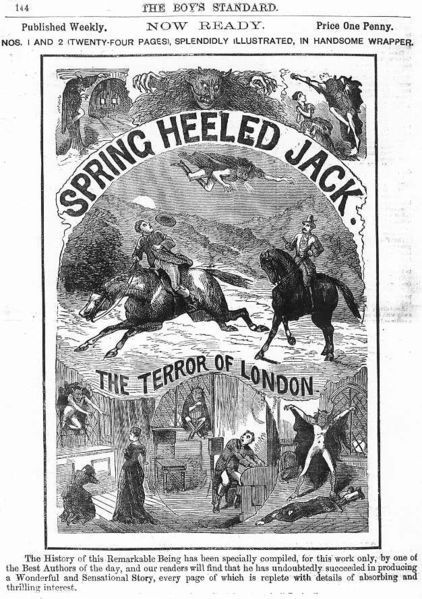
So perhaps the Brockley events should also be considered in this context. The man dressed as a ghost may have been imitating  these earlier scares, inspired by the accounts in Penny Dreadfuls such as 'Spring Heeled Jack: The Terror of London' (advert above is from 1886).  Though doubtless others may have more exotic explanations.

Monday, November 05, 2012

Spike Milligan's Grave

Spike Milligan (1918-2002) was born in India but spent many of his formative years in South East London from the age of 12 in 1931.  He went to Brownhill Road School and then to St Saviours School in Lewisham High Road. In 1933 his family rented part of a house at 22 Gabriel Street, Honor Oak Park, later moving to 50 Riseldine Road nearby.

In 1934 Milligan got a job at Stones' Engineering in Deptford (Arklow Road) and later worked at Chislehurst Laundry. After being sacked from a tobacconist for stealing cigarettes he worked as a labourer at Woolwich Arsenal.  Meanwhile he had won a crooning contest at the Lady Florence Institute in Deptford, come second in a talent show at Lewisham Hippodrome and sung at St Cyprians Church Hall in Brockley and Ladywell swimming baths. He taught himself the ukulele, bass and trumpet and guitar ("My mother bought my first guitar for eighteen shillings from Len Stiles’ shop in Lewisham High Street") and took music classes at Goldsmiths in New Cross. He played with local dance bands including the New Era Rhythm Boys and Tommy Brettell's New Ritz Revels in South London dance halls.


In a 1970 interview he recalled 'we used to go to the jazz sessions at the rhythm clubs. Do you remember the rhythm clubs? The Number One Rhythm Club—and the local one, at the Tiger’s Head at Lee?'.

In 1940 he joined the army, after a period of out-patient treatment at Lewisham Hospial for back pain apparently caused by overdoing weightlifting at Ladywell Recreation Track in an effort to impress the women working at Catford Labour Exchange ('Spike Milligan' by Humphrey Carpenter). Returning after World War Two, Milligan moved in with his parents for a while at 3 Leathwell Road, Deptford, before leaving South London and finding fame through the Goon Show on radio.

Spike Milligan gave a less than romantic view of 1930s South London working class life in his poem 'Catford 1933':

The light creaks and escalates to rusty dawn
The iron stove ignites the freezing room.
Last night's dinner cast off popples in the embers.
My mother lives in a steaming sink. Boiled haddock condenses on my plate
Its body cries for the sea
My father is shouldering his braces like a rifle,
and brushes the crumbling surface of his suit.
The Daily Herald lies jaundiced on the table.
'Jimmy Maxton speaks in Hyde Park',
My father places his unemployment cards in his wallet - there's plenty of room for them.
In greaseproof paper, my mother wraps my banana sandwiches
It's 5.40. Ten minutes to catch that last workman train.
Who's the last workman? Is it me? I might be famous.
My father and I walk out are eaten alive by yellow freezing fog.
Somewhere, the Prince of Wales and Mrs Simpson are having morning tea in bed.
God Save the King.
But God help the rest of us.

Last week on a day trip to Dungeness and Rye in East Sussex I came across Spike Milligan's gravestone in the churchyard of St Thomas' Church in Winchelsea, where he is buried along with his wife Shelagh. Milligan spent his later years  at Udimore, a village near Rye. The grave reads 'love, light, peace - Terence Alan (Spike) Milligan CBE KBE, 1918-2002... writer, artist, musician, humanitarian, comedian' and famously includes the line in Irish Gaelic  'Duirt mé leat go raibh mé breoite' - 'I told you I was ill'. Milligan once joked about heaven "I'd like to go there. But if Jeffrey Archer is there I want to go to Lewisham." 


Sources include: Spike Milligan: the biography by Humphrey Carpenter (2003).

It would be dishonest to pass over the fact that some of his comedy was incredibly racist even by the standards of the time. He appeared blacked-up as a 'pakistani' in the TV series Curry and Chips (1969) and his books feature many Jewish and Asian jokes. In a 1975 interview he declared 'I'm sorry that you can't call people n*ggers anymore. Or w*gs'

Wednesday, September 14, 2011

Freddie Mills

I've been reading All the Devils are Here (2002) by the late David Seabrook, a kind of Iain Sinclair-at-the-seaside ramble round the underbelly of Kent, populated by deranged artists (Richard Dadd killing his father at Cobhham), unhappy writers (TS Eliot recovering from a breakdown in Margate), nazi sympathisers (including Arthur Tester in Broadstairs, and Audrey Hepburn's parents) and alcoholic actors cruising for trade (Charles Hawtrey in Deal).

He heads into Transpontine territory when he discusses the life and death of boxer Freddie Mills (1919-1965). Mills was the world light heavyweight boxing champion from 1948 to 1950 and went on to run a nightclub in Charing Cross Road after he retired. He also acted in a number of films. After he got married in 1948 he moved to 186 Denmark Hill in Camberwell (towards the Herne Hill end) where he remained until his mysterious death.

In July 1965 he was found shot dead in a car outside his nightclub. The verdict was suicide, but many believed that he had been murdered, or possibly driven to suicide by threats. His life and death continues to prompt speculation from crime writers - a 2004 book by James Morton suggests Mills had been threatened by the Kray twins, while there have even been claims that he was responsible for the Jack the Stripper serial killings.


Another angle is the claim that Mills was secretly bisexual, and that he may have been blackmailed. Seabrook's book includes an interview with a then Peckham-based man who claims to travelled to a flat in the Red Post Hill area for sex with Mills in the late 1940s.

Mills' grave is in Camberwell New Cemetery in Brenchley Gardens - there is more detail at Find a Grave, from where I sourced this photo.

Tuesday, November 09, 2010

Up the Line Remembrance 2010


Up the Line, a Remembrance event with a difference in Brockley and Ladywell Cemetery, takes place this Thursday November 11th. People are invited to remember the war dead in a candle lit walk through the cemetery, with music, poems, film and dance performance along the way. Brockley-based leading classical pianist Julian Jacobson will be among those taking part. People can arrive at any time between 7 and 8:20 pm and wander through at their leisure, but there will be a children's lantern procession at 7:30 pm. Admission is free (click flyer to enlarge).

Sunday, April 20, 2008

Adelle Stripe/Entertaining Mr Sloane


Here's Brutalist poet Adelle Stripe reading her poem Veronica - which is all about a grave in Camberwell Old Cemetery in Forest Hill Road/Honor Oak. She mentions Joe Orton in this - the 1970 film version of his play Entertaining Mr Sloane was filmed in the area, including in the gatehouse to the cemetery.

Kath (played by Beryl Reid) comes across Sloane (Peter McEnery) lounging in the cemetery.


She invites him to come and stay with her, pointing out the cemetery gatehouse where she lives and saying 'lovely piece of building that'.


(Post updated November 2012. While the Keepers Gatehouse in the film is definitely in Camberwell Old Cemetery, someone who visited earlier this year said he couldn't find the graves shown and wondered whether those scenes were actually shot somewhere else. See also discussion at Reel Streets, where it is suggested that the graves are in Camberwell Old Cemetery and that the now demolished chapel there can be seen in that scene, behind Reid in the first of the stills above. What do others think?)