New book out now - click on image for more details, including where to get it
Showing posts with label Moonshot. Show all posts

Sunday, September 05, 2021

Dub London - nights of raving


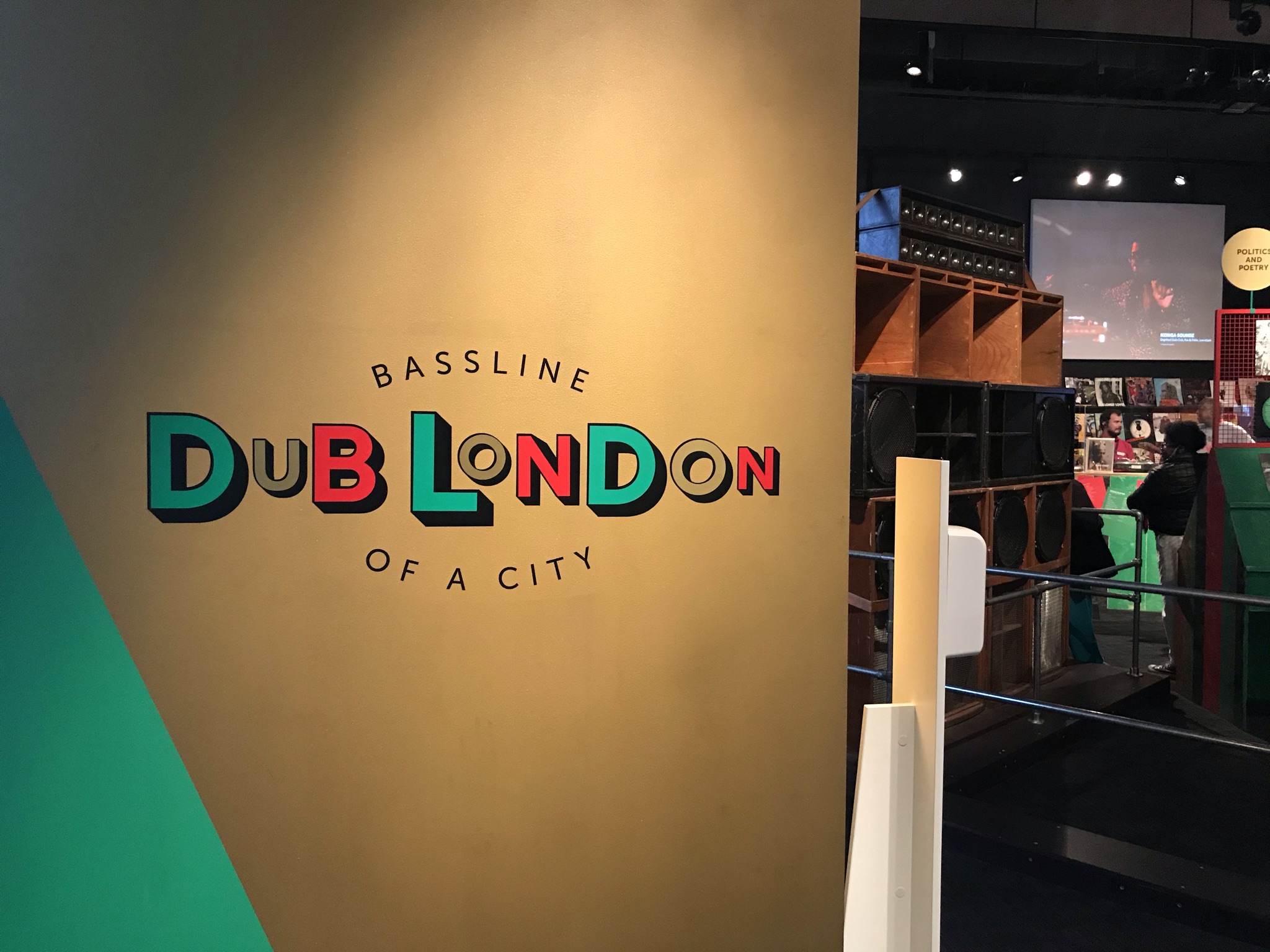
'Dub London: Bassline of a city' closed last week at the Museum of London, a small exhibition documenting the impact of reggae sound system culture in the capital. Exhibits included a speaker stack from Channel One sound system, photographs and a vinyl selection provided by London reggae record shops.


 Naturally, South East London featured prominently, with references to the New Cross Fire, the Battle of Lewisham, Jah Shaka and Lewisham's Saxon Studio International sound system.  There was a film of Mad Professor in his Ariwa studio - currently in White Horse Lane SE25, previously in Gautrey Road SE15 (where the recently departed Lee Scratch Perry visited and recorded in the 1980s).


Photo of Saxon Sound in exhibition - taken at Lewisham Riverdale Centre in 1982 it includes Maxi Priest (also Lezlee Lyrix now Prof. William Lez Henry)

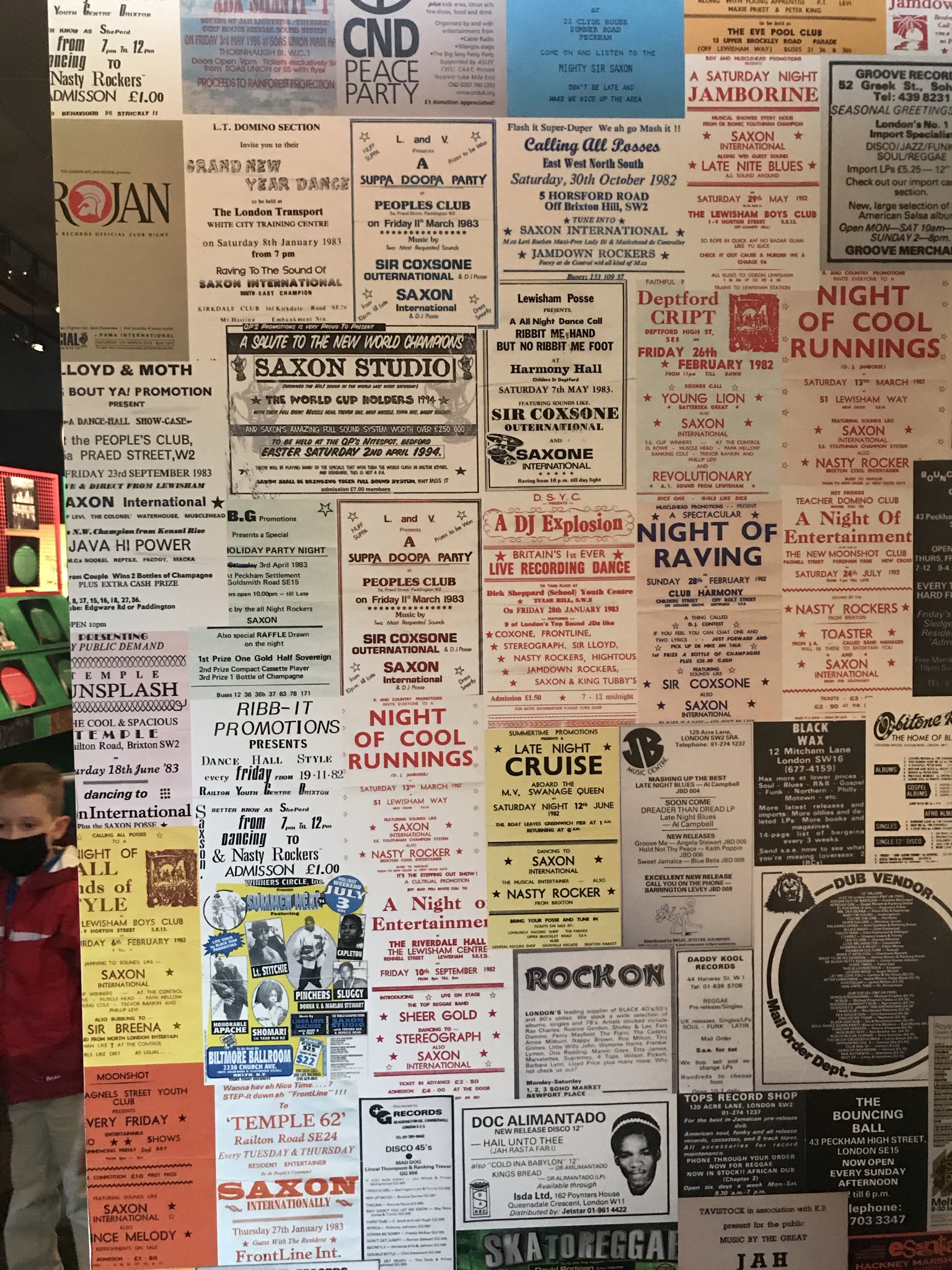
My favourite bit was a wallpaper of flyers, many of them from Saxon parties in the 1980s. Lots of South London venues featured in this including:

The Eve Pool Club, 13 Upper Brockley Road Parade

Lewisham Boys Club, 1-9 Horton Street SE13 ('A Saturday Night Jamboree' in May 1982)

Deptford Crypt [St Pauls Church], February 1982 with Saxon, Young Lion and 'Revolutionary A1 sound from Lewisham'.

Club Harmony [aka Harmony Hall], Childers Street, Deptford - Fe.b 1982 'Night of Raving' with Saxon and Sir Coxsone Outernational 

New Moonshot Club, Fordham Park SE14, July 1982 with Saxon and Nasty Rockers from Brixton

51 Lewisham Way - 'Night of Cool Runnings' in March 1982

Dick Sheppard Youth Centre, Tulse Hill SW2

Temple 62, Railton Road SE24 ('Wanna have ah Nice Time? STEP-it down ah Front Line!' with Saxon and Front Line International in 1983)

Late Night Cruise on a boat from Greenwich Pier (the MV Swanage Queen) in June 1982

22 Clyde House, Sumner Road, Peckham

Would be great to hear memories of these nights and others like them.


Friday, October 23, 2015

Mek' it Blow: police raid New Cross Jah Shaka Blues Dance (1975)

From the groundbreaking black radical magazine, Race Today (May 1975), a report on 'the atmosphere of tension that has gripped the community of black youth in South London following a police invasion of a blues dance at Malpas Road, New Cross, on Saturday 26th April'. 

'More than 200 young blacks danced to the sound of the popular Jah Shaka at Malpas Road on Saturday/Sunday 26th-27th'. After visiting to demand the sound be turned down, the police 'reinforced in numbers and violent in attitude... ordered everyone to leave the building. One of the organisers who stood at the door was dragged out and thrown into the van. The police proceeded to kick, punch and truncheon people indiscriminately. Not content, they went on to wreck £400 of equipment with their truncheons. Sixteen people were charged with crimes ranging from assault to drunk and disorderly behaviour... one police officer exuding arrogance warned Jah Shaka that the sound was banned from playing in South London'.

'A mass meeting was organised on Monday 28th at the Moonshot Youth Club, New Cross. Some 300 youths attended. They dealt at once with the ban placed on Jah Shaka. They immediately announced details of another party in the area at which Shaka would play'


Sunday, January 16, 2011

New Cross Fire Remembered at the Albany

The Albany was packed last Friday for the Remembering the New Cross Fire 30 Years On event. It was a moving and uplifting night, which began with a short audio-visual presentation on the fire and its aftermath, soundtracked by extracts from Linton Kwesi Johnson's New Craas Massahkah poem:


This was followed by a very evocative film made at the time, Blood Ah Go Run. It started out with the funeral of brother and sister Yvonne and Paul Ruddock, who lived in the house where the fire took place (looked like the service was at St Paul's Deptford). The film then documents the Black People's Day of Action of March 1981, showing the demonstration heading from Fordham Park, past New Cross Gate station, down Queens Road to Peckham, up Walworth Road and on to Blackfriars Bridge via Elephant and Castle, before heading on to Fleet Street and central London (it ended up in Hyde Park).

Next up was a panel discussion facilitated by Kwame Kwei-Armah with three key people involved in the movement that emerged in the aftermath of the fire. Menelik Shabazz made the film Blood Ah Go Run, and was involved in the New Cross Massacre Action Committee as the representative of the Black Liberation Front. He has gone on as a film-maker to make films including Burning an Illusion and The Story of Lovers Rock (not fully released yet, but have seen an early version of it and it's great), and is involved with BFM Media. Shabazz compared the policing of the demonstration to the recent 'kettling' of student protests, recalling that the police stopped the march by Blackfriars Bridge where there was a brief confrontation before the demonstration was able to continue (the film shows people struggling to pull back people from being snatched by the police).

Professor Gus John described his work with the Black Parents Movement in mobilising support for the New Cross Fire demonstration in Manchester and across the north of England. He also recited Martin Carter's poem Death of a Comrade with its closing lines 'Dear Comrade, if it must be, you speak no more with me, nor smile no more with me, then let me take, a patience with a calm, for even now the greener leaf explodes, sun brightens stone, and all the river burns. Now from the mourning vanguard moving on, dear Comrade I salute you and say, Death will not find us thinking that we die'.

Alex Pascal was the presenter of Black Londoners at the time on BBC Radio London, one of the few black voices in the mainstream media. He described how he used the programme as a platform to spread information about the New Cross Fire and to launch an appeal to raise funds for the families of the victims.

Charlie Collins (aka Sir Collins) was in the audience, and was invited to say a few words. His son Steven died in the fire, where he had gone to provide the music. Mr Collins ran the famous Four Aces club in Dalston for many years, where he planted 13 trees in memory of the fire's victims. The club has now been demolished and those trees lost, but to replace them 13 new trees are being planted in the public square next to the new Collins Tower.

After an interval there was some excellent spoken word performance and music. Courttia Newland read his poetic short story Flight of Freedom; Zena Edwards sang a Zulu prayer accompanied by kalimba (thumb piano), making beautiful music that put me in mind of Alice Coltrane. El Crisis performed an amazing piece of songful fastchat rhyme that got me wondering at the power of the unaccompanied human voice to carry melody, meaning and rhythm and hold a crowd transfixed.

The night concluded with two of the legends of Lovers Rock, Carrol Thompson and Janet Kay, performing some of their hits, including the former's I'm So Sorry and the latter's Silly Games. There was something poignant about the crowd singing along nostalgically recalling their youth, which the fire's victims never grew up to look back on. Songs like these would have been the last things those children ever heard.

So congratulations to the organisers, and a reminder too of the importance of the Albany as a crucial hub of Deptford social and cultural life for so many years. Profits from the event will go to the local Irie Dance Company, a youth project based at the Moonshot Club.

The fire remembered on Radio 4

The fire was remembered again on BBC Radio 4's Saturday Live where one of the guests was
Wayne Haines, a survivor of the fire. Wayne was DJing at the party and warned people when he saw smoke on the ground floor. But fire spread quickly up the stairs, leaving no means of escape but the upper floor windows. With railings below, jumping out was also very dangerous. Wayne himself tried to climb down a drainpipe but it broke and he fell from the top of the house on to the outside toilet. He was critically injured and spent months in hospital.

Wayne's testimony was a reminder that the New Cross Fire is not just a historical event, but part of the daily experience of those who were there down to the present. As he says:

'I got burnt from my fingertips to the tops of my shoulders. I'm lucky my face came back. I smashed my hip up, I walk with a walking stick every day of my life for the last 30 years. This never goes away, it can't go away, I have to look at myself every day in the mirror... I carry the physical scars... but it's the mental scars that the other people carry that has them in a worse state than me.

There are a lot of people who aren't getting through even now, there are 56 injured from the New X fire that nobody talks about... I have a friend now who 30 years on, who phones me... because the nightmares are back, he can't sleep..

There are 14 children most of them had great glittering careers to look forward too... you've got 56 people walking around and still living in 1981 and here we are in 2011'.

Like many of the families, Wayne no longer believes that the fire was caused by a racist attack or a petrol bomb, but the exact cause of what started the fire in the ground floor living room remains a mystery. But as Gus John remarked at the Albany, the reaction to the New Cross Fire has to be understood in the context of the time - the fire may not have been caused by racism, but there was racism in the response (and lack of response) of the police, press, and government, and who knows whether young people at the party might have ended up being framed for the killings if the investigation hadn't come under such close community scrutiny?

Two more events

A reminder that there's a memorial service at St Andrews Church, Brockley this afternoon at 3 pm with speakers including George Francis, Chair of the New Cross Fire Parents Committee.

Then on Tuesday 18 January a plaque will be unveiled at the scene of the fire, 2pm at 439 New Cross Road, London, SE14.

See also: New Cross Fire - the bleakest moment for an account of what happened

If you like Lovers Rock, check out this great mix by John Eden and Grievous Angel. John was at the Albany on Friday too.

Friday, January 14, 2011

New Cross Fire Memorial Service

I am going to the New Cross Fire event at the Albany tonight, but there's also a memorial service on Sunday 16 January (3 pm) at St Andrews United Reform Church in Brockley. As pictured here recently, the church features a stained glass window dedicated to the fire's victims.

The church was strongly linked to the tragedy, with many of the young people who were in the fire having attended the youth club at the church.

The youth club was mentioned by Les Back in a recent interview on reggae sound systems in the 1970s and 1980s:

'Any available space would be used. There were dances on Lewisham way opposite the college in houses. Lots of dances happened at the Moonshot youth club, so many dances there. And what kind of space is that? Well actually it was a gym. Lots of dances were in the place where the basketball court was. In Brockley, places like St Andrews church. There was a very radical, open minded vicar in charge who opened the church, they had dances in the church. Lewisham way youth club, regular dances there. They weren’t night clubs, they weren’t tailor made because there weren’t any tailor made spaces in those days'

(full interview at Tropical Waste)

Wednesday, January 12, 2011

New Cross Fire: the bleakest moment

My first memory of New Cross comes from around 1981, years before I lived here. I was in the back of a car being driven by a friend's parents across London to Kent, in the days before the M25 made it possible to drive around London instead. In the traffic jam we stopped by the haunting burnt out shell of a house, which we immediately recognised from the TV coverage as the scene of the terrible New Cross Fire.


On Saturday 17th January 1981, a 16th birthday party was held at 439 New Cross Road for Yvonne Ruddock. In the early hours of the next morning, a fire broke out and 13 young black people, all between the ages of 15 and 20 years old, were killed. Yvonne Ruddock was among the dead. One survivor killed himself a couple of years later, so the death toll is often given as 14.

There's an excellent BBC Windrush Years documentary about the fire, first broadcast in 1998, which you may be able to find online. It describes the New Cross Fire as ‘the bleakest moment in a decade of alienation and bitterness', and includes interviews with people who were at the party. Sometimes the actual event gets lost behind its political and cultural significance - we must never underestimate the horror of the night, with the terrible injuries, physical and mental, suffered by the survivors, and the dreadful scenes that greeted emergency services and others when they arrived at the house. Harry Powell, a witness, recalled: ‘I lived on Alpha Road... as I turned the corner I realized there was kids ... jumping out of the window, fire was blazing, screaming’.

Shocking too was the racist response to the fire, with abusive letters sent to victims’ families. In this climate, it is not surprising that many believed that that the fire was the result a racist attack and the police initially suggested that it may have been caused by a firebomb – a theory they later rejected in favour of claiming that the fire had been started following an argument in the party.

Local black people recalled that there had been other racist arson attacks in the area. In November 1977 a newspaper reported that a National Front meeting had included talk of burning down the Moonshot, a New Cross youth club popular with young black people. On December 18th, it was indeed gutted in a firebomb attack and had to be rebuilt.

The Albany in Deptford was a centre of local anti-racist activity, including ‘Rock Against Racism’ gigs, a three day ‘All Together Now’ festival, a benefit to scrap the suss laws and a successful anti racist show called ‘Restless natives’. On the 14th July 1978 the Albany (then at 47 Creek Road) was gutted by fire. The next day a note was pushed through the door of the building saying ‘GOT YOU’.

Back in January 1971, in nearby Ladywell, three petrol bombs had been thrown into an African-Caribbean party in Sunderland Road, seriously injuring several people. Two white racists were later jailed for the attack, and as with the New Cross Fire ten years later, the police were accused of inaction. In fact in the following week, the police arrested eight members of the Black Unity and Freedom Party in a fracas on their way home from visiting the fire’s victims at Lewisham hospital. A march by 150 black people and supporters to Ladywell police station a few weeks after the fire saw further arrests.

Throughout the 1970s there had a significant far right presence in south East London. In 1976, the National Front and the National Party achieved a combined vote of 44.5% in a Deptford council by-election. And on 13 August 1977, a National Front March to Lewisham started in New Cross, in Achilles Street by Fordham Park. The clashes between the NF, anti-fascists and the police on that day became known as the Battle of Lewisham.

But it wasn’t just the possible racist attack that inflamed anger. While local community activists like Sybil Phoenix rallied round to support those affected, there was little or no official support, not even the usual messages of condolence from the Queen or the prime minister. The police interrogated party goers as if they were criminals rather than victims, and the press reporting was largely unsympathetic. As Linton Kwesi Johnson recalled ‘a lot of people were angry... not just about what happened, but about the way the whole business was handled by the police and the way it was reported in the press and the media'.

On the Sunday following the fire a mass meeting was held at The Moonshot Club, attended by over 1000 people. From that meeting there was a demonstration to the scene of the fire, which blocked New Cross Road for several hours. A New Cross Massacre Action Committee was established and organised weekly mass meetings in New Cross. It also called the Black People's Day of Action on Monday 2nd March 1981.

On a wet working day, at least 15,000 (some say 20,000) marched over a period of eight hours from Fordham Park to Hyde Park with slogans including: 'Thirteen Dead and Nothing Said', 'No Police Cover-Up', 'Blood Ah Go Run If Justice No Come' – the largest single political mobilization of black people ever seen in the UK. LKJ was a steward on the march, and remembers that 'all along the march we kept on picking up more people... school children were climbing over fences to come and join the demonstration in Peckham'. Other walked out of their workplaces to join in.

The march passes Clifton Rise in New Cross

Although the march was mainly peaceful, The Sun reported it with the headline: ‘The Day the Blacks Ran Riot in London’, with other press reports featuring headlines like 'Black day at Blackfriars' and 'When the black tide met the thin blue line'. Paul Gilroy, who took part, relates that 'we were deeply disappointed that the justice in our claim and the tragedy itself was still considered to be secondary to the sensation'.

Black People's Day of Action - the New Cross Massacre Action Committee banner on the march

Thirty years later the families of those who died still have no answers. A second inquest in 2004 recorded an open verdict, and nobody has ever been charged. Many now query the racist attack hypothesis, but the sense of injustice remains. Playwright Rex Obano, who is helping to organise the memorial event at the Albany on Friday, was featured in an article in The Guardian this week. He stated: "To me, the New Cross fire, the fact that no one in authority seemed to care, forced the black community to unify, to find its voice in a way it hadn't before. This politicised people from all over the country. They marched in protest: thousands of people on a workday. I was 13 at the time and I always thought the older generation was comparatively passive. New Cross shows it wasn't like that at all. They dealt with so much. There had been other uprisings. But this was a line in the sand."

It is no coincidence that in the month following the New Cross Fire demonstration, Brixton erupted in the first of what was to be a long hot summer of riots in cities across the country.

See also: New Cross Fire remembered at the Albany and on Radio 4

(updated post, March 2016 - the original post included clips from the BBC documentary mentioned, but these have now been taken down from youtube)

Thursday, August 26, 2010

Nollywood Now in New Cross

Nollywood Now, the UK's first festival of Nigerian film, is taking place at the Moonshot Club in New Cross in October. According to the organisers:

'The Nigerian film industry, popularly known as Nollywood, exploded at the beginning of the 1990s and is now the world’s second largest film industry in the world in terms of number of annual film production. The industry has an estimated turnover of US$250 million, and produces around 2400 films a year. Films are rarely released in cinemas, but are distributed in DVD and VCD format in markets and shops for home viewing. In London, many Nollywood fans rent or buy their films from shops in Deptford, Peckham and Dalston...

Nigerian film is popular with audiences from across Africa. In 2006, 42% of Nollywood films were made in English language, 37% in Yoruba and 18% in Hausa. The industry has taken influence from all around the world (including Bollywood melodrama, Latin American soap operas, low-budget American/British horror and Hong Kong gangster flicks) but transform these influences to address local concerns.'

The festival runs from 6 to 12 October, with the launch event on Wednesday 6 October featuring a panel discussion and screening of the documentary Nollywood Babylon. The venue is the Moonshot Centre, Fordham Park, New Cross, London SE14 6LU

Full details of all events at the Nollywood Now site.

Monday, March 29, 2010

South East of the Thames Border Infection Mix

Last week I took part in Border Infection, an event at Goldsmiths in New Cross themed around borders, migration and creativity. My contribution was to lead a radical history walk/talk around New Cross and Deptford. In the evening there was a party at the Amersham Arms, with the highlight a great DJ set by Ges-E and Osmani Soundz from Nasha records (Eastern-flavoured bassism). I also played a set, in effect a soundtrack after the fact to the walk, featuring music linked to the area - specifically stuff that could be placed on a loose South London bass continuum from 70s reggae to current UK funky. Here's my selection:

South East of the Thames Border Infection Mix - Neil Transpontine (download full mix here)

1. TT Ross - Imagine: released on Dennis Harris's Lovers Rock in 1978, the label that named a whole genre of soulful reggae. The label was based in Harris's studio at 13 Upper Brockley Road, SE4.

2. Johnny Osbourne -13 Dead: this and the next four tracks all relate to the 1981 New Cross Fire, when 13 young black people died in a house fire at 439 New Cross Road.

3. Sir Collins and His Mind Sweepers - New Cross Fire: Sir Collins - or Charlie Collins -was involved in the famous Four Aces club in Dalston. His son was DJing at the New Cross party and died in the fire. I have added a sample from a BBC news report in January 1981.

4. Roy Rankin & Raymond Naptali - New Cross Fire (1981): I have added a sample of Sybil Phoenix discussing racism in late 1970s and the setting up of the Moonshot Club in New Cross, youth club for young black people and scene of mass meetings in the aftermath of the fire.

5. Linton Kwesi Johnson -New Craas Massahkah.

6. Benjamin Zephaniah - 13 Dead and Nothing Said.

7. Mad Professor & Jah Shaka - Gautrey Road Style. The Mad Professor had his Ariwa studio at 42 Gautrey Road, SE15 in the 1980s. Jah Shaka was based in New Cross.

8. Brown Sugar - I'm in love with a Dreadlocks - another release on the Lovers Rock label from 1977, written by John Kpiaye, guitarist at Dennis Harris's studio, with Dennis Bovell as sound engineer. Brown Sugar included singers Kofi (later a solo artist) and Caron Wheeler (later of Soul II Soul).

9. Brinsley Forde - Can't tek no more of that - the sound of the closing scene of the great reggae sound system film Babylon, shot around Deptford and Brixton in 1979.

10. Dizzee Rascal - Can't tek no more - he's from East rather than South East London, even if his career took off via a Deptford studio, but since this track from last year's Tongue'n'Cheek album samples Babylon it's on the list.

11. Southside Allstars - Southside Riddim - this and the following two rap tracks offer a gritty realist take on South East London life, doing their bit to undermine gentrification by reminding everybody that the area has gangs and violence as well as estate agents!

12. Tinie Tempah - South East of the Thames

13. Blak Twang - Dettwork South East

14. Controlled Weirdness vs. Excentral Tempest -South London Bass/South East: my mix combining South London Bass by DJ Controlled Weirdness with South East, a rap by Excentral Tempest (now Kate Tempest).

15. Kyla - Do you Mind: a bit of an obvious funky anthem I know, this comes via Digital Holdings, the New Cross studio used by producers Crazy Cousinz. There's a continuity between Lovers Rock and UK Funky I think, expressing the soulful current of London bass culture as the flipside to the dread, beat an' blood current.

16. Leslee Lyrix - a short extract from the 1983 Ghettotone vs. Saxon sound system clash at Lewisham Boys Club, featuring Leslee Lyrix as Ghettotone MC. In his other guise as Dr William (Les) Henry he has published an essential book about sound system culture, What the Deejay Said: A Critique from the Street. Overlaid on this are samples from a short film, Voice for the Voiceless, made by some Goldsmiths students in 2008, with Les Henry and Les Back discussing the significance of sound systems and specifically nights in the Crypt at St Pauls in Deptford. I had a small role in this film, mainly supplying them with the soundtrack after a drink with the film makers in the New Cross Inn.


Voice for the Voiceless Uploaded by nickstreet83.

[the sound quality on the mix is variable, some of it ripped from vinyl and cassette and then thrown together on Audacity, but hope you'll agree that the content is all good... Also posted at History is Made at Night]

Friday, October 30, 2009

A Lens on Deptford - 1978

The following article. 'A Lens on Deptford', appeared in the radical magazine The Leveller (no.16) in June 1978. It was written by Sandy Craig with accompanying photos by Chris Schwarz. Very interesting - certainly suggests that not everything has got worse, which is important to recognise. For instance movements against racism have had some success since then, support for the BNP outside of London notwithstanding. If you recognise any of the photo locations post a comment.

In concerned-statisticians' and social justice seekers' computerese, Deptford is "one of the decaying heartlands of London", a "deprived inner-urban area", with a "low record of employment initiative", "inadequate housing supply" and "high intra-racial tensions".

There are 2,716 male unemployed in Deptford. That's 15%, and the percentage is higher for West Indians. Over the last decade there's been a net decline in jobs of over 20%. And now the power station is closing down. Meanwhile, there's fights at the dole offices ...

There's one of the largest doss houses in London in Deptford, Carrington House. A Victorian institution with turnstiles on the door, panda-cars carting back the dossers parked Sweeney-fashion outside, and 750 beds inside. Reporters and photographers not welcome. More dossers sleep in the disused Deptford Odeon across the road. Gypsy caravans on bomb sites and waste-ground waiting for redevelopment down the road.

And cramped rows of austere Victorian "artisan" terracing; clumps of red-bricked century-old tenements, gaze blankly across rubbish tips at the huge, futuristically-planned and graffiti-scrawled, housing developments and a sky-line prickling with tower blocks. All: "neither good enough to promote, happiness nor bad enough to produce hopelessness."


Yet, of course, with nowhere else to go, they defend what little they have. Students and other tenants on the Speedwell estate are about to be chucked out to make way for a new: housing complex. (Only, the Labour Council haven't even put a provisional date on when this will be built.) Their flats are cramped, with little light, few services and without bathrooms. There are few lights on the external stairs. But it's somewhere to stay.


Of houses in Deptford, 80% are council-owned. Under 5% are owner-occupied. Yet, the Tories campaign here on issues of Law and Order and "mugging". In neighbouring, middle-class Greenwich, where only about a third of the houses are council but where the percentage of blacks is much less, the Tories campaign on issues of "buying your own council house" and home improvement grants.
And race relations - how "good" are they? There's different measures: in the 1976 local council be-election the NF and National Party polled 44%. This was a freak result, but it resulted in the formation of ALCARAF (All Lewisham Campaign Against Racism And Fascism). Recently, they organised a Festival over three Saturdays which was attended by well over 5,000 people, black and white, all enjoying the stalls, theatre shows and the sounds.


On the other hand Deptford was one of the starting points for the "Stop Sus" campaign, because this is one of the worst areas for police harassment of black youth, where the police continually pull them in on "Sus" (suspicion). And the NF, though they don't have many activists in the area, pull in outsiders to capitalise on that ‘76 freak result (and, of course, the street-battles on 13 August 1977 in, Lewisham High Street). A few weeks after an NF meeting when it was suggested "to send the boot-boys in to burn down The Moonshot (a local West Indian club), the Moonshot was burned down. Police continue with their enquiries.

Life can get even heavier for West Indians and Asians. On 11 March an Asian student, Nyrup Reddi, was killed in a fight outside a party on the Speedwell Estate. He was killed by a gang of white youths. Witnesses from the party (who joined in the fight) state that Reddi was separated 'and taken around the corner by these white thugs. They are convinced this was a racial murder. There is, of course, no report of this "mugging" in the press.

Down in Deptford the Tories are even more overtly racist than Thatcher: when ALCARAF asked all the political parties not to share any election platform with the NF, only the Tories didn't comply. They went further and stated they would share their platform with the other parties, only if the NF were there.


And what about the Labour Party? They've been in charge of Deptford for decades. They've not provided any policies to halt the slide of unemployment and bad housing. (At the moment they're opposing the extension of the Fleet tube Line which might just bring back industry.) But while nationally they practise policies which are covertly racist, in Deptford things might change.

For there, we have Russell Profitt, a black left-wing Labour councillor. And there's the growing power of black and white grass-roots organisations like The Stop Sus campaign and ALCARAF. Fighting back. And despite their hardships, so do the people of Deptford. Making the best of someone else's bad job with fun, humour and vitality.

(This copy of The Leveller was found in the archive at the 56a Infoshop Social Centre, SE17. They have an excellent collection of radical literature, particularly from the 1980s and 1990s and are always interested in more, inlcuding from earlier periods. So if you have any old boxes of magazines, leaflets or other ephemera get in touch with them. On a personal note I would love to come across copies of the People News Service bulletins - a newsheet from the 1970s - as I am sure there would be some lost nuggets of South London history in them. If you have any you would like to donate, or even just lend for copying/scanning, please get in touch with Transpontine or 56a)

Thursday, October 01, 2009

Babylon returns to the Albany

A full house at the Albany in Deptford this week (Tuesday night) with an appreciative crowd cheering at the end of a showing of Franco Rosso's fine film Babylon. The event was arranged by Fred and David Aylward as part of the Deptford X festival, to accompany the former's exhibition there (of which more in a later post).

The film is centred around the lives of those involved with a South London reggae sound system struggling in the face of racism from the police, employers and neighbours. What gave the film showing at the Albany a particular charge was not just that much of it was filmed in surrounding streets in Deptford with many local people as actors. The whole idea of the film grew out of the Albany (then it's earlier Creek Road location), as Rosso recalled in this interview:

'At the time both Martin Stellman [the film's co-writer with Rosso] and I worked at Albany Empire where they had a youth theatre for kids who were seen as really hopeless, but were in fact terrific. The hall was being hired by black kids who had their own soundsystem and they had to have a staff member because everyone was terrified to leave them on their own, and they asked us "would you sit in with us?". So we volunteered and Babylon really grew out of that because virtually the story of the kids was there, the fights and everything - it was very educational.

There was also a church at the bottom of the garden that had a soundsystem every Friday night. It was all coming together, the soundsystems, the kids, it was all really multi-racial. It was more by accident that people were mixing, than by design, but it was the atmosphere of the time and we were really just observing it and being there. As we were writing the story for Babylon, two guys from the soundsystem would come in and we would say "OK, this is it", and they would say "Oh I like that", or "No, that wouldn't happen", and then they would actually speak it to us, so the whole script was written in patois - it was very much done with them.


In another interview, Martin Stellman recalled:

The stories behind Babylon came from the kids we were working with and also from Franco and I going out separately or together with sound systems. Dennis Bovell, for instance, was busted and ended up in prison. The original script was longer, and had a whole second half that was set in a borstal.

Local people were recruited to take part in the film from the Albany's Combination Theatre group (which I believe Stellman was involved with), its Basement Youth Theatre group as well as other local venues such as the Moonshot Club in New Cross.

Thirty years later - Babylon was filmed in early 1979 and released the following year - it has become a time capsule of period clothes, cars and street scenes. The director was clearly looking for some suitable scenes of urban decay - alleyways, estates, boarded up buildings - and Deptford seems to have had plenty to offer. The whole area of 1980s housing immediately near to the Albany today (Vaughan Williams Close etc.) was, at the time of filming, empty Victorian terraces and bomb sites, surrounded by corrugated iron and awaiting demolition.

This has vanished completely, but other locations in the film are still to be seen and after the showing David Aylward took us on a short tour pointing out some of the surviving places featured in Babylon. These include:

- the railway arch used by the sound system, round the back of Deptford rail station in Ffinch Street, now part of the Titan Business Centre.

- the crypt of St Pauls Church, used for the soundclash scenes with the real Jah Shaka versus the fictional Ital Lion (the latter's music supplied by Aswad).

- the garage on Watson's Street where Blue (Brinsley Forde's car mechanic character) is sacked by his racist boss (played by Mel Smith) - still there today as Watson's Garage and Tyres.

- Deptford High Street - the (now closed) Windsor Castle pub is among the buildings seen in the film.

Other places visible in the film include Brixton market, the Silwood and Pepys estates in Deptford, the Dacre Arms (Blackheath) and the Venue in New Cross - there's a scene of people flyposting on the latter, putting their posters over others advertising the opening night of Cheeks nightclub, 18 Deptford Broadway.


In Babylon, the racist brutality of the streets is contrasted with the (intimately shot) spaces of respite where black people come together - sound system nights, engagement parties, churches and Rastafarian gatherings. In all of these sanctuaries music is central. It may not offer magical protection - the tensions of survival still explode along the competitive edge of the soundclash - but it inspires and acts as a rallying point. The film ends with the sound systems hastily packing up as the police raid, leaving Blue standing firm and chanting over the closing credits; 'Babylon brutality, We can't take no more of that.'


Babylon is an important social document, but it would be a mistake to view it as a straightforward representation of reality. It is after all a story, and just as the sharp eyed will spot some of the editing tricks (people skipping between locations shot in Brixton and Deptford in the course of a single scene) those who were there at the time will no doubt have their own take on the accuracy of the film's characters and dialogue.

But at the very least it directly connects, via the real people and places it includes, with the lived histories of the period. A time when the National Front was confronted as it marched through New Cross (1977), and when both the Moonshot (1977) and the Albany (1978) were set ablaze in suspected fascist arson attacks.

Babylon was remastered and released on DVD last year - so you've got no excuse for not watching it. Franco Rosso, the director, comes from a London Italian family and spent his youth in the Brixton/Streatham area before going to Camberwell art college. He also directed Dread Beat an' Blood, a documentary about Linton Kwesi Johnson. Martin Stellman also wrote the screenplay for Quadrophenia and wrote and directed For Queen and Country.

Sunday, January 28, 2007

New Cross Fire

It's that time of year to mark the anniversary of the New Cross Fire in 1981. As described in Deptford Fun City: "On Sunday 18th January 1981, 13 young black people, all between the ages of 15 and 20 years old, were killed in a fire at a birthday party at 439 New Cross Road. The police reported initially that the fire was caused by a firebomb, and many believed that it was a racist attack. On the following Sunday a mass meeting was held at The Moonshot Club, attended by over 1000 people. From that meeting there was a demonstration to the scene of the fire, which blocked New Cross Road for several hours.

The New Cross Massacre Action Committee organised weekly mass meetings in New Cross. It also called the Black People's Day of Action on Monday 2nd March 1981, the biggest mobilisation of black people ever seen in Britain. 20,000 marched over a period of eight hours from Fordham Park to Hyde Park with slogans including: 'Thirteen Dead and Nothing Said', 'No Police Cover-Up', 'Blood Ah Go Run If Justice No Come'.

Ever since the Fire, the police have leaked stories about breakthroughs, but have never charged anybody. Perhaps it will turn out not to have been a racist attack, but this was not the only issue at the time. The slogan of 'Thirteen Dead and Nothing Said' was a response to the official indifference to the deaths".


The tragedy was commemorated in a number of reggae songs and poems at the time. Sir Collins, whose son Steven died in the fire, recorded an album 'New Cross Fire' (sleeve pictured). Benjamin Zephaniah recorded '13 dead' and Linton Kwesi Johnson, ‘New Craas Massahkah’. Johnny Osbourne released '13 dead and nothing said' on Simba records (see label here).

Listen to Johnny Osbourne’s '13 dead and nothing said'

See also Don't Let it Pass You By