Well I mentioned that I was going to write something about the history of coffee in South London, but you can read a really good overview of the wider London picture over at the excellent Classic Cafes - short synopsis:
First London coffee shop was opened in 1652 by a Greek man named Pasqua Rosee in St Michael's Alley, Cornhill in the City of London; hundreds of coffee shops sprung up in the remainder of the century, but in the 18th century coffee fell from favour, partly as a result of the East India Company (who started out from Deptford) pushing tea; in the 1880s there was a boom in coffee houses and taverns, partly prompted by the Temperance movement who wanted to offer an alternative to alcohol and partly by Arab, Turkish, Greek and Sicilian migrants running places. After World War II, Italian-run coffee houses proliferated in Soho and elsewhere, revolutionised by the arrival of the modern espresso machine - cappuccino was invented in 1946, and the first modern espresso bar in London - The Moka - opened at 29 Frith St, Soho in 1953. Coffee houses were the focus of the London beatnik and folk scenes but fell from favour and had largely died in the 1970s. Then came the 1990s coffee boom, which hasn't faded yet...
Would like to be able to trace local connections to these various waves - where was the first South London coffee house? Where were the 1950s/60s espresso bars?
As a starting point for the late Victorian coffee boom I had a look in the local historian's friend, Kelly's Directory (available in local history archives in Southwark and I believe Lewisham). In 1888, the London Suburban directory lists over 300 coffee rooms and coffee taverns in the Southern Suburbs, covering areas including Camberwell, Peckham, Greenwich, Dulwich and Croydon. However, New Cross and Deptford seemed to have been a coffee desert with none listed. Not for the last time in history, coffee lovers had to travel to Brockley where they could take their choice between Samuel Syme's Coffee Tavern at 310 Brockley Road or Henry Lanbery's coffee room at 2 Coulgate Street. The latter is of course in the same row where coffee can nowadays be had from Broca (no.4) and Browns (no.5) - so clearly the habit of grabbing a coffee before getting the train from Brockley Station on the opposite side of the road was already established at this point.
By 1900, Deptford had caught up with coffee rooms run by William Gearing at 44 Deptford Bridge and Arthur Charles Wilkins at 111 Tanners Hill. In New Cross, Bartholomew Gwaspari was running a coffee room at 1 Lewisham High Road (now Lewisham Way). I wonder where the name Gwaspari comes from? Anyway back in Brockley no.2 Coulgate Street was still going, but now run by the wonderfully named Mrs Sophia Bellchambers, while at 310 Brockley Road Edward F Lepers was now the proprietor of the Coffee Palace, no less. They had been joined at 2 Crofton Terrace by Alfred Deveraux's coffee tavern.
Coffee rooms and cafes have always been places to socialise rather than just to consume caffeine, sometimes labelled, as Classic Cafes states, as "penny universities" because of their role as forums for discussion. In Deptford for instance, the local branch of the Social Democratic Federation - the largest socialist organisation of the time held meetings in 1889 at Hadleys Coffee Shop, Deptford Bridge, as well at 20 Frobisher Street, Greenwich (source: Mary Mills,The Gasworkers of South London, South London Record No.3, 1988).
Will report back on future researches, if you want to join in you could help by trawling through some of the old trade directories available online at the invaluable Historical Directories.
See next installment, SE London coffee, 1914-1950.

New book out now - click on image for more details, including where to get it
Thursday, September 30, 2010


Wednesday, September 29, 2010
How does it Feel? this Friday
This Friday at legendary Indie Pop club How Does it Feel? in Brixton the guest DJ is Amelia Fletcher, of Tender Trap and Heavenly and Talulah Gosh fame.
They say 'Amelia used to live opposite the Canterbury Arms and was our semi-regular resident DJ for the first few years of the club in Brixton, so it's always a pleasure to welcome her back. As usual, she'll be playing a set of female fronted artists and bands'.
I had a great time when Amelia was DJing there a while ago, as reviewed here.
How Does It Feel To Be Loved?, Friday Oct 1st, Canterbury Arms, Canterbury Crescent, Brixton, SW9 7QD, 9pm-2am. £4 for members, £6 for non members. Membership is free from http://www.howdoesitfeel.co.uk/
Tuesday, September 28, 2010
Lewisham Irish Community Centre
Some good music coming up next month at Lewisham Irish Community Centre (2a Davenport Road, Catford SE6 2AZ).
On Saturday 2nd October at 8 p.m. there a Traditional Irish Music concert featuring Brendan Hendry & Jim Rainey 'Exceptional fiddle & singing from Northern Ireland - Brendan’s album “Tuned Up” was instrumental album of the year 2009'. Admission £10/£8.
On Saturday 30th October at 8 p.m. there's a Halloween Céilí, a family event with music by Delga Trad/ They say 'It’s great fun even if you don’t know the steps. We have a great caller!' (Margaret Morrin). Admission £10/£8.
If you fancy learning Traditional Irish Fiddle there are classes at Saturday lunchtime ( 1- 2pm), and they are also planning Irish Tin Whistle classes on either Wednesdays at 5:30 p.m or Saturdays 2-3 p.m depending on demand.
Tel 020 8695 6264 or info@lewishamirish.org.uk
Monday, September 27, 2010
Deptford X
Checked out some of Deptford X at the weekend, now self-styled as 'London's foremost contemporary visual arts festival'. There's certainly lots of interesting work and it is much more ambitious than just local artists displaying their wares to the community.
As well as gallery spaces, there's work on display in shop windows. Chrissie Stewart is showcasing her work in Gimcrack, that intriguing bric-a-brac shop at the bottom of Tanners Hill (opposite the Deptford Deli if you fancy coffee with your art, and let's face it, who doesn't?).

Feels like a good setting for her work which is assembled from bits of dolls and the kind of found objects to be discovered in that shop.

The strongest work I've seen so far was at St Pauls House (125 Deptford High Street) where Wayne Lucas and Julia Bardsley have created 'Fami-liar', a disturbing space of hair, rubber, body fluids, underwear and brown paper. I think this is only open at weekends, check the website for details.
 It put me in mind of Louise Bourgeois or even COUM Transmissions, who once shocked the world with a display of hair, blood and tampons at the ICA in the far-off days (1976) when art could still shock enough to excite the tabloids

In the stairwells of Deptford Train Station Liz Harrison has put in place a sound installation of bird song, not as sweet and tranquil as it sounds. There's something urgent and piercing about the sound, reflecting her take on recent research that suggest that birdsong in urban areas is rising in pitch as birds compete with city noise to be heard.
Lot's more to see, Deptford X runs until 3 October, full details at the Deptford X website.
As well as gallery spaces, there's work on display in shop windows. Chrissie Stewart is showcasing her work in Gimcrack, that intriguing bric-a-brac shop at the bottom of Tanners Hill (opposite the Deptford Deli if you fancy coffee with your art, and let's face it, who doesn't?).

Feels like a good setting for her work which is assembled from bits of dolls and the kind of found objects to be discovered in that shop.

The strongest work I've seen so far was at St Pauls House (125 Deptford High Street) where Wayne Lucas and Julia Bardsley have created 'Fami-liar', a disturbing space of hair, rubber, body fluids, underwear and brown paper. I think this is only open at weekends, check the website for details.


In the stairwells of Deptford Train Station Liz Harrison has put in place a sound installation of bird song, not as sweet and tranquil as it sounds. There's something urgent and piercing about the sound, reflecting her take on recent research that suggest that birdsong in urban areas is rising in pitch as birds compete with city noise to be heard.
Lot's more to see, Deptford X runs until 3 October, full details at the Deptford X website.
Sunday, September 26, 2010
London Wildlife Folklore Events
A couple of interesting folklore-inspired events especially for kids/families coming up soon courtesy of London Wildlife Trust's Wildlife Gardening Centre, a green oasis in Marsden Road, Peckham.
On Sunday October the 17th, Vanessa Woolf-Hoyle will be telling stories about harvest, growing, field boggles, London wildlife etc., all this plus a nature trail at the centre itself.
Then on the afternoon of Halloween (31st Oct) between 2 and 4pm, there will be a trip to Norwood for an afternoon of storytelling in a yurt (a spooky tale about the gypsy queen of Norwood Hill) and a chance to make your own tree spirit!
Both events are free, but booking is advised. For more information or to book your place please contact Celia Hammond on chammond@wildlondon.org.uk
Friday, September 24, 2010
Camber Well Open Day: This Sunday
This just in from John Chaple, who is busy uncovering the Camber Well:
We are having a second open day and the well is now more exposed so people can climb into it to see it.
If you missed the last open day or are interested to see work in progress there will be another open day on Sunday 26th September 1pm to 4pm at 56a Grove Park, off Camberwell Grove, Camberwell SE5. to view the ancient well of Camberwell.
The well that gives Camberwell its name. It is an on going archaeological dig and so far the sides of the well are beginning to emerge. As Roman coins were reputed to have been found at the bottom of the well, it is likely to be two thousand years old or earlier.
Thursday, September 23, 2010
St David Coffee House

I had an exceptionally good coffee last week at the new St David Coffee House in Forest Hill (across the road from the train station). The cafe has a slightly retro feel in terms of the decor - there's an eight track cartridge player (not sure if it works) and strategically placed iconic vinyl (e.g. Morrissey and Stone Roses). Reading matter includes a book swap scheme, a couple of daily papers and a stack of vintage Vogues.
At some point I am going to write about the history of coffee houses in SE London, but for now check out this love letter to coffee by Carolyn (all way from Detroit to Nunhead) at her I Am Not A Reliable Narrator blog:
'I remember, Coffee, how I used to struggle through a mug of you when we first became acquainted, back in 1993. I was young, my palate untested. I added creamer after creamer to you in order to hide your flavour. But, Coffee, I learned and I grew and now I understand. And I know I stopped drinking you for a few sad years in the early Oughts when my stomach was giving me troubles, but that wasn’t about you Coffee, it was never your fault, it was all me and my traitorous digestive system'.

Tuesday, September 21, 2010
Last Chance to Save the Skateboard Park Tonight
At tonight's Telegraph Hill Assembly meeting (Tues 21st, 7:30 pm at Aske's school lower site, Jerningham Road), there will be a public vote on whether to go ahead with plans to site a small skatepark in the Telegraph Hill lower park.
As reported here before, proposals to put this facility in the upper park proved contentious at the last meeting of the Assembly. Since then a broad group - including some who opposed the earlier plans - has come up with a second proposal which seems to address the concerns of the objectors.
At the last minute however, a campaign has been launched against the plan with posters put up today on trees around the area saying 'Your last chance to save the lower park from the skateboard park is tonight... If you care about the lovely green space of our park and don't want all the potential problems associated with such facilities please turn up and vote No to the proposal'.
This is entirely misleading - the new plans envisage squeezing the ramp in next to the existing tarmac sports area, replacing a path. There will be no loss of green space. As for the 'potential problems' this sounds like code for 'keep young people out of the park unless they are on a lead'.
Can't help thinking that the timing of these posters is very cynical - the objectors have not made their views known in the kind of places you might expect to read them (e.g. in the comments thread at Brockley Central or on the Hill discussion boards). In this way they have allowed the impression to be created that there is a consensus about the plans with their approval a formality. On this basis I am sure that some people in favour of the skatepark might have felt there was no need for them to turn up, requiring only a semi-clandestine 'anti' mobilisation along with some last minute hysteria to get the plans voted down.
Don't let them get away with it.
Upate 22 September 2010: the meeting last night voted 72 against and 196 for the proposal. Whatever else you think about it, the issue has certainly put some life into the Telegraph Hill Assembly meetings!
Monday, September 20, 2010
Kick Up the Fire
Kick up the Fire are a new locally based rock band, with a debut mini album due out in November. According to Rock Sins:
'Spawned from the murky depths of the London New Cross scene, Kick Up The Fire deliver angular rock & roll with strict ideals. The South-East London four-piece formed in early 2009, drawing influence from post-hardcore acts such as Q and not U, At The Drive-In and Cursive.
Childhood friends from Italy, Andrew and Kenny formed ‘Raid on the Arcade’ [earlier band] with art-student Thom Wicks in late 2007 after working together at a local art-house cinema in Greenwich'.
The band are on Twitter where they say: 'We are a four piece indie rock band from Deptford, London. We love SE London and want SE London to love us back. We want to play your bar/house/squat/party'. You can listen to them on myspace and they also have a blog.
Friday, September 17, 2010
Saving New Cross Library
The campaign to save New Cross Library has stepped up a notch with a meeting last week and lots of activities coming up.
There's going to be leafleting and petitioning at a few places, as follows:
- outside the library sat 18th, between 14.00 - 16.00; tues 21st 9.00 - 11.00, thur 23rd 13.00 - 15.00 .
- 'school gates' petitioning monday 20th - 8.40 am St James' Hatcham , 3pm outside Edmund Waller School, Waller Road.
- Telegraph Hill Ward Assembly, Tuesday 21 September 2010, 7-9.30pm, Haberdashers Aske's Hatcham College, Jerningham Road, London SE14 5N
There's a joint lobby of the Full Council Meeting by all the Lewisham library campaigns at 6.45pm on Thursday 23rd. September
The next Save New Cross Library meeting is on Wednesday 29th sept, upstairs at the Amersham Arms pub.
Full details at Save New Cross Library facebook page
No decision has been made about the closure of up to five Lewisham libraries, but they have been identified on a list of potential cuts. As a small library only open for three days a week, New Cross is perhaps particularly vulnerable. It is important to keep it open for its own sake, but also because if it disappears and people get used to not having a library in the area it may make it easier for the Council to back down on its commitment to open a new library on the ill-fated Briant Street site.
Thursday, September 16, 2010
Jane Jones at Brockley Mess

Went along to Brockley Mess last week for the launch of a new exhibition of collages and prints by Jane Jones. My favourite image was this one of 'Jim and Kit' - seemingly the artist's cool grandparents.
Tree Paper Tree continues at the cueB gallery at Brockley Mess, 325 Brockley Road, until 14th October.
Electric Eden - South East London Folk
I've been reading Rob Young's 'Electric Eden: Unearthing Britain's Visionary Music' (Faber, 2010), an excellent overview of 20th century folk music and related scenes. It includes some good South East London connections, and indeed starts out in the area in 1967 with the singer Vashti Bunyan and her artist partner Robert Lewis living at ‘a camp in a clearing in some Kentish woods, where they had been living for several months among piles of home-made wooden stools and tables, log fires, bivouacs and hammocks. The clearing was decorated with Lewis’s giant sheet paintings, part of the diploma he was enrolled in at Ravensbourne College of Art, near Chislehurst on the fringes of south-east London. The land was just at the back of college’
Having been evicted from the land, they set off on a journey by horse drawn carriage from London to the Isle of Skye, where the singer Donovan had bought a couple of islets and offered them a place to stay (by the time they finally got there Donovan and co. had moved on, but that’s another story) . Bunyan drew on her experience of the journey and living in the Hebrides in writing songs for her beautiful 1970 album, Just Another Diamond Day.
Electric Eden includes a section on the late 60s/early 70s singers David and Toni Arthur (the latter best known in the period as a TV presenter on Play School and Play Away). Seemingly they were only two of a cluster of South East London folk luminaries at the time: 'by the end of the decade [the 1960s] they were living in Lewisham, part of a babysitting circle with Shirley Collins, who lived across the heath, and Pete Maynard and Marian Gray of Martin Carthy's former folk/skiffle group The Thamesiders. Dave Swarbrick lived nearby'.
More detail is included in an article on the Arthurs by Rob Young published in the music journal Loops ('Hearken to the Witches Rune' in Loops, No. 1, 2009), where we learn that 'Arthur found that he and A.L. Lloyd were near neighbours in south-east London, and Lloyd wound up as artistic director of the duo's 1969 album of folk songs, The Lark in the Morning, on Topic'.
That’s quite a list:
– AL (Albert) Lloyd was a key figure in the 1950s/60s folk revival. He recorded albums on his own and with Ewen McColl (who as covered here before, lived in Beckenham), and wrote books including the classic Folk Song in England;
- Shirley Collins was one of the the most striking voices in English folk music and recorded landmark albums with Davey Graham, her sister Dolly, and the Albion Country Band, as well as solo albums. She married Ashley Hutchings, of Fairport Convention, Steeleye Span and the Albion Country Band in 1971, so presumably he was also living locally (in Blackheath?) in this period.
- Dave Swarbrick is the best known fiddler in English folk music, famous for his work with Fairport Convention among others.
As for the Arthurs, they were particularly interested in looking for possible connections between English traditional song and a supposed underground pagan strand in English culture. It was a search that led them to record an album of magical-themed folk songs, Hearken to the Witches Rune, and indeed to participate in Wiccan ceremonies overseen by self-styled King of the Witches Alex Sanders. A search that ultimately led them to conclude that Wicca, rather than being the ancient religion of witchcraft, had largely been stitched together by Gerald Gardner in the 1940s from literary, occult and folklore sources (now generally accepted to be the case - see Ronald Hutton's book The Triumph of the Moon). They came to a similarly sceptical view of claims that folk songs can be read simply as survivals of pagan ritual lore. According to Toni Arthur, it was 'a total illusion, but a nice one. Most of us that bothered to research knew that this was not a continuation of anything. But it was a reinvention of something that we thought had been before. It was a look at values that we seemed to be losing' (quoted in Loops).
Anybody have more detail on where any of the above lived in Lewisham and Blackheath?
Monday, September 13, 2010
Red Cross Bards - new Southwark songs, poems and stories
Red Cross Bards - new Southwark songs, poems & stories is an early evening event next Wednesday 15th September happening in the lovely Red Cross Garden, 50 Redcross Way SE1 1HA. It runs form 5:30 to 7:00 pm.
'hosted by John Constable aka John Crow (SOUTHWARK MYSTERIES) with Nigel of Bermondsey and Vanessa Woolf-Hoyle (LONDON DREAMTIME). Floor spots: come and perform your own poem or song inspired by your local neighbourhood. Open-air poetics in the beautiful Red Cross Garden setting. FREE! This event is funded by SOUTHWARK MYSTERIES with special thanks to Bankside Open Spaces Trust'.
I'm thinking of popping along to sing a song myself.
Sunday, September 12, 2010
Monster Policeman lands on New Cross, 1845
An odd tale from this day in 1845 - a model of a policeman floating over London. The last sentence says a lot about popular dislike of the new police force at that time. Minerva Place, where the 'monster' landed, was seemingly where 104-110 New Cross Road now stand.
A "Monster" Policeman (Times, September 12 1845)
'On Tuesday evening the inhabitants of Brixton, Walworth and Peckham, were considerably amused by the aerial gambols of a "monster" policeman, who was seen floating about the air for some time, and who at length fell upon the roof of a house in Minerva-place, Old Kent-road. It appears that Mr Bass, a gentleman of fortune residing in Kent-terrace, Lyndhurst-road, Brixton, has been in the habit of letting off small balloons from his pleasure grounds, for the amusement of his friends. Latterly he has caused the construction of a figure of 12 feet in height in glazed paper, with head, neck, arms and legs, and painted in colours to represent a perfect fac simile of a "peeler", with truncheon in hand; and on Tuesday night he (Mr Bass) had caused this figure to be attached to a pilot balloon, and so arranged it that it should drop from its companion upon the former attaining a certain altitude.
The experiment was very successful, and, upon ascending, the figure of the peeler had an exceedingly ludicrous appearance, and seemed as if in the act of being hung. On attaining a certain altitude the figure dropped from the balloon, when its appearance became much more comic and laughable. It had been so constructed as to maintain an erect position, and its various evolutions in the air were truly ludicrous. It gradually descended, until at length it fell on the top of one of the houses in Minerva-place, Old Kent Road, and was secured by police constable 146 P, who on Wednesday restored it to Mr Bass. It was fortunate it had not fallen to the ground, for had it done so, no exertions of the police would have prevented the public from seriously damaging the representative of the law'
Saturday, September 11, 2010
Ukebox returns

Brockley Ukulele Group are back at the Amersham Arms tomorrow (Sunday 12th) after a summer break for their monthly Sunday night ukebox. 8 pm start, admission is free.
Nice flyer, featuring uke-strumming aliens in New Cross.
Friday, September 10, 2010
Up Shooters Hill with the Dover Mail
Charles Dickens's A Tale of Two Cities opens on Shooters Hill in 1765, with the Dover mail coach struggling up the hill on the muddy road, and the travellers in fear of being robbed by the highwaymen for which the area was notorious:
'It was the Dover road that lay, on a Friday night late in November, before the first of the persons with whom this history has business. The Dover road lay, as to him, beyond the Dover mail, as it lumbered up Shooter's Hill. He walked up hill in the mire by the side of the mail, as the rest of the passengers did; not because they had the least relish for walking exercise, under the circumstances, but because the hill, and the harness, and the mud, and the mail, were all so heavy, that the horses had three times already come to a stop, besides once drawing the coach across the road, with the mutinous intent of taking it back to Blackheath...
There was a steaming mist in all the hollows, and it had roamed in its forlornness up the hill, like an evil spirit, seeking rest and finding none. A clammy and intensely cold mist, it made its slow way through the air in ripples that visibly followed and overspread one another, as the waves of an unwholesome sea might do. It was dense enough to shut out everything from the light of the coach-lamps but these its own workings, and a few yards of road; and the reek of the labouring horses steamed into it, as if they had made it all.
Two other passengers, besides the one, were plodding up the hill by the side of the mail. All three were wrapped to the cheekbones and over the cars, and wore jack-boots. Not one of the three could have said, from anything he saw, what either of the other two was like; and each was hidden under almost as many wrappers from the eyes of the mind, as from the eyes of the body, of his two companions. In those days, travellers were very shy of being confidential on a short notice, for anybody on the road might be a robber or in league with robbers. As to the latter, when every posting-house and ale-house could produce somebody in "the Captain's" pay, ranging from the landlord to the lowest stable nondescript, it was the likeliest thing upon the cards. So the guard of the Dover mail thought to himself, that Friday night in November, one thousand seven hundred and seventy-five, lumbering up Shooter's Hill, as he stood on his own particular perch behind the mail, beating his feet, and keeping an eye and a hand on the arm-chest before him, where a loaded blunderbuss lay at the top of six or eight loaded horse-pistols, deposited on a substratum of cutlass'.
Wednesday, September 08, 2010
Nunhead & Peckham Free Film Festivals
If you've ever fancied watching a vampire film on top of a car park in Peckham, you are in luck this weekend. Actually there are lots of free outdoor cinematic delights to be had as part of the Nunhead Free Film Festival and the Peckham Free Film Festival running from 8 to 12 September.
At the Nunhead end, it kicks off with World War II film A Matter of Life and Death being shown in Nunhead Cemetery on Friday 10th at 8 pm, followed by a film-themed dance night at the Old Nun's Head. The next day Blues Brothers is being shown in Peckham Rye park by the cafe.
In Peckham it starts on Thursday 9th (8.30 pm) at the lovely Centre for Wildlife Gardening (28 Marsden Road, SE15) with Koyaannisqatsi - great Philip Glass soundtrack.
And yes, it ends on Sunday 12th with Nosferatu at Frank's Cafe on top of Peckham car park (Cerise Road, SE15).
Full listings at http://www.freefilmfestivals.org/. All events free of charge.
The Sweep-Preacher of South London
William Carter was a nineteenth century sweep who gave up his job to become a full time preacher. According to the Christian Spectator in 1867, he was 'called the "sweep-preacher" by the roughs of Lambeth' and dedicated to 'pleading the cause of the destitute, the helpless, and the fallen on South London, with its half million of inhabitants nearly all belonging to the poorer classes'. Indeed his aim was to 'perservere in this line of things until I shall have preached Jesus to all the subdivisions of the working-classes in the south of London'.
Carter organised large scale free teas in Deptford and elsewhere:
'Mr. Carter mentioned that he had given five thousand free teas to companies of thieves, prostitutes, and drunkards, who had been thus drawn within the sound of the gospel, and many of them permanently converted. They had given proofs of this by maintaining honest and virtuous behaviour in spite of severe temptations to the contrary. He had engaged for sabbath services, chiefly for these classes, the Victoria Theatre, the Deptford Dancing Rooms, and a hall at Kennington' (Thomas Shillitoe, the Quaker Missionary and Temperance Pioneer, 1867)
In 1864, he opened the South London Refuge as night shelter for 250 homeless people on Southwark Bridge Road, where in addition to a bed for the night, people were given 'half a pound of bread and a pint of coffee' (Christian Spectator).
Thieves, prostitutes and drunkards in Deptford. Who knew?! I wonder where the Deptford Dancing Rooms were, I've never heard of them before.
Monday, September 06, 2010
The Templars in London
Coming up this week at South East London Folklore Society, the very erudite Rob Stephenson will be givng an illustrated talk on the Templars in London, discussing places in London that were either occupied, owned or had some connection with the Knight Templars and their dramatic downfall, including the sites of their imprisonment and interrogation.
All at the Old King's Head, Kings Head Yard 45-49, Borough High Street, London, SE1 1NA (by London Bridge), 8 pm start, all for the price of a pint.
Not sure what South London sites will be featured. As Brockley Central reported a while back, Brockley once belonged to the Templars along with the manor of Deptford (or West Greenwich as it was then known)
The manor of Paris Garden, on the South Bank, also belonged to the Templars for a while.
Saturday, September 04, 2010
Nothing is Forever

Ernset Caramelle has decorated the walls above the new cafe space (below) - where incidentally I had an excellent coffee.


The exhibition closes on September 19th (not 5th September as I erroneously stated in an earlier version of this post)
Thursday, September 02, 2010
Memory of a Free Festival
Memory of a Free Festival by David Bowie is a song I've known for years - it's on his 1969 Space Oddity album - but I've only recently discovered it is a true South London song.
Bowie's Beckenham connections have been documented here before, but I didn't realize that this song was apparently inspired by the Free Festival held in Beckenham Recreation Ground, Croydon Road on August 16 1969. The festival was put on by Bowie and others involved in the Beckenham Arts Lab held on Sundays at the Three Tuns pub in Beckenham High Street. As David Bebbington recalls at Beckenham History, 'Bowie played solo, and the bill also included singer-songwriters Bridget St John, Keith Christmas and Toni Visconti'. Comus and The Strawbs also played.
Here's the lyrics:
"Memory Of A Free Festival"
The Children of the summer's end
Gathered in the dampened grass
We played Our songs and felt the London sky
Resting on our hands
It was God's land
It was ragged and naive
It was Heaven
Touch, We touched the very soul
Of holding each and every life
We claimed the very source of joy ran through
It didn't, but it seemed that way
I kissed a lot of people that day
Oh, to capture just one drop of all the ecstasy that swept that afternoon
To paint that love
upon a white balloon
And fly it from
the toppest top of all the tops
That man has pushed beyond his brain
Satori must be something
just the same
We scanned the skies with rainbow eyes and saw machines of every shape and size
We talked with tall Venusians passing through
And Peter tried to climb aboard but the Captain shook his head
And away they soared
Climbing through
the ivory vibrant cloud
Someone passed some bliss among the crowd
And We walked back to the road, unchained
The Sun Machine is Coming Down, and We're Gonna Have a Party
The Sun Machine is Coming Down, and We're Gonna Have a Party
The Sun Machine is Coming Down, and We're Gonna Have a Party
The Sun Machine is Coming Down, and We're Gonna Have a Party
The Sun Machine is Coming Down, and We're Gonna Have a Party."
Wednesday, September 01, 2010
Nunhead Soul

The Twisted Wheel.... Wigan Casino... and now.... the Old Nun's Head .
Northern Soul in Nunhead - what's not to like? Saturday 25th September sees Downtown Soulville bringing the noise to the pub on Nunhead Green, SE15. Further information at their Facebook page. I went to the Brockley Soul night some of these folks put on at the Wickham Arms earlier this year, and can confirm they have great record collections. Bring your own talc.
Tuesday, August 31, 2010
1960s Jazz and R'n'B in Blackheath
Interesting interview at Coventry Music History with Colin Richardson about the Jazzhouse Club in Blackheath, which he co-ran at the Green Man pub in 1962/63. As Colin recalls:
“The jazz club was held at the Green Man pub in Blackheath every Sunday evening, upstairs in what was euphemistically referred to as the "Banqueting Suite". It was a decent sized room, which originally had a tiny triangular stage across one corner of the room (though this was later enlarged to an oblong area which extended right across one end of the room). The 'house band' was the Ian Bird Quintet... Every week a different 'star' soloist would be booked... Tubby Hayes, Joe Harriott, Ronnie Scott, Don Rendell, Tommy Whittle... all the current premier league instrumentalists of the day. They all got paid the same fee...£5 (which was about 3 times what the resident musicians took home!) The resident band would play the first half, then, after the break, the 'star' would play, backed by the house rhythm section. Sometimes (depending on the whim of said 'star', the other guys would return for a jam session end to the evening. The atmosphere was always friendly, the audience usually around the 100 mark, depending on how strong a draw that week's soloist was. There was a bar at the rear of the room, but the audience, though enthusiastic, was always well-behaved and knew their jazz.”
Manfred Mann also played early gigs there with his band of the same name. In 1963, shortly after arriving in the UK from South Africa, he played a jazz gig at another club run by Richardson and friends at the Hackwood Hotel in Bromley. Soon he switched to R&B:
'Next time we saw him, he pitched up at the Jazzhouse one Sunday and told us he had switched to Hammond organ and was playing R&B as Manfred Mann (he probably deemed his real name, Lubowitz, too unwieldy). He suggested that we open a 'rhythm and blues' night, saying that they would play every other Friday for a straight 50% of the door take (such was his confidence that they would draw a good crowd, which turned out to be well-founded)... On the first Friday, I turned up at my usual time of around 7 pm...30 minutes prior to opening the doors. Normally, on a Sunday, I would arrive to find maybe 15 or 20 people waiting in an orderly queue. On this occasion as I was approaching the venue, I noticed that there seemed to be a crowd milling around and wondered if there was a problem of some kind. As I got closer, I realised that it was 'our' queue...which stretched from the club entrance on the first floor, down the stairway, out the main entrance and around the block! Around 300+ fans were waiting (with incredible patience, it should be mentioned) to get in. We were, as they say, 'gobsmacked'! The gig was a resounding success and we cleaned up! Not every group did quite as well, but nevertheless, we always made money, whoever was on.
As fate would have it, the success of the R&B night, with its much larger crowds, was indirectly the cause of its demise. It happened thus: On Saturday nights at the Green Man, a slightly dubious promoter used to stage what he described as "A Battle of the Bands", when he would assemble a bill of 5 or 6 local 'beat groups' (as they were known then) who would 'compete' for the title of the night's best group. They would 'win' the prize money of about a tenner..the rest got zilch! The promoter, of course, always made a bomb! There were often minor scuffles on these evenings...nothing serious...but one Saturday a fight broke out and a knife was used...enter the 'fuzz', who promptly closed ALL the clubs down... even though we were unconnected and had never had any trouble on our nights... [the jazz club was eventually allowed to continue] So, our venture into the world of 'commercial promotions' came to an end..but , at least we had made a bit of money, which we used to fund the formation of a 'big-band workshop', the brainchild of Clive Burrows, co-leader of the resident quintet. The rehearsal band eventually evolved into the New Jazz Orchestra'.
The Green Man at the top of Blackheath Hill, replaced with Alison Close housing in the early 1970s, was obviously an important local music venue. As mentioned here recently, it also hosted a folk club where Paul Simon played.
As for Manfred Mann (the man), he went on to have many hits with Manfred Mann (the band), and eventually bought a music studio at 488 Old Kent Road, called the Workhouse. Many great records were made on that spot, now covered by the Asda supermarket. Incidentally, Mr Mann/Lubowitz once lived in Southbrook Road, Lee.
 |
| Advert for The Gaff, jazz club at the Green Man with compere George Melly. The Green Man is described as 'South London's greatest jazz centre' (from Jazz News, 28 February 1962, found at great National Jazz Archive) |
[post updated September 2022 with advert from Jazz News]
Friday, August 27, 2010
Henry Miller and Crystal Palace
A fine day off work spent on the book and coffee trail, starting off at the excellent Bookseller Crow in Crystal Palace, then on to Kirkdale Bookshop in Sydenham and the various charity shops nearby (with refreshment stops at Domali in Crystal Palace and Blue Mountain in Sydenham). Came home with Leonard Cohen's Beautiful Losers and Adorno's The Culture Industry (the latter a 50p snip at the hospice shop), among other things. Pleased to report that Kirkdale still got lots of second hand London books downstairs, at Bookseller Crow they are doing a good line in new paperback editions of beat classics (Burroughs, Kerouac) at three for a tenner. What are you waiting for?
Anyway in a brief conversation with the Bookseller himself, I mentioned that the American author Henry Miller refers to Crystal Palace in his novel Sexus, first published in Paris in 1949. Here's the quote:
'It is to Covent Garden I go a few hours after landing in London, and to the girl I single out to dance with I offer a rose from the flower market. I had intended to go direct to Spain, but circumstances obliged me to go straight to London. A Jewish insurance agent from Baghdad, of all places, is the one to lead me to the Covent Garden Opera which has been converted into a dance hall for the time being. The day before leaving London I pay a visit to an English astrologer who lives near the Crystal Palace. We have to pass through another man's property to get to the house. As we are walking through the grounds he informs me casually that the place belongs to Thomas Burke, the author of Limehouse Nights' .
Of course the work is novel, albeit a fictionalised account of episodes in the author's life. So did Miller himself visit the Crystal Palace area? Quite possibly, as he was a friend of the writer Lawrence Durrell. According to Norbert Blei's blog 'Durrell had come to London with Henry Miller, another writer whom Dylan [Thomas] greatly admired. They were at that time editing an English language magazine in Paris together, originally called The Booster and later Delta.'
Durrell's novel The Black Book (1938) was written in 1935-6, a period during which he lived for a while at the Queens Hotel on Church Road, Crystal Palace (the work features local scenes). So as a friend of Durrell it's quite likely that Miller would have visited and been familiar with the area. The Covent Garden Opera was indeed turned into a dancehall at the start of World War II in 1939. Thomas Burke (1886-1945) was a South London born writer of books set in London's Chinese communities.
In a post on The Crystal Palace in Literature, Sarah J Young discusses other literary references, including George Gissing’s The Nether World (1889), E Nesbit's The Ice Dragon, or Do As You Are Told (1900) and The Enchanted Castle (1907), and Peter Carey’s Oscar and Lucinda (1988). She has also discussed the differing perspectives of the Russian authors Dostoevsky and Chernyshevsky on the Crystal Palace itself, and even pondered whether 'Dostoevsky was thinking of the Crystal Palace dinosaurs when he wrote ‘The Crocodile’'.
Emile Zola's stay in Crystal Palace is covered in a previous Transpontine post.
Thursday, August 26, 2010
Nollywood Now in New Cross
Nollywood Now, the UK's first festival of Nigerian film, is taking place at the Moonshot Club in New Cross in October. According to the organisers:
'The Nigerian film industry, popularly known as Nollywood, exploded at the beginning of the 1990s and is now the world’s second largest film industry in the world in terms of number of annual film production. The industry has an estimated turnover of US$250 million, and produces around 2400 films a year. Films are rarely released in cinemas, but are distributed in DVD and VCD format in markets and shops for home viewing. In London, many Nollywood fans rent or buy their films from shops in Deptford, Peckham and Dalston...
Nigerian film is popular with audiences from across Africa. In 2006, 42% of Nollywood films were made in English language, 37% in Yoruba and 18% in Hausa. The industry has taken influence from all around the world (including Bollywood melodrama, Latin American soap operas, low-budget American/British horror and Hong Kong gangster flicks) but transform these influences to address local concerns.'
The festival runs from 6 to 12 October, with the launch event on Wednesday 6 October featuring a panel discussion and screening of the documentary Nollywood Babylon. The venue is the Moonshot Centre, Fordham Park, New Cross, London SE14 6LU
Full details of all events at the Nollywood Now site.
Wednesday, August 25, 2010
New Cross: handy for Millwall
Another groundbreaking piece of social research in Monday's Evening Standard, looking at the impact of the East London Line on house prices:
'Exclusive research for the Evening Standard today showed the value of properties in areas such as Haggerston, Shadwell, Wapping and New Cross have risen sharply over the past two years.
Estate agents along the route from Dalston in the north to Crystal Palace and West Croydon in the south have seen a flood of enquiries from workers looking for quick transport links into central London'.
It includes summaries for some of the areas along the line, including New Cross and Brockley:
'New Cross/Gate [Average House] Price: £286,036 (+22.7%). Best roads: Billington Road and Pepys Road for Victorian houses. Why live there: Excellent if you are a Millwall fan. Good pubs include the Amersham Arms. “Outstanding” Haberdashers' Aske's Hatcham College. Who lives there: Musician Steve Harley grew up here.
Brockley [Average House] Price: £294,157 (+7.8%). Best roads: Five minutes' walk from the station, Wickham Road is rated one of the area's best. Why live there: The area is not short of green spaces with Blythe Hill, Brockley and Hilly Fields. Who lives there: actor David Haig and musician Nick Nicely'.
The article is based on the totally unbiased view of housing offered by local estate agents, who as usual are peddling two contradictory stories:
1. South East London is always already cheap, you can afford to live here.
2. House prices in South East London are always already rising, if you buy here you will be able to make money in the long run.
There's no questioning of the assumption that rising house prices are intrinsically a good thing - no interviews with people who might now not be able to afford to live locally (perhaps despite growing up round here) because of rising prices and their knock on effects on rents.
Anyway the fact that the Standard article highlighted the Millwall connection, complete with a photo of banner waving fans, should help to keep New Cross more affordable for a while longer!
Tuesday, August 24, 2010
Telegraph Hill Skate Park Latest
Earlier in the summer, the streets, pubs and cafes of New Cross and Brockley were abuzz with arguments about the potential location of a skateboarding area in Telegraph Hill top park. At a packed public meeting, the general consensus amongst skaters and park lovers was that it would be better to try and locate it in Telegraph Hill Lower Park. Since then a Skate Park Working Group has met three times and has come up with a proposal, as this report from Skate Park Action Group explains:
'The Skate Park Working Group includes: local councillors, Skate Park Action Group, designers, Park Users Group, Save Our Park and other interested people.The proposal is to use the path area on one side of the basketball court (East) and a small section at either end of this.
The Skate Park Working Group had a site meeting in the Lower Telegraph Hill Park and looked at all of the possible spaces. The site we agreed was best was to use the strip of path along the top side of the basketball court with a piece opening out at either end of this. It would create a dog bone / telephone type shape. The site benefits from banking and planting which screens views and noise, as well as being a good distance from houses. The fact that there are already activities (basketball / football) in the area was also seen as a plus. There is a path on the other side of the ball court so it wouldn’t affect access. The space chosen was far enough away from trees not to create problems, although drainage will be a consideration for the groundworks'.
The proposal will be put to a public vote at the next Telegraph Hill Assembly on Tuesday 21st September 2010, 7:30pm at Haberdashers’ Askes’ Hatcham Road College ( Jerningham Road site - lower school).
Monday, August 23, 2010
Upstairs in the Amersham Arms

Many bands have played at the Amersham Arms in New Cross over the years, and upstairs in the pub a few of them seem to be commemorated with their promotional photos framed on the wall (click to enlarge). Bit of a random collection - from top there's Beki Bond (also known as Beki Bondage from punk band Vice Squad); Attila the Stockbroker & John Otway; and The Barely Works.
Naturally this selection has got my musical archaeologist brain working. Obviously these photos date from the pre-internet days when a band's idea of self-promotion amounted to sending round black and white glossy pictures of themselves. London folkies The Barely Works existed from 1988 to 1993, so that narrows it down to a five year period. The caption on the Beki photo says Beki Bond (Bombshells) - the band she played with after Vice Squad and Ligotage from 1986 afterwards. Otway and Attila have been gigging for decades around London, separately and sometimes together. But in 1991 they made an album together called 'Cheryl, a Rock Opera'. So I am guessing that the Amersham Arms photo collection dates from around then.
Anyway back to the future, American songwriting legend Jonathan Richman is playing at the Amersham Arms on October 9th. Expect to hear the words 'One, Two, Three, Four, Five, Six...'
Friday, August 20, 2010
172 to Brockley Rise
MC Jimit is seemingly an American house/hip hop MC and producer who was in London last December. He enjoyed his bus trip across town so much that he made this track '172 to Brockley Rise' (there's a sample of the title phrase at the end - obviously recorded on the bus). Not sure if he ever made it as far as Brockley, but the film shows a trip across the river, round the Elephant and Castle roundabout and down the Old Kent Road.
Wednesday, August 18, 2010
Melodica, Melody and Me
Brixton-based Melodica, Melody and Me have a sweet folkstep sound that combines folk and reggae influences. Their new single, Piece Me Back Together, is more towards the folky end, with a video shot at various Brixton and Herne Hill locations, including Brockwell Park (the front of the Prince Regent pub puts in an appearance).
Tuesday, August 17, 2010
Ballroom Boot Fair at the Ivy House
The next Ballroom Boot Fair at The Ivy House is happening on Sunday 29th August, 12 - 4 pm with 'art, wares, bric-a-brac, records, vintage clothes & cool junk!'.
Entrance is 50 p (kids free) at the Ivy House, 40 Stuart Road, Peckham Rye SE15 2PL.
Entrance is 50 p (kids free) at the Ivy House, 40 Stuart Road, Peckham Rye SE15 2PL.
Monday, August 16, 2010
Jude Cowan - Doodlebug Alley
Singer Jude Cowan kindly sent me a copy of her album and very good it is too - lots of uke-accompanied theatrical/melodramatic melodies. Jude played at Transpontine's legendary South London Songs day at the Telegraph Hill Centre a couple of years ago, where she performed her song Doodlebug Alley -named after the area of southern England/South London most vulnerable to Nazi rocket attacks during World War Two. This song is now the title track of the album, and here she is singing it:
More details at Jude's myspace site. You can catch her at the Montague Arms on 9th September.
More details at Jude's myspace site. You can catch her at the Montague Arms on 9th September.
Sunday, August 15, 2010
Beautiful South Benefit
'Beautiful South' is a planned 'new free-of-charge anti-authoritarian South London newspaper', with the first issue due out in later this month. To raise funds for it there's a folk gig on Wednesday 18th August, 7.30pm @ The Windmill Brixton, 22 Blenheim Gardens, SW2 5BZ .
The line up includes:
* GRACE BANKS [ http://myspace.com/gracebanks]
* HANNAH SCOTT [ http://myspace.com/hannahscottuk]
* GABRIEL MESH [ http://myspace.com/gabrielmesh]
* MILLA TRAYLEN [ http://myspace.com/millatraylen]
Suggested donation: £3 waged / £2 unwaged.
For further information about the project contact beautifulsouth@riseup.net
Friday, August 13, 2010
Lewisham Booze Ban, No Thanks
As reported at Brockley Central, Lewisham Council is proposing to trial 'a borough-wide Designated Public Place Order (or Drinking Control Zone)' which 'will give police discretionary powers to stop people and confiscate, demand and dispose of any alcohol within the boundaries of Lewisham borough'. Failure to comply with a request from the Police to hand over alcohol would result in arrest and/or a fine of up to £500.
Is SE London now Straight Edge London, by order of the Mayor? Is Lewisham the new Saudi Arabia? Maybe not, but this is a pernicious plan
Firstly, there is nothing wrong with drinking in public as such. Sitting in the park watching the sunset with a drink in your hand, sipping from a can on the way to a party - these are some of life's harmless pleasures.
But wait, says the Lewisham press release, 'The DPPO is not a ban on alcohol consumption in a public place, and does not make drinking in public an offence, but is a measure that can assist in tackling problematic street drinking linked to anti-social behaviour'. So it's OK for some people to drink in parks and streets but not others, with the police deciding who can and who can't. If that's not a recipe for discrimination I don't know what is. In practice, as well documented for instance in Brighton, DPPO powers have been used to implement de facto bans on public drinking in some places, with people having drink confiscated while sitting in parks and on the beach, or even having unopened cans and bottles taken off them while walking back home from the off licence. The implementation certainly hasn't been restricted to 'problem street drinkers', but it has been used to target people who the police may not be so keen on, such as protesters.
Yes, say the advocates but this is just about tackling 'problematic street drinking'. It is true that there are places, such as outside betting shops, where heavy street drinkers tend to congregate. Some of these people clearly have alcohol problems, but for the most part don't cause anything more than minor inconvenience to other people most of the time. Sometimes drunk people do get aggressive and violent - but when they do, the police already have plenty of powers to deal with them.
There are some broader issues at stake here. The first is the use of arbitrary police powers. The historical relationship between police, courts and the individual in the UK requires the police to present evidence of wrong doing to a court, with the person accused having the right to defend themselves before a judgement is made on their guilt and a sentence passed. With the DPPO, the police officer is judge, jury and 'executioner' - they can impose a punishment on the spot, such as pouring away somebody's drink, with the person affected having no right to question their authority or decision before 'sentence' is implemented. Worse, under the Police and Criminal Justice Act 2001 (which gave Council's powers to introduce DPPOs), these arbitrary powers can be extended to other 'authorised officers' such as park wardens.
The second wider issue is the creeping hyper-regulation of public space. The nature of public spaces is that people engage in lots of different behaviours and activities, some of which other people may find irritating, annoying or even mildly offensive. As long as people aren't actually harming others, they should be left to get on it. Just because some people disapprove of others' actions is no reason to ban them. Just because a few people engaging in an activity do cause harm to others is no reason to band everybody from that activity. In this case the 'drunk and disorderly' behaviour of a few people, already covered by existing laws, is being used as the basis to affect everybody's right to drink in public. It may not be a total booze ban, but it does mean that drinking in public is only permitted if the police choose to allow it.
A further comment on the consultation. The Lewisham press release states that the plans 'have been given the go-ahead by the Mayor, Sir Steve Bullock' but that 'Before the implementation of any DPPO, the Council is required by law to consult with the public'. The whole tone of the press release suggests the consultation is an afterthought to a decision already made. The consultation information provides no real rationale for the decision, or evidence that there is a major problem that requires it. It doesn't ask for view, but only a 'yes' or 'no' on a survey monkey questionnaire. If you want to take part in the consultation, you need to do so at the Lewisham consultation site before 27 August 2010.
The Manifesto Club have lots of information about Designated Public Order Orders and their implementation elsewhere, as well as some good arguments against them.
See also Deptford Dame on this.
Thursday, August 12, 2010
The Only Living Boy in New Cross
Indie outfit Carter the Unstoppable Sex Machine (or Carter USM as they were often known) took SE14 into the top 10 of the UK singles chart in 1992 with 'The Only Living Boy in New Cross' - it reached number 7, though the album it was on, '1992 - The Love Album', reached number one.
Must admit it was years later that I realized that it was a pun on the lovely Simon & Garfunkel song, The Only Living Boy in New York. Puns on South London locations were Carter's stock in trade, with other songs including '24 Minutes From Tulse Hill' and 'The Taking Of Peckham 123'. I think they were actually Brixton/Streatham based - one of them used to live on my road in Brixton when I was over there.
With its reference to 'gypsies, the travellers and the thieves... grebos the crusties and the goths', I always imagine that this song was inspired by the 1990s scene in The Dewdrop Inn, a pub with just such a crowd (just as the Crystal Palace Tavern in Tanners Hill had in the 1970s, according to an interesting recent comment at this earlier post). Anyway here they are on Top of the Pops in 1992 (the original video for the song is here):
Sang this great South London folk song a lot when I was with the Brockley Ukulele Group.
Wednesday, August 11, 2010
Lewisham Anti-Cuts Alliance
Just starting off, complete with new blog and Facebook Group, the Lewisham Anti-Cuts Alliance. They say:
'On 27/07/10 several local trade unionists, former councillors and local campaigners met to discuss ways to fight the cuts in services that both the Con-Dem Government and Lewisham Council have planned. The people at the meeting resolved to all they could to campaign in Lewisham and work with community campaigns to defend services that we all rely on'.
More to come, no doubt.
Tuesday, August 10, 2010
Tidemill Parents Question Academy Plans
A campaign has been started to oppose plans to turn Tidemill Primary School in Deptford into one of the country's first primary 'Academies'. Legislation to create Academies - independent schools funded by the government, but outside of any influence by local authorities -has been rushed through by the new ConDem government.
In the first instance, concerned parents are campaigning for a proper consultation about the proposals. They say: 'To consult with and inform parents, it has been suggested that over the summer holiday a random selection of 5 parents from each year followed by a one hour meeting by the Board of Governors is adequate. This petition is for a full and unbiased consultation with all parents and the local community before this important and far reaching change is pushed through to become an Academy'. They further argue:
Truth to tell, the full implications of the ConDem Academy plans are still unclear as so little detail has been published. But what is clear is that the plans are driven by an ideological imperative to create a market of competing schools, with a greater role for private business, and a reduction in the already limited input for parents and the community on governing bodies.
In the first instance, concerned parents are campaigning for a proper consultation about the proposals. They say: 'To consult with and inform parents, it has been suggested that over the summer holiday a random selection of 5 parents from each year followed by a one hour meeting by the Board of Governors is adequate. This petition is for a full and unbiased consultation with all parents and the local community before this important and far reaching change is pushed through to become an Academy'. They further argue:
- 'The decision to become an academy can’t be reversed,
- It affects whole community, not just current parents
- Some claim it will mean more money, but others say this will mean taking money off other local schools
- Some claim it will mean more freedom but other say parents will lose rights over Special Educational Needs etc
- The school will be run by a ‘trust’ – a private company set up by the governors. We may like the current head and governors, but what happens when they leave?'
Truth to tell, the full implications of the ConDem Academy plans are still unclear as so little detail has been published. But what is clear is that the plans are driven by an ideological imperative to create a market of competing schools, with a greater role for private business, and a reduction in the already limited input for parents and the community on governing bodies.
Monday, August 09, 2010
South London Folk Clubs in the 1960s
Folk music in London (and elsewhere) is going through one its periodic revivals, with banjos and mandolins flying off the shelves of the capital's music shops.
Over at folk music site Mudcat they've been discussing the London folk clubs of the earlier 1960s revival, and a few SE London venues get a mention.
In the early 1960s, there was a Friday night folk club at the Railway Tavern on Catford bridge, and a club run by the Young Communist League in Forest Hill. Seemingly, 'There was often a sing song in the Three Tuns, Blackheath... a fine 'alternative' pub in those days'.
In 1967/68 venues for folk clubs included the "Rising Sun" at Catford, the "Mansion House" in Deptford, the two "Tigers Head" pubs (Old & New) in Lee Green, and a club called Tramps & Hawkers at a pub on Blackheath Hill. This may (or may not) have been at The Green Man at the top of Blackheath Hill, where a club was held in the mid-1960s with notable guests including Paul Simon. The pub has long gone, replaced by housing in Alison Close (according to Edith's Streets, developed in 1972).
There was also at some point (early 1970s?) the Quaggy Folk Club somewhere near Manor Park.
As with all SE London musical histories, would be interested in any memories of these or similar places.
Saturday, August 07, 2010
Thais, Jhoselin and Justina belong in Lewisham!
 Hope it's not too late to highlight the plight of this Lewisham family, facing imminent deportation. According to Lewisham Anti-Racist Action Group:
'Thais and Jhoselin arrived in the UK with their mother Justina Grajeda and their father in 2002. Their father died tragically in 2007 in a bike accident. The girls were 8 and 9 when they arrived, and have done very well in two Lewisham schools. Now aged 16, they are described as grade A students, and both have places at local sixth forms. The have integrated well into their schools and the community, and have made significant friendships.
Since coming to the UK, the girls have become disconnected from the customs and the way of life in Bolivia. Their education and future well-being would be severely affected if they were removed from the UK at this crucial time in their lives.
The family’s application to remain in the UK has recently been turned down by the Home Office. This decision has brought great stress to this family, especially to the girls, who have been trying to come to terms with the unexpected recent death of their father. We call on the Home Secretary to grant this family the right to stay in the UK, where have built their lives. They are an asset to our community'.
There's a petition here.
Thursday, August 05, 2010
Deptford spooks
Following on from the recent Brockley ghost tales, here's a couple from Deptford. The first comes care of Old Deptford History which recently reproduced a story from the Woolwich & Charlton Mercury 1994 (reprinted later in the Fortean Times). It tells of a resident of Watergate Street in Deptford who apparently suffered around that time from eery footsteps, doors slamming and a flying mirror, not to mention the sighting of a ghostly 'little girl with blonde curly hair'. The poltergeist activity was reported as coming to an end following the intervention of Gary Stock, a medium from Thames Street, Greenwich.
A more sceptical account of a Deptford ghost story comes from an interesting book entitled The Lone-Star of Liberia - Being the Outcome of Reflections on Our Own People by Frederick Alexander Durham. Published in 1892, this book by an African man living in London attempted to turn racist attitudes to Africans on their head by arguing that the natives of London were at least as superstitious and credulous as his compatriots.
The story, from 1891, is of a crowd of thousands turning out at St Pauls Church in Deptford to try and spot a rumoured ghost - said spirit apparently no more than a trick of the moonlight on some flyers posted on the church door.

The account remarks 'Just imagine the good people of Deptford believing in Junabaes!' The latter is obviously some kind of ghost, but does anyone know anymore? I googled that word and could find no trace of it.
Update 31 October 2016:
I have found a further account of the 1891 Deptford Ghost, from Maitland Daily Mercry (New South Wales) 15 July 1896. It adds the additional detail that 'a well-know local man who had committed suicide under somewhat romantic circumstances was at that very time awaiting inquest in the mortuary adjoining' and that this had fuelled belief in 'a ghost garbed in a flowing white sheet':

Tuesday, August 03, 2010
Goldsmiths Postgraduate Art Show
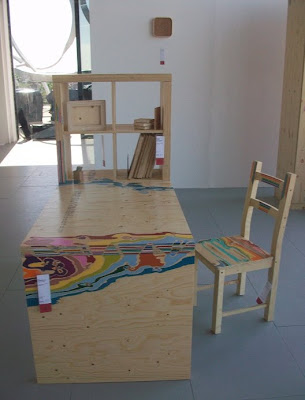
Some good work as ever in the Goldsmiths Department of Art MFA Fine Art exhibition last month. Coincidentally or not, a lot of my favourite work was by Korean students.
Highlights for me were Jin Hee Park's range of Ikea-like furniture with a twist...
 ... Hee Seung Sung's paintings (this one entitled 'The Garden of Eve')
 Jin Yen-Lee's elaborate photo collages...

...and Hye Young Ku's performance/film piece, featuring Gaga-esque dance scenes shot in New Cross Road in that gap between Prangsta and the old Deptford Town Hall.

Highlights for me were Jin Hee Park's range of Ikea-like furniture with a twist...
 ... Hee Seung Sung's paintings (this one entitled 'The Garden of Eve')
 Jin Yen-Lee's elaborate photo collages...

...and Hye Young Ku's performance/film piece, featuring Gaga-esque dance scenes shot in New Cross Road in that gap between Prangsta and the old Deptford Town Hall.

Thursday, July 29, 2010
George Melly on Transpontine
Thanks to Stephen Troussé on Twitter for spotting this letter by Don Locke in this week's London Review of Books:
'George Melly would not have agreed with Peter Gillman that the East London Overground runs from, rather than to, West Croydon (Letters, 8 July). Melly borrowed Henry Mayhew’s description of a gentleman crossing Waterloo Bridge and entering a ‘transpontine brothel’, and used the word to sum up what was so different about his band’s drummer: ‘simply the fact that he came from, lived in and was loyal to South London’. When the drummer discovered what the word meant he pointed out: ‘All you c*nts is transpontine.’ ‘He had logic on his side,’ Melly commented, ‘but he knew it didn’t work.’
Actually somebody once picked me up on the same point - that transpontine refers to the area on the other side of the bridge, so strictly speaking for someone based in South London, transpontine should refer to North London. But historically in London, transpontine has always referred to the southlands - usually used disparagingly but now proudly reclaimed!
The Bones go Last: Austin Osman Spare film
The Bones go Last is a blog documenting progress towards making a new film about the South London artist and visionary Austin Osman Spare (1886-1956).
Spare's South London movements were traced a few years ago by my friend Chris Jones, who organised a Austin Osman Spare pub crawl around some of his old haunts. As a child's Spare's family home was at 15 Kennington Park Gardens, and from 1916 to 1921 he lived at 298 Kennington Park Road. From 1921 to 1933 his home and studio was on the Tabard Estate at 52 Becket House, then he moved to a flat at 56a Walworth Road, near Elephant and Castle. This was destroyed in a German bombing raid in 1941. In the immediate aftermath he stayed for a while at the Newington Reform Club at 86 Walworth Road., and then moved to a Brixton basement at 5 Wynne Road.
Spare drew much of the inspiration for his portraiture from the faces of the Walworth Road and East Lane market. He also exhibited his work in local venues. As a child artist some of his drawings were exhibited in Newington Library. After WW2 he staged shows in local pubs including the Temple Bar in 1949 (286 Walworth Road), the Mansion House Tavern in 1952 (46 Kennington Park Road) and the White Bear in 1953 (138 Kennington Park Road).
106 years after his exhibition at Newington Library, there will be a major exhibition of his work next door on Walworth Road at Southwark's Cuming Museum. Austin Osman Spare: Fallen Visionary will take place from Tuesday 14 September 2010 to Saturday 13 November 2010.
The makers of the new films have put out a request for any photos or stock footage of South London Circa 1880 - 1950: 'Kennington, Walworth Road, Snow Hill [in the City], Brixton and Bourough are what we are after really, we are an amateur production and so cannot pay a fee, but the film will be shown at a Spare exhibition later in the year and will receive full credit. This would be greatly appreciated if you could help us'. If you can help contact them at info@thebonesgolast.com
In the mean time here's a short psychogeographical ramble through some of the Spare's London - Spare Places by Jamie Gregory (2006):
Spare Places from Jamie Gregory on Vimeo.
Subscribe to:
Posts (Atom)